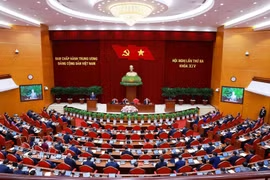
Hanoi (VNA) – In his opening address at the third plenum of the 14th Party Central Committee, Party General Secretary and State President To Lam has outlined a new approach to organising Vietnam's marine development space, linking the utilisation of marine resources with regional connectivity, environmental protection and sustainable livelihoods for coastal communities.
In his speech, the top leader stressed that the sea is a space for national survival, development, and the safeguarding of sovereignty, and should therefore be managed through an integrated governance approach closely connected to the mainland, seaports, logistics networks, economic corridors, and international cooperation.
From fragmented management to integrated governance
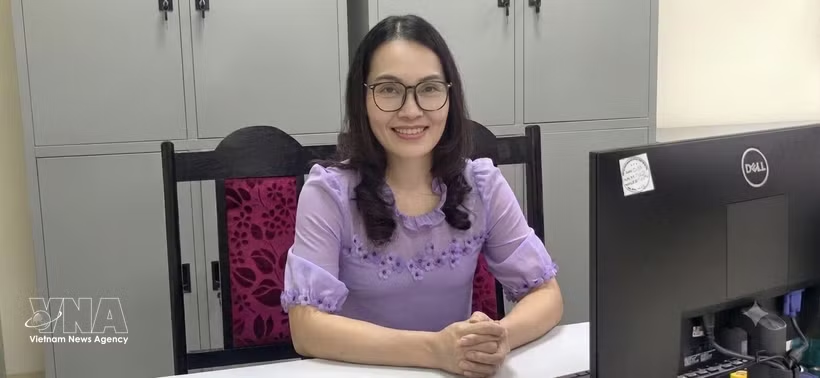
According to Dr Nguyen Thi Bich Nguyet, head of the Office of Environmental Geography and Sustainable Development under the Vietnam Academy of Social Sciences, the speech marks an important evolution in Vietnam's thinking on marine development. While the sea was previously viewed mainly through the lens of resource exploitation and the development of individual economic sectors, it is now regarded as an integral component of the country's overall development space and a vital area for national survival, development, and sovereignty protection.
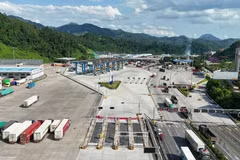
She said this represents not merely a shift in perception but also reflects the need to establish a modern, integrated and sustainable marine governance model. Integrated governance requires the sea to be considered in close connection with the mainland, seaport systems, logistics infrastructure, coastal urban areas, economic corridors and regional connectivity networks.
Such an approach would help allocate development space more effectively, reduce overlaps among sectors, improve resource efficiency and strike a better balance between economic growth, ecosystem conservation and the protection of national sovereignty.
Another key requirement, she noted, is to place people at the centre of the development process. Marine economic policies should aim to improve living standards, create sustainable livelihoods for coastal communities, preserve maritime cultural values and strengthen resilience to natural disasters and climate change. At the same time, local communities, businesses and authorities should play a meaningful role in the management, utilisation and protection of marine space.
Nguyet also said that it is necessary to study the issuance of a new Party Central Committee resolution on marine economic development, building on the results of the implementation of Resolution No. 36-NQ/TW, while incorporating new perspectives on unified marine spatial governance, regional connectivity and the role of science and technology.
However, to translate these orientations into practice, institutional reforms must be accompanied by changes in the way marine space is organised, utilised and managed, overcoming the past fragmented, sector-by-sector approach.
Maximising multiple values of marine space
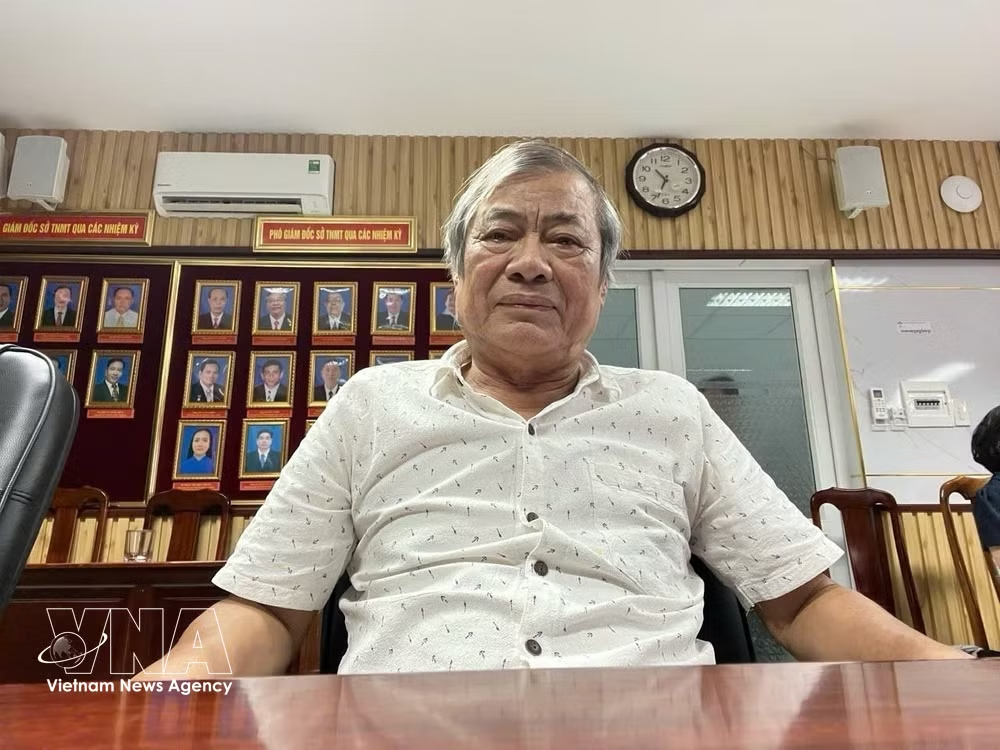
According to Associate Professor Dr Vo Si Tuan, Vice Chairman of the Vietnam Seculture Association and former Director of the Institute of Oceanography, marine development in the new era requires a shift from traditional exploitation methods to an industrial, modern and cross-sectoral approach.
To achieve this objective, he said, Vietnam needs mechanisms that provide businesses with stable, long-term rights to use designated marine areas, enabling them to invest confidently in infrastructure, apply science and technology, and develop large-scale projects. Without such conditions, technological innovation in fisheries, aquaculture and other marine industries will remain difficult, and the efficient use of marine resources will be hard to achieve.
Alongside improvements to domestic mechanisms, integrated marine spatial governance should also be pursued within the context of increasingly extensive international cooperation, Tuan added.
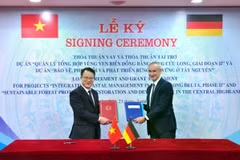
Vietnam should participate in regional initiatives, expand cooperation in scientific research, marine environmental management and the resolution of transboundary issues. It should also actively propose new ideas, engage in cooperation mechanisms, and promote models such as transboundary marine protected areas to conserve biodiversity, improve marine environmental management and reinforce its role in regional maritime cooperation.
The expert noted that when marine spatial governance is implemented through effective cross-sectoral coordination, strengthened by science and technology and supported by expanded international cooperation, the sea will become not only a resource to be exploited but also a long-term development space for the nation.
This, he said, will provide a solid foundation for the efficient use of marine resources, environmental protection, the integration of economic development with national defence and security, and the promotion of a sustainable marine economy in the years ahead./.