Vietnam launches project to phase out ozone-depleting substances

The project aims to eliminate 97.5% of baseline HCFC consumption by 2030 and cut baseline HFC consumption by 10% from 2029.

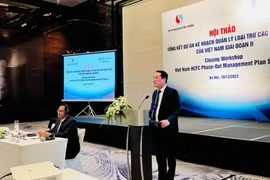
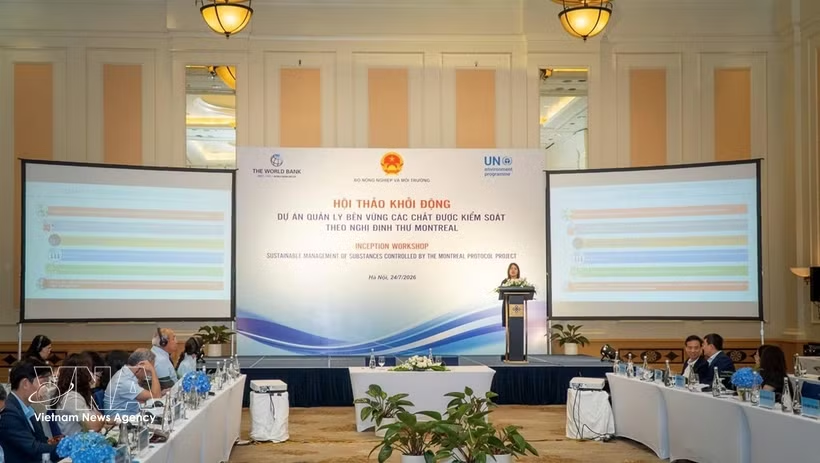
An overview of the conference (Photo: VNA)

Hanoi (VNA) – Vietnam has launched a new project to accelerate the phaseout of ozone-depleting substances and climate-warming refrigerants under the Montreal Protocol, thereby supporting the country's transition to greener cooling technologies and its net-zero target.

The project, unveiled at a workshop in Hanoi on July 24 by the Ministry of Agriculture and Environment in partnership with the World Bank and the United Nations Environment Programme (UNEP), is funded with grants from the Montreal Protocol's Multilateral Fund.

Nguyen Tuan Quang, Deputy Director of the Department of Climate Change, said Vietnam has fully complied with its Montreal Protocol commitments since joining the Vienna Convention and the protocol in 1994. With support from international partners, the country has strengthened regulations, tightened import-export controls, promoted technology upgrades, trained technicians and raised public awareness on ozone protection.

He noted that the national plan issued in 2024 provides a framework for phasing out hydrofluorocarbons (HFCs), promoting low-global-warming refrigerants and improving energy efficiency, while paving the way for the final elimination of hydrochlorofluorocarbons (HCFCs).

The project aims to eliminate 97.5% of baseline HCFC consumption by 2030 and cut baseline HFC consumption by 10% from 2029. Key activities include expanding technical training in refrigeration and air conditioning, supporting low-emission cooling technologies for railway air-conditioning systems, improving policies to reduce HFC use, and promoting climate-friendly, energy-efficient cooling solutions.

Nguyen Duy Son, Acting Country Operations Manager for the World Bank in Vietnam, said the initiative will help replace high-global-warming refrigerants in both stationary and mobile air-conditioning systems, strengthen efforts to combat illegal trade in controlled substances, and develop a skilled workforce capable of safely servicing modern cooling equipment.

He said the project is expected to reduce annual greenhouse gas emissions by 6.1 million tonnes of CO₂ equivalent by the end of 2031, while creating better employment opportunities through training and certification for thousands of refrigeration technicians.

The Department of Customs said it has completed a cooperation agreement with the Department of Climate Change to strengthen information sharing, customs enforcement, officer training, equipment upgrades, business outreach and international cooperation to improve control of regulated substances.

Officials at the workshop also discussed coordination mechanisms among customs, vocational education authorities, the railway sector and industry partners to support technology transfer, technician training and pilot deployment of low-global-warming refrigerants in railway air-conditioning systems.

The Montreal Protocol is widely regarded as one of the world's most successful environmental treaties. Its Kigali Amendment, which mandates a gradual reduction in HFC production and consumption, is expected to help avoid up to 0.5°C of global warming by the end of the century if fully implemented./.

VNA

See more

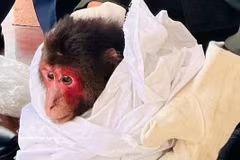
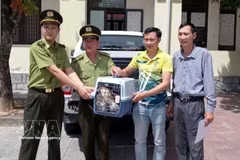
A stump-tailed macaque (Macaca arctoides) is handed over to the Cam Lo–Dong Ha forest ranger station in Quang Tri province on January 27, 2026 (Photo: VNA)

Rare primate handed over to Phong Nha - Ke Bang National Park

A stump-tailed macaque (Macaca arctoides) was handed over to the Centre for Rescue, Conservation, and Development of Creatures under the Management Board of Phong Nha - Ke Bang National Park in Quang Tri province on July 21, for rehabilitation and eventual release into the wild.

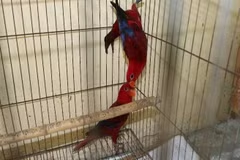
Two Red Lories (Eos rubra) found among the 104 wild animals being kept without documentation proving their lawful origin in Phuoc Thanh commune, Tay Ninh province. (Photo published by VNA)

Criminal proceedings launched against case of illegal keeping, trading of 104 wild animals

They recorded a total of 104 wild animals, comprising 92 African spurred tortoises (Geochelone sulcata) of various sizes, six Red Lories (Eos rubra) and six Green-cheeked Parakeets (Pyrrhura molinae). Authorities said the animals are subject to management under Vietnam's forestry legal regulations and are listed in Appendix II of the Convention on International Trade in Endangered Species of Wild Fauna and Flora (CITES).

BUYO Bioplastics' biodegradable plastic products are made from brewer's grains and sugarcane bagasse. (Photo: nhandan.vn)

Vietnam urged to shift from plastic waste treatment to full life-cycle management

For years, efforts to tackle plastic pollution in Vietnam have focused mainly on waste collection, recycling and disposal. However, as sustainable development and green trade standards become increasingly important, specialists argued that a broader approach is needed, covering everything from product design and material selection to production, consumption and recycling.

Bang Mo volcano in Lam Dong province (Photo published by VNA)

Lam Dong optimises value of UNESCO Dak Nong Global Geopark

Alongside conservation, Lam Dong aims to tap the geopark's tourism potential through geological, ecological and community-based tourism. Infrastructure and tourism development projects must ensure that heritage values, landscapes and the natural environment are preserved.

Dr. Dang Trung Phuoc (left) is introducing the history and origin of the Pinhey sand dunes (Photo: VNA)

Vietnamese Canadian scientist revives forgotten ecosystems

From restoring an ancient sand dune ecosystem in Canada to promoting the conservation of Vietnam's coastal dunes, native forests and ecological corridors, Vietnamese-born scientist Dang Trung Phuoc has remained committed to using science to revive ecosystems long misunderstood or neglected. His quiet but sustained efforts reflect both a scientist's responsibility to the communities he serves and the enduring commitment of a Vietnamese expatriate to his homeland.

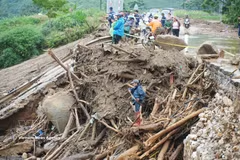
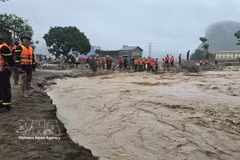
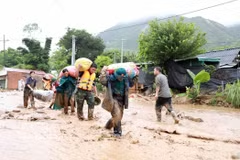
Police and military forces work together to rescue people and assist local residents in affected areas. (Photo: VNA)

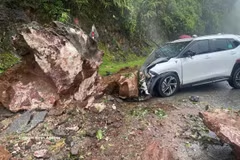
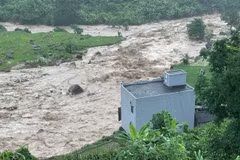
PM orders proactive response to heavy rainfall in northern mountainous region

To minimise casualties and damage to public and private property, the PM instructed ministries, sectors and local authorities to strictly implement directions issued by Party General Secretary and State President To Lam, as well as the Government's directives on strengthening disaster prevention and response in 2026.

A view of the Ea So Nature Reserve in Dak Lak province (Photo: VNA)

Rare wild animals released into natural habitat in Dak Lak

Among them are two species classified under Group IB of Vietnam's protected wildlife list, namely the Bengal slow loris (Nycticebus bengalensis) and the Sunda pangolin (Manis javanica). Both are endangered forest species protected under Vietnamese law and are prohibited from commercial exploitation or use.

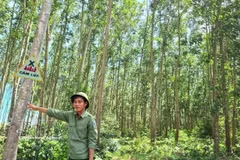
A large-timber plantation model in Gia Lai province (Photo: VNA)

96-million-USD project promotes agroforestry to cut emissions

The Reduction of Emissions in the Central Highlands and South Central Coast of Vietnam (RECAF) project will run from 2026 to 2031 across the provinces of Dak Lak, Gia Lai, Lam Dong, and Khanh Hoa covering about 145,000ha, according to the International Fund for Agricultural Development (IFAD).

Crested goshawks are handed over by the People's Committee of Dong Le commune, Quang Tri province. (Photo: VNA)

Quang Tri rescues six rare wild animals

The animals are now receiving quarantine, treatment and specialised care. Once recovering their physical condition and wild behaviour, they will be reassessed for release back into the wild.

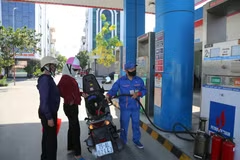
The Ministry of Industry and Trade has reported initial signs that the fuel is helping reduce emissions and protect the environment. (Photo: VNA)

E10 biofuel shows initial environmental benefits: Ministry

An official said the initial results indicate the nationwide rollout has begun to achieve its intended objectives, but more comprehensive monitoring over a longer period, with a wider observation network and more frequent measurement, is needed for a precise and objective assessment.