Tuyen Quang seeks balance between monkey conservation and local livelihoods

The growing populations of rhesus macaques and assamese macaques in Lung Cu, Sa Phin and surrounding areas are seen as a positive sign for biodiversity. However, their increasing presence has also created challenges for local communities whose livelihoods depend on agriculture.

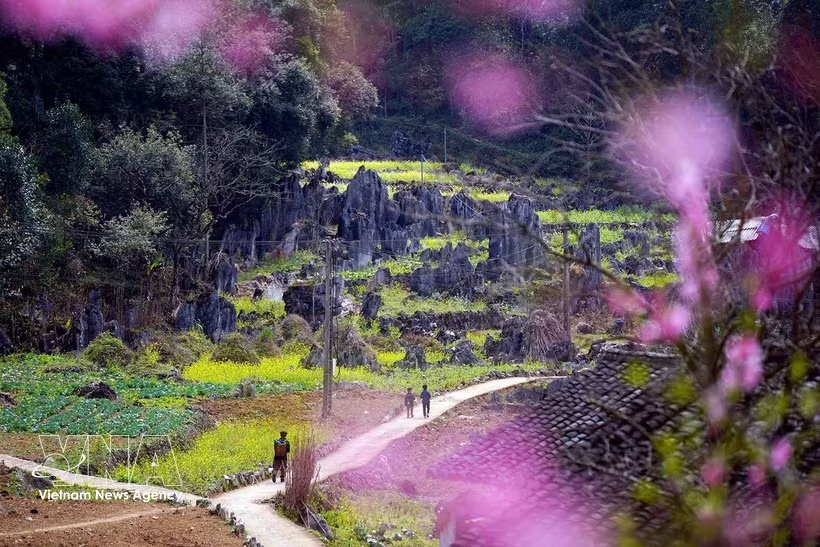
The Dong Van Karst Plateau is a special heritage landscape where dramatic limestone mountains, local communities, and nature together define the unique character of Vietnam's northernmost region. (Photo: VNA)

Tuyen Quang (VNA) – Authorities of the northern mountainous province of Tuyen Quang are working to balance biodiversity conservation with local livelihoods as growing populations of wild monkeys in the Dong Van Karst Plateau increasingly damage crops, highlighting the need for long-term solutions that safeguard both wildlife and communities.

The growing populations of rhesus macaques and assamese macaques in Lung Cu, Sa Phin and surrounding areas are seen as a positive sign for biodiversity. However, their increasing presence has also created challenges for local communities whose livelihoods depend on agriculture.

According to local residents and authorities, wild monkeys have been present in the area about 20 years, with their popultion estimated at around 200 individuals. As their population has grown, they have expanded their foraging range into farming areas in villages such as Lung Hoa A, Lung Hoa B, San Si Tung, Ma Lung, Ma Lau, Mo Pai Phin and Lung Thau.

Since late 2023, monkeys have increasingly raided vegetable plots and fruit orchards in Lung Cu, Sa Phin and nearby areas, damaging more than 12 hectares of farmland.

Sung Mi The, a farmer in Sa Phin commune, said vegetables, beans and fruit trees are all vulnerable to monkey attacks. Switching to alternative crops is not an easy solution, as farmers must choose varieties suited to local soil and climate while also being less attractive to wildlife. In the mountainous region, where harvests are already heavily dependent on weather conditions, crop losses directly threaten household food security.

In recent years, local authorities have stepped up public awareness campaigns, urging residents not to hunt or harm the monkeys while providing guidance on protecting crops through non-destructive measures.

Vice Chairman of People's Committee of Sa Phin commune Vang Di Xoang called for a comprehensive assessment of damaged farmland and appropriate support for affected households alongside measures to conserve the monkey population.

He said effective conservation depends on addressing people's concerns. Conservation organisations should conduct detailed surveys to identify practical solutions that promote harmonious coexistence between humans and wildlife.

Reliable data on monkey populations, habitats, migration routes, seasonal feeding patterns, affected crops and the extent of damage are needed to develop appropriate support policies, designate conservation zones, adjust farming practices and build sustainable livelihood models.

According to Dao Duy Tuan, head of the provincial Forest Protection Department, immediate priorities include proposing compensation mechanisms for crop losses while studying policies to help farmers diversify crops and livestock to improve incomes.

He said the approach represents a shift from responding to individual incidents toward managing the long-term relationship between biodiversity conservation and socio-economic development.

The Dong Van Karst Plateau is a unique heritage landscape where dramatic limestone mountains, local communities, and nature together define the unique character of Vietnam's northernmost region. Preserving its UNESCO Global Geopark status is not only a matter of completing documents, but also safeguarding the living heritage found in its villages, forest and diverse wildlife.

Authorities hope that science-based conservation, backed by government policies and community participation, will make efforts to protect the monkey population a model for balancing biodiversity conservation with sustainable livelihoods./.​

VNA

See more

The Ministry of Industry and Trade has reported initial signs that the fuel is helping reduce emissions and protect the environment. (Photo: VNA)

E10 biofuel shows initial environmental benefits: Ministry

An official said the initial results indicate the nationwide rollout has begun to achieve its intended objectives, but more comprehensive monitoring over a longer period, with a wider observation network and more frequent measurement, is needed for a precise and objective assessment.

Forest development in Phan Son commune, Lam Dong province. (Photo: nhandan.vn)

Vietnam lays groundwork for transparent carbon market

Experts say the launch of the trading platform is only the first step. The long-term success of the market will depend on a transparent system backed by robust measurement, reporting and verification (MRV) standards to ensure every transaction reflects genuine emissions reductions.

A rubber plantation are in Dong Nai province. Vietnam has more than 900,000 ha of rubber plantations, with over 60% operated by smallholders. (Photo: VNA)

Rubber traceability accelerated as EU deforestation regulation deadline nears

Speaking at a conference held recently in Ho Chi Minh City to gather feedback on draft EUDR compliance guidelines for the rubber sector, Nguyen Quoc Manh, Deputy Director of the Plant Production and Protection Department under the Ministry of Agriculture and Environment, said that Vietnam had spent the past three years preparing for the regulation through awareness campaigns, training programmes and coordination with ministries, local authorities and businesses.

A view of the Can Gio mangrove forest, a crucial "carbon sink" ecosystem that contributes to generating carbon credits for operating Vietnam's carbon market. (Photo: VNA)

Vietnam earns 56.5 million USD from forest carbon credit sales to World Bank

Speaking at a conference in Hanoi on July 2 to introduce Decree No. 180 on forest carbon sequestration and storage services, Luong said the latest transaction brought the country's total revenue from the transfer to 56.5 million USD, covering 11.3 million tonnes of CO2 emission reductions at a price of 5 USD per tonne.

Dray Sap Waterfall is located within the UNESCO Dak Nong Global Geopark in Nam Da commune, Lam Dong province. (Photo: VNA)

UNESCO review spurs conservation drive at Dak Nong Global Geopark

The provincial Department of Culture, Sports and Tourism, in collaboration with the Vietnam UNESCO Global Geoparks Network and relevant agencies, surveyed 41 geological, cultural and tourism sites across the geopark, identifying a number of issues requiring urgent attention to safeguard the site's outstanding values.

The release site is carefully selected to provide suitable ecological conditions and improve the pangolin's chances of survival in the wild. (Photo: VNA)

Tay Ninh releases rare pangolin back to nature

Following health checks, care and monitoring, the pangolin was confirmed be in good condition and fit for release. The release site was carefully selected to provide suitable ecological conditions and improve the animal's chances of survival in the wild.

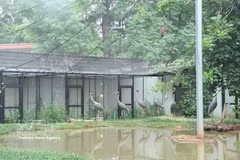
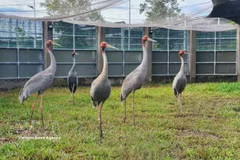
Sarus cranes cranes are being cared for at Nakhon Ratchasima Zoo in Nakhon Ratchasima province, Thailand. (Photo: VNA)

Six sarus cranes from Thailand arrive in Dong Thap

Of the six cranes, two are males and four females, with individual weights ranging from 5.3kg to 6.7kg. The birds were raised at Nakhon Ratchasima Zoo in Thailand and transported to Vietnam by air.

An area in Ha Tinh province under water following Storm Megi in October 2010 (Photo: VNA)

Conference delivers hydro-meteorological outlook for 2026

Deputy Minister of Agriculture and Environment Le Cong Thanh, in his speech, said climate change is making weather more severe and unpredictable, with a powerful El Nino set to hit Vietnam in the second half of 2026 and early 2027. Against such backdrop, enhancing forecasting and early warning capacity, while effectively translating scientific information into management decisions and timely response actions, has become urgent, he said.