Vietnamese Canadian scientist revives forgotten ecosystems

From restoring an ancient sand dune ecosystem in Canada to promoting the conservation of Vietnam's coastal dunes, native forests and ecological corridors, Vietnamese-born scientist Dang Trung Phuoc has remained committed to using science to revive ecosystems long misunderstood or neglected. His quiet but sustained efforts reflect both a scientist's responsibility to the communities he serves and the enduring commitment of a Vietnamese expatriate to his homeland.

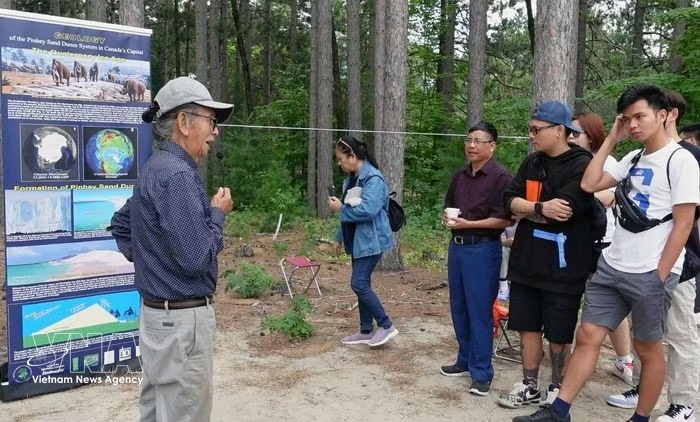
Dr. Dang Trung Phuoc (left) is introducing the history and origin of the Pinhey sand dunes (Photo: VNA)

Hanoi (VNA) – For more than a decade, in Canada's capital Ottawa, Vietnamese-born scientist Dang Trung Phuoc and his colleagues have restored part of an ancient sand dune system formed some 8,000-10,000 years ago.

Once dismissed as barren and of little value, the Pinhey Sand Dunes have become a habitat for rare plant and animal species, as well as a renowned site for research, education and ecotourism in the Canadian capital region.

Restoring the dunes' unique habitat required an approach that initially seemed at odds with conservation: felling thousands of 25-30m-tall pine trees in a plantation forest.

Speaking to the Vietnam News Agency’s correspondent in Canada, Phuoc, President of the Biodiversity Conservancy International, said the prehistoric sand dunes around Canada's capital has been severely reduced by urbanisation and inappropriate afforestation.

For many years, the dunes were viewed as barren land and planted with pine forests. In reality, however, the open landscape of white sand exposed to sunlight and wind, free of large trees, provides the essential habitat for thousands of endemic plants, insects and animals. Restoring the dunes, he stressed, means restoring the original ecosystem rather than destroying nature.

Supported by scientific evidence and years of persistence, Phuoc convinced Canadian authorities to back the restoration project. The work proceeded in stages, from removing plantation trees and stripping surface soil to restoring the natural sand landscape. Native wildflowers gradually returned, followed by butterflies, beetles and several rare arthropod species once thought lost from Ontario.

According to Phuoc, the project proves that sand dunes are not "dead land" but distinctive ecosystems rich in biodiversity. Every dune system has unique ecological characteristics, from Africa's Namib Desert to the famous "singing dunes" of Nevada in the US.

After more than 30 years in Canada, Phuoc sees the project as a way of giving back to the country that enabled his scientific career. At the same time, he has remained determined to apply his experience in Vietnam. Biodiversity, he noted, takes millions of years to develop into the interconnected web that sustains life, making every unique ecosystem worth protecting.

Drawing on the Pinhey project, he has focused on Vietnam's central coastal sand dunes. He said he believes they serve not only as natural barriers against rising sea levels but also as habitats for numerous species, some potentially still unknown to science.

He argued that the dune system in Ninh Thuan should be recognised as a unique East Sea coastal ecosystem rather than simply being treated as arid land for development. He has already connected with specialists in Ho Chi Minh City and Khanh Hoa province to discuss conservation solutions.

Phuoc is also advocating the restoration of native forests in Vietnam. Following surveys along the Truong Son Mountain range, he found many areas dominated by acacia plantations that generate economic returns but create biodiversity-poor monoculture forests. He proposes gradually replacing part of these plantations with bamboo and native tree species while safeguarding local livelihoods.

Bamboo, he said, grows quickly, has strong commercial value, stabilises soil, conserves water, reduces erosion and absorbs significant amounts of carbon dioxide. Planted alongside native trees in linked corridors across the Truong Son range, it could help create ecological corridors that allow wildlife to move and thrive.

From restoring an ancient sand dune ecosystem in Canada to promoting the conservation of Vietnam's coastal dunes, native forests and ecological corridors, Phuoc has remained committed to using science to revive ecosystems long misunderstood or neglected. His quiet but sustained efforts reflect both a scientist's responsibility to the communities he serves and the enduring commitment of a Vietnamese expatriate to his homeland./.

VNA

See more

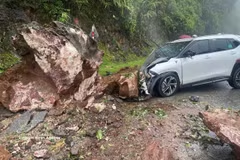
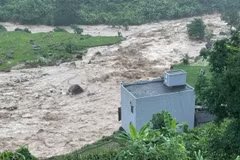
Police and military forces work together to rescue people and assist local residents in affected areas. (Photo: VNA)

PM orders proactive response to heavy rainfall in northern mountainous region

To minimise casualties and damage to public and private property, the PM instructed ministries, sectors and local authorities to strictly implement directions issued by Party General Secretary and State President To Lam, as well as the Government's directives on strengthening disaster prevention and response in 2026.

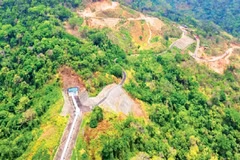
A view of the Ea So Nature Reserve in Dak Lak province (Photo: VNA)

Rare wild animals released into natural habitat in Dak Lak

Among them are two species classified under Group IB of Vietnam's protected wildlife list, namely the Bengal slow loris (Nycticebus bengalensis) and the Sunda pangolin (Manis javanica). Both are endangered forest species protected under Vietnamese law and are prohibited from commercial exploitation or use.

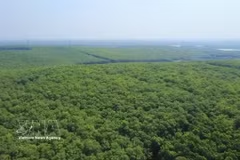
A large-timber plantation model in Gia Lai province (Photo: VNA)

96-million-USD project promotes agroforestry to cut emissions

The Reduction of Emissions in the Central Highlands and South Central Coast of Vietnam (RECAF) project will run from 2026 to 2031 across the provinces of Dak Lak, Gia Lai, Lam Dong, and Khanh Hoa covering about 145,000ha, according to the International Fund for Agricultural Development (IFAD).

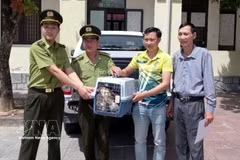
Crested goshawks are handed over by the People's Committee of Dong Le commune, Quang Tri province. (Photo: VNA)

Quang Tri rescues six rare wild animals

The animals are now receiving quarantine, treatment and specialised care. Once recovering their physical condition and wild behaviour, they will be reassessed for release back into the wild.

The Ministry of Industry and Trade has reported initial signs that the fuel is helping reduce emissions and protect the environment. (Photo: VNA)

E10 biofuel shows initial environmental benefits: Ministry

An official said the initial results indicate the nationwide rollout has begun to achieve its intended objectives, but more comprehensive monitoring over a longer period, with a wider observation network and more frequent measurement, is needed for a precise and objective assessment.

Forest development in Phan Son commune, Lam Dong province. (Photo: nhandan.vn)

Vietnam lays groundwork for transparent carbon market

Experts say the launch of the trading platform is only the first step. The long-term success of the market will depend on a transparent system backed by robust measurement, reporting and verification (MRV) standards to ensure every transaction reflects genuine emissions reductions.

A rubber plantation are in Dong Nai province. Vietnam has more than 900,000 ha of rubber plantations, with over 60% operated by smallholders. (Photo: VNA)

Rubber traceability accelerated as EU deforestation regulation deadline nears

Speaking at a conference held recently in Ho Chi Minh City to gather feedback on draft EUDR compliance guidelines for the rubber sector, Nguyen Quoc Manh, Deputy Director of the Plant Production and Protection Department under the Ministry of Agriculture and Environment, said that Vietnam had spent the past three years preparing for the regulation through awareness campaigns, training programmes and coordination with ministries, local authorities and businesses.

A view of the Can Gio mangrove forest, a crucial "carbon sink" ecosystem that contributes to generating carbon credits for operating Vietnam's carbon market. (Photo: VNA)

Vietnam earns 56.5 million USD from forest carbon credit sales to World Bank

Speaking at a conference in Hanoi on July 2 to introduce Decree No. 180 on forest carbon sequestration and storage services, Luong said the latest transaction brought the country's total revenue from the transfer to 56.5 million USD, covering 11.3 million tonnes of CO2 emission reductions at a price of 5 USD per tonne.

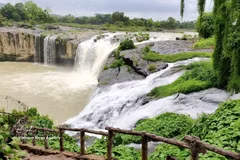
Dray Sap Waterfall is located within the UNESCO Dak Nong Global Geopark in Nam Da commune, Lam Dong province. (Photo: VNA)

UNESCO review spurs conservation drive at Dak Nong Global Geopark

The provincial Department of Culture, Sports and Tourism, in collaboration with the Vietnam UNESCO Global Geoparks Network and relevant agencies, surveyed 41 geological, cultural and tourism sites across the geopark, identifying a number of issues requiring urgent attention to safeguard the site's outstanding values.