Argentine researcher publishes comprehensive study on Vietnam’s post-war development

The book, titled “Vietnam, Proceso de Reunificación” (Vietnam: Process of Reunification), was written in Spanish by Gaston Fiorda and examines how Vietnam overcame the economic crisis, international embargoes and the devastation of war to become one of Asia’s most dynamic economies.

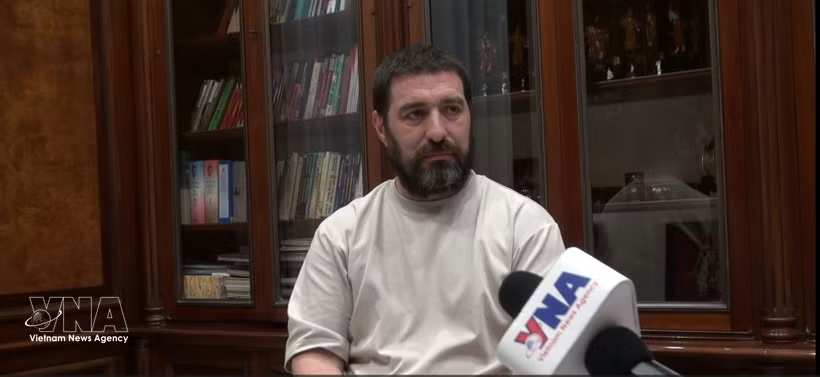
Argentine journalist and researcher Gaston Fiorda speaks to a Vietnam News Agency correspondent in Buenos Aires (Photo: VNA)

Buenos Aires (VNA) – An Argentine journalist and researcher has published what is considered the first comprehensive study by a South American scholar of Vietnam’s post-war reunification, reconstruction and development, offering Latin American readers a broader understanding of the country’s contemporary history.

The book, titled “Vietnam, Proceso de Reunificación” (Vietnam: Process of Reunification), was written in Spanish by Gaston Fiorda and examines how Vietnam overcame the economic crisis, international embargoes and the devastation of war to become one of Asia’s most dynamic economies.

Talking to a Vietnam News Agency correspondent in Buenos Aires, Fiorda said that unlike many Western studies that focus primarily on the war in Vietnam, his research concentrates on the difficult period after national reunification, when Vietnam had to heal the wounds of war, rebuild its economy and gradually implement the Doi Moi (Renewal) policy.

The nearly-250-page work is the result of seven years of doctoral research supported by institutions in both Vietnam and Argentina, including the Vietnamese Embassy in Argentina, the Argentine Embassy in Vietnam, the Vietnam Union of Friendship Organisations (VUFO) and the University of Social Sciences and Humanities under the Vietnam National University, Hanoi.

The study covers the period from the victory of April 30, 1975, which led to the liberation of the South and national reunification, to the Sixth National Congress of the Communist Party of Vietnam in 1986, when the Doi Moi policy was adopted. Fiorda described those eleven years as one of the most decisive periods in contemporary Vietnamese history as the country faced enormous challenges after the war.

To conduct the research, he interviewed more than 20 veterans, armed forces heroes and revolution contributors, while also examining Party documents, newspapers of the period and other historical materials to analyse policies implemented in the political, economic, social and cultural fields.

The researcher said his main motivation is to understand how a country that had suffered millions of casualties, widespread infrastructure destruction and severe environmental damage from the war managed to rebuild itself and become a dynamic economy with internationally recognised achievements.

He emphasised that the book seeks not only to analyse history but also to present Vietnam to Argentine and Latin American audiences through the perspectives of Vietnamese people themselves.

According to the author, one of the most striking aspects of the research is the combination of documentary evidence with the memories of those who directly experienced the war. These testimonies, he said, reveal reunification not only as a political event but also as a process of healing for millions of people.

Fiorda noted that Vietnam’s greatest challenge began after the war ended. The Communist Party of Vietnam had to unify a country marked by major economic, social and cultural differences between the two regions while simultaneously confronting embargoes, border conflicts, inflation and other difficulties.

He said one of the aspects that impressed him most is the Party’s ability to make flexible policy decisions in response to practical demands. In his view, the launch of Doi Moi in 1986 marked a major turning point, demonstrating a proactive adjustment of development thinking and socio-economic policies while maintaining the goal of national independence and development.

The Argentine researcher expressed his hope that the book will help Spanish-speaking readers gain a full understanding of Vietnam not only as a nation that bravely fought for independence and sovereignty, but also as a country that overcame immense challenges to rebuild and develop itself./
VNA

See more

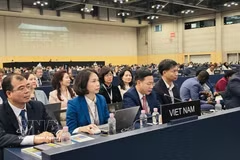
Deputy Minister of Foreign Affairs Ngo Le Van, Chairman of the Vietnam National Commission for UNESCO, addresses the session. (Photo: VNA)

UNESCO endorses vision for restoring Thang Long Imperial Citadel's central axis

The committee commended Vietnam for fulfilling the commitments it has made since the citadel was inscribed on the UNESCO World Heritage List in 2010, as well as for implementing recommendations from the committee and its advisory bodies. It also praised the country's efforts to preserve the site's cultural, historical and social values, transforming the imperial citadel into a space for public engagement, cultural exchange and historical education. The committee further welcomed the long-term vision as an important basis for the proposed restoration of Kinh Thien Palace in line with the approved conservation strategy.

The cast and crew of Spirit Guardians: The Last Secret of the First Emperor at the film's showcase launch in Ho Chi Minh City in April. (Photo: BHD)

Vietnamese martial arts fantasy film selected for Toronto festival

Inspired by one of the mysterious folk legends surrounding the tomb of Dinh Tien Hoang, the film follows a gripping journey to protect the final secret of Vietnam's first emperor. It is presented as a martial arts epic blending historical fantasy with themes of family, love, brotherhood, unwavering loyalty to the sovereign and noble sacrifice.

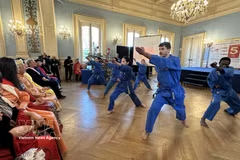
Vietnamese traditional martial arts are performed at an event in France. (Photo: VNA)

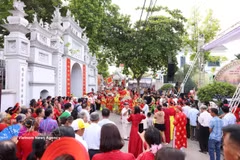
Traditional martial arts festival to welcome 16 international delegations

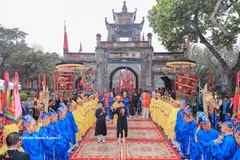
The festival will feature a packed programme of cultural and sporting activities, including flower- and incense-offering ceremonies at Kinh Thien Monument and the Quang Trung Museum, large-scale martial arts performances, exchange demonstrations, tours of traditional martial arts schools, and visits to historical, cultural and scenic sites across the central province.

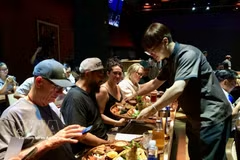
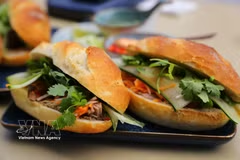
Foreigners taste unique Vietnamese cuisine (PhotoL VNA)

Vietnam looks to turn culinary acclaim into tourism revenue

Vietnam is sitting on a massive culinary heritage with thousands of signature dishes spanning 54 ethnic groups, many of which have earned international acclaim. More and more localities are positioning food not just as a service for tourists, but as a standalone attraction.

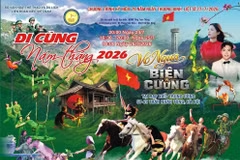
The poster of the Vietnam Circus Federation's special performance dedicated to soldiers who devoted and sacrificed their lives in safeguarding the nation's borders. (Photo: Vietnam Circus Federation)

Wide range of artistic programmes to commemorate war invalids and martyrs day

Alongside tribute activities nationwide to mark the 79th anniversary of War Invalids and Martyrs Day (July 27, 1947–2026), arts organisations and local authorities are staging special performances honouring fallen heroes, war invalids, sick veterans and people who rendered meritorious service to the revolution, while promoting the tradition of gratitude, patriotism and national pride.

At the opening of the first-ever Cultures of the World Festival in Hanoi. (Photo: VNA)

Vietnam charts course for regional culture, creativity hub status by 2045

The blueprint seeks to deepen international cultural integration, export Vietnamese values and absorb the essence of world cultures. The end goal is an advanced culture steeped in national identity, deployed as a soft power to fuel rapid, sustainable growth, lift Vietnam’s global standing, and add a distinct thread to the tapestry of human civilisation.

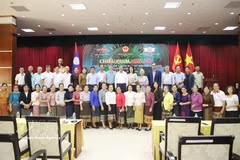
Deputy Minister of Foreign Affairs Ngo Le Van, Chairman of the Vietnam National Commission for UNESCO, speaks at plenary session of the 48th session of the UNESCO World Heritage Committee in Busan on July 20, 2026. (Photo: VNA)

Vietnam proposes priorities to strengthen international cooperation on world heritage conservation

On behalf of Vietnam, the deputy minister proposed three priorities of strengthening international cooperation and capacity-building for member states, particularly developing countries; promoting science-based conservation that strikes a balance between preservation and development while placing local communities at the centre; and enhancing coordination among relevant conventions and programmes, alongside the responsible application of digital technologies and artificial intelligence in heritage conservation.

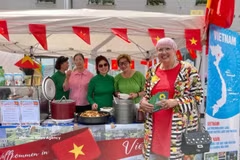
Claudia Roth, a member of the German Bundestag, visits the Vietnamese booth at the festival. (Photo: VNA)

Vietnam attends multicultural festival in Germany as guest of honour

The Vietnamese booth attracted a large number of visitors with traditional dishes such as "nem cuon" (fresh spring rolls) and "bun cha" (grilled pork with vermicelli), along with displays of ao dai (traditional long dress), conical hats and cultural performances imbued with Vietnamese identity. These activities helped spread Vietnamese culture and foster understanding and closer ties between the Vietnamese community, German residents and international friends.

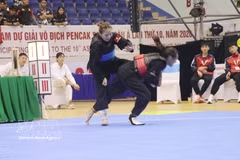
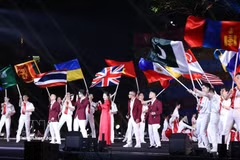
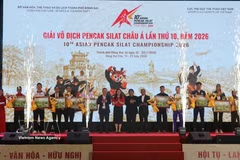
Representatives of countries and territories participating in the Asian Pencak Silat Championship. Photo: VNA)

10th Asian Pencak Silat Championship opens in Dong Nai

Speaking at the opening ceremony, Director of the municipal Department of Culture, Sports and Tourism Le Thi Ngoc Loan said the championship offers athletes an opportunity to compete in a spirit of fairness and sportsmanship while promoting exchanges, mutual understanding and friendship among participating countries.