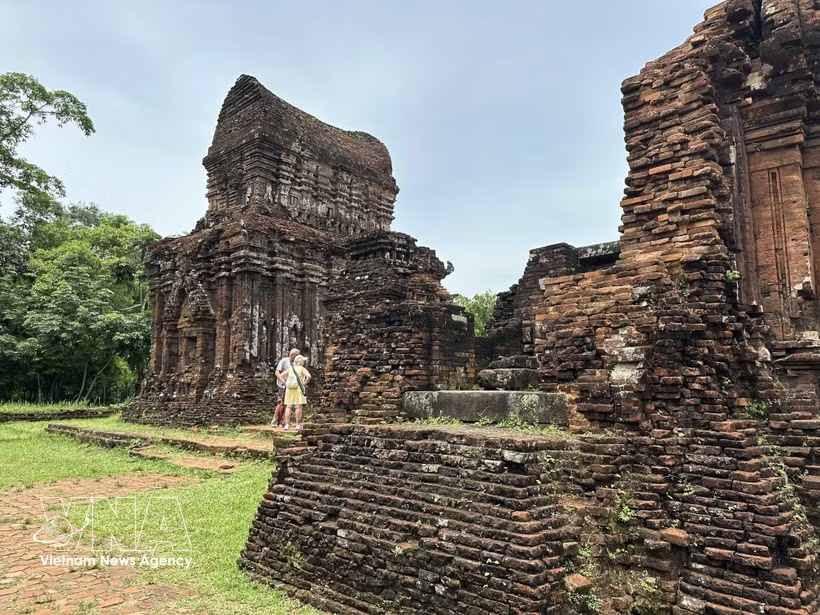
Hanoi (VNA) – Beyond its celebrated temple towers, the My Son Sanctuary is home to another priceless legacy carved in stone. Through its ancient inscriptions, the UNESCO world heritage site is now working towards recognition as a documentary heritage site in Asia-Pacific, opening a new avenue for preserving and promoting its historical value alongside its existing world heritage status.
Located in Thu Bon commune, Da Nang city, My Son is renowned for its architectural heritage, but it also preserves an exceptional archive engraved on stone. These inscriptions have enabled scholars to unravel the history of the sanctuary and trace the rise and development of the ancient Champa kingdom over many centuries.
A stone archive of history
The management board of My Son World Cultural Heritage has completed the initial phase of a project to catalogue, document and build a digital database of the site's inscriptions.
The preliminary survey identified around 50 inscriptions, including complete steles and numerous fragmented stones bearing engraved texts.
According to Nguyen Van Tho, head of the board’s conservation and museum division, the inscriptions are not only original artefacts of outstanding historical, cultural and scientific value, but also primary historical sources that shed light on the establishment and evolution of the My Son temple complex, as well as the political, religious and cultural life of the Champa Kingdom across different periods.
He said the goal of securing recognition as UNESCO Memory of the World for Asia and the Pacific is entirely achievable.
International cooperation to unlock ancient texts
Since 2018, the management board has worked with Indian scholars and the Embassy of India in Vietnam on a project to study and translate around 30 Sanskrit inscriptions preserved at My Son into Vietnamese and English.
The inscriptions are of exceptional significance, as most were carved directly onto the stone structures of the temple complex and contain invaluable information about Champa's history, religion and society.
Deciphering them, however, has proved far from straightforward. Many were damaged during wartime, leaving broken or missing sections, while centuries of weathering have eroded numerous engraved characters.
Complicating matters further, many original artefacts were transferred in the early 20th century to the Da Nang Museum of Cham Sculpture, the Vietnam National Museum of History, and other institutions, making it more difficult to compare and systematically document the entire corpus.
Against this backdrop, experts from the French School of Asian Studies (École française d'Extrême-Orient – EFEO) reaffirmed in May their commitment to translating the Cham-language inscriptions, sharing archival materials from French archaeological research and restoration work at My Son, and supporting preparations for a UNESCO documentary heritage nomination
According to researcher Tran Ky Phuong, former curator of the Da Nang Museum of Cham Sculpture, cooperation with EFEO has led to the discovery of around 140 additional Champa inscriptions since 2010, many of which have already been translated into English and French.
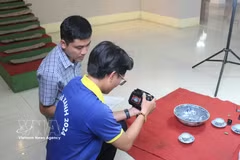
The EFEO also possesses advanced photogrammetry technology capable of creating highly accurate digital models of the inscriptions, recording every crack, chip and weathered surface in remarkable detail. The accompanying software can digitally reconstruct fragmented steles, allowing researchers to piece together missing sections and recover previously unreadable texts.
"We have also completed a comprehensive study of the My Son inscription system, which will be published soon," Phuong said. "Together with the EFEO's published research on Champa, it will provide an important body of reference material for future scholarship and heritage conservation."
Strong potential for UNESCO recognition
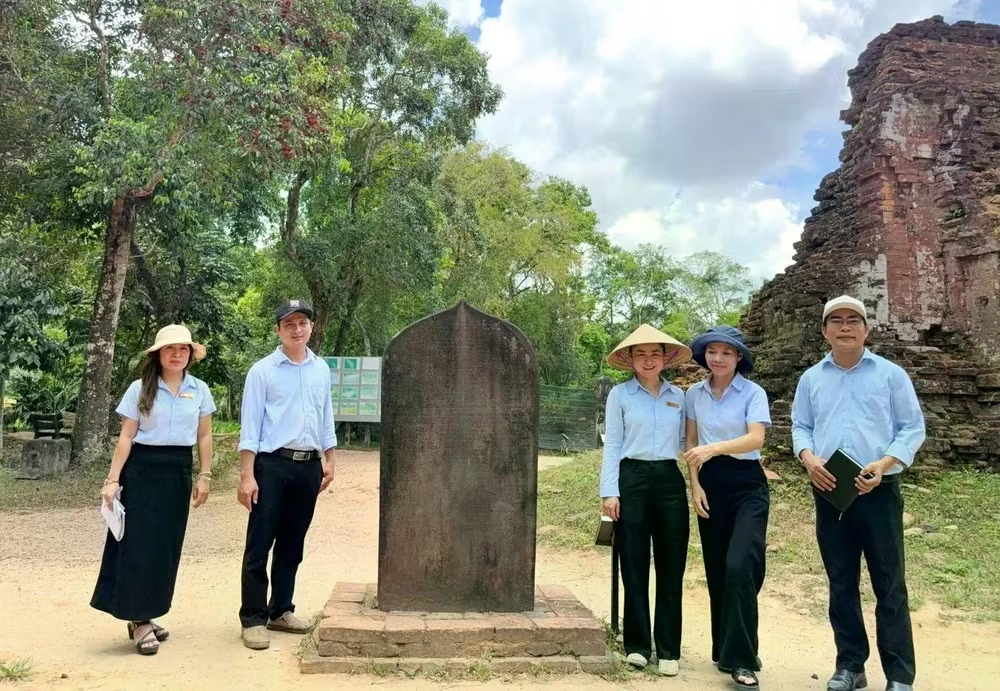
Architect and Cham culture researcher Le Tri Cong said numerous studies have demonstrated that the My Son inscriptions are the key to understanding the history of the Champa Kingdom, its religious institutions, and the relationship between royal authority and spiritual power.
In his view, the inscription collection possesses all the qualities needed for UNESCO to consider it for inscription on the Memory of the World Register.
Few places in Southeast Asia, he noted, have preserved such a coherent body of inscriptions within a single sacred landscape, documenting the continuous history of a kingdom over nearly 900 years.
The inscriptions also record the process of cultural exchange between India and Southeast Asia through the transition from Sanskrit to Old Cham.
"It is this combination of historical, linguistic, religious and regional significance that gives the inscriptions their outstanding international value," Cong said./.