Hanoi brings new life to suburban tourism villages

Hanoi has long been known for the heritage cachet of a thousand-year-old capital. Hoan Kiem Lake, the Old Quarter, the Temple of Literature, the Thang Long Imperial Citadel and a network of craft villages have given the city a singular pull.

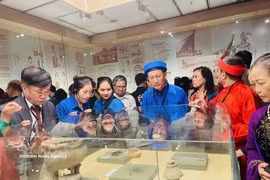
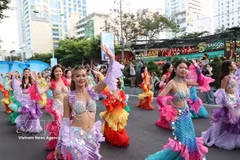
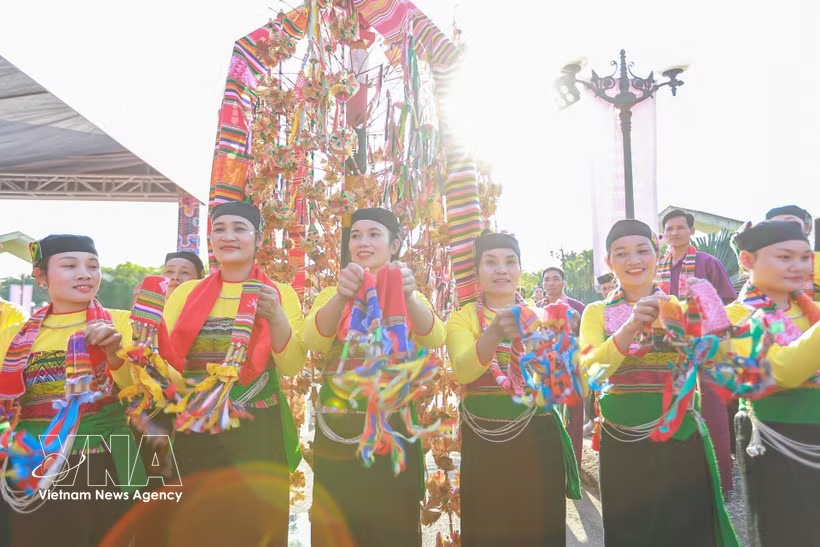
An ethnic festival at the Vietnam National Village for Ethnic Culture and Tourism (Photo: VNA)

Hanoi (VNA) - Hanoi is redrawing its tourism map, pushing beyond the postcard mainstays of Hoan Kiem Lake and the Old Quarter to woo travellers with a slate of community-based destinations in suburban areas, betting that herbal baths, stilt-house stays and rice-field cycling can turn a day-trip capital into a multi-night experience.

Winning visitors over with cultural identity

Hanoi has long been known for the heritage cachet of a thousand-year-old capital. Hoan Kiem Lake, the Old Quarter, the Temple of Literature, the Thang Long Imperial Citadel and a network of craft villages have given the city a singular pull.

But as global travel pivots sharply from ticking off landmarks to immersive experiences, Hanoi is finding a new edge in community-based tourism, where culture isn’t staged but lives in the homes, meals and daily rhythms of residents.

Nestled at the foot of Ba Vi mountain, Ban Mien has carved out a reputation for the Dao ethnic group’s herbal medicine, rituals and folk arts. Visitors there go beyond passive sightseeing, plunging into local life with Dao herbal baths, traditional cooking and lessons in medicinal plant lore.

The capital’s newest community-tourism bet is Muong Coc in My Duc commune. In early July, the municipal Department of Tourism and local authorities launched “Muong Coc – Touching Peace”, minting a new product on Hanoi’s tourism map.

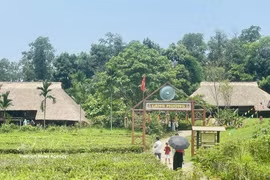
About 60 kilometers from central Hanoi, Muong Coc serves up semi-mountainous scenery of rocky hills, lakes and rice paddies dotted with Muong ethnic villages. The draw isn’t concrete polish but the unvarnished simplicity of local existence. Visitors can stay in stilt houses, cycle through paddies, trek low slopes and sample dishes rich in Muong culinary tradition.

Further afield, the Vietnam National Village for Ethnic Culture and Tourism in Dong Mo offers a larger-scale proposition. Transferred to Hanoi’s control on July 1, the site is being positioned as a cultural, tourism and creative-industry hub, and a new growth pole for the city’s western part.

Far from a static museum, the village functions as a living stage where ethnic communities hold festivals, demonstrate crafts, serve traditional food and practice rituals year-round. In a single trip, tourists can roam cultural spaces from Central Highlands communal houses and Ede longhouses to Tay and Muong stilt homes and the traditional dwellings of Khmer and Cham groups.

Turning “tourism villages” into Hanoi brand

Taken together, these destinations remain in their infancy. Scale is limited, product diversity is thin, links between sites are weak, and overnight stays are short. To turn these villages into signature offerings, Hanoi needs a long-term, coordinated strategy that puts local communities at its centre.

Nguyen Tien Dat, Vice Chairman of the Hanoi Tourism Association, said operators must stop thinking in isolated attractions and start building an integrated community-tourism network. Localities are mining their own strengths in different ways, missing the connections that would forge a compelling product chain. Given that distances are modest, Dat argued, two-to-three-day experiential itineraries are well within reach.

Phung Quang Thang, Chairman of the Vietnam Green Tourism Association, said each village needs a distinct story. Muong Coc should be pitched as a Muong cultural immersion set against a semi-mountainous landscape and the unhurried pace of local life. Ban Mien should double down on Dao heritage, herbal medicine, wellness and resort-style stays. The national ethnic-culture village, meanwhile, ought to become a hub for cultural festivals, art events, craft showcases and large-scale experiential activities, spreading year-round visitor traffic, not just festival dates.

Vu Van Tuyen, Director of Travelogy, flagged the scarcity of accommodation as a critical weakness. To lengthen stays and deepen immersion, local authorities need to channel investment into quality lodgings and homestays.

Tuyen said as digital transformation accelerates, Hanoi could build a dedicated digital map for community-based tourism destinations, layering accommodation and tour bookings, online payments and multilingual interpretation onto a single platform./.
VNA

See more

The wedding of an Indian couple in Da Nang. Vietnam is gradually becoming a hot wedding destination for global billionaires. (Photo courtesy of the Da Nang Culture, Sports and Tourism Department)

Vietnam emerges as premier wedding destination

With advantages such as scenic landscapes, increasingly developed infrastructure and the capacity to host large-scale events, Vietnam is well-positioned to develop wedding tourism into a specialised product, helping to attract high-spending visitors and enhance the destination's competitiveness, an official has said.

A booth promoting Ho Chi Minh City's tourism is set up at Tan Son Nhat International Airport. (Photo: VNA)

Integrated tourism strategy draws more visitors to Ho Chi Minh City

According to the municipal Department of Tourism, the city welcomed more than 7.1 million international visitors from January to July, up 42.7% year-on-year, while domestic tourists reached 31.6 million. Tourism revenue surged 55.3% to nearly 237.5 trillion VND (9.01 billion USD), achieving 72% of this year's target.

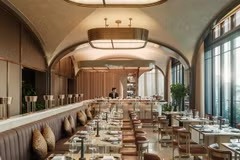
The elegant rooftop setting of The Hudson Rooms at Capella Hanoi.

A Sun Group hotel's bar makes Asia's 50 Best Bars

The Hudson Rooms, the rooftop bar perched atop Capella Hanoi, has been ranked No. 46 in Asia's 50 Best Bars 2026. It marks the first time a bar in Hanoi has entered Asia's Top 50, making Vietnam one of the few countries represented in this highly respected ranking. This year, only two Vietnamese bars secured a place in the Top 50.

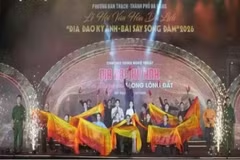
An artistic performance at the "Ky Anh Tunnels – Epic Beneath the Earth" programme. (Photo: Nhandan.vn)

Da Nang builds heritage tourism around Ky Anh Tunnels

The 2026 Ky Anh Tunnels–Dam River Reed Bed Cultural and Tourism Festival featured a rich programme of cultural, tourism and sporting events, including art performances, traditional ceremonies at Thach Tan and Vinh Binh communal houses, a re-enactment of soldiers returning to their village during wartime, a fish and shrimp release to replenish aquatic resources in the Dam River, and a community folk dance contest.

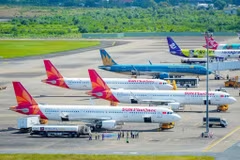
Thailand has become the sixth international destination of Vietnam's newest carrier, Sun PhuQuoc Airways. (Photo: The courtesy of Sun PhuQuoc Airways)

Thailand is sixth international destination of Vietnam's newest airline

Speaking at the recent launch event for the Bangkok route, La Vinh Nam, the airline's Deputy Commercial Director, said the full-service carrier, owned by Vietnam's Sun Group, views Thailand as an important partner in promoting two-way tourism and attracting international transit passengers, rather than as a competitor.

Vietnam Railways has introduced a range of tourism, heritage and dedicated train services, attracting growing numbers of passengers. (Photo: VNA)

Railways reinvent themselves with tourism, heritage trains

One of the most notable successes is the premium Hoa Phuong Do (Flamboyant Flower) train operating between Hanoi and Hai Phong city. Since entering service in May 2025, the train has completed nearly 3,000 trips and carried around 1.33 million passengers.

A rammed-earth house of the Mong ethnic community in the mountainous province of Tuyen Quang. (Photo: VNA)

Heritage fuels distinctive destination brands across Vietnam

As localities move beyond resource-based tourism towards value-driven cultural development, they are creating distinctive destination brands while reinforcing Vietnam's position as a culturally rich and compelling destination on the global tourism map.

Foreign tourists explore Hoi An ancient town in Da Nang city. (Photo: VNA)

Tourism sector pivots to quality-led growth in second half of 2026

According to the Vietnam National Authority of Tourism (VNAT), Vietnam welcomed 12.3 million international visitors in the first six months of 2026, up 15% year-on-year. The figure is the highest first-half number in recent years and puts the country close to halfway towards its target of 25 million foreign arrivals this year.

Travel guide Lonely Planet describes Da Nang as an outdoor lover’s paradise. (Photo: VNA)

Da Nang proves Lonely Planet right as Asia’s must visit summer destination

According to Lonely Planet, Da Nang stands out for its harmonious blend of beautiful beaches, an energetic yet relaxed lifestyle, a rich culinary scene and a diverse range of experiences spanning nature, culture, leisure and entertainment. The city is also praised as an ideal gateway to central Vietnam, offering convenient access to Hoi An, Hue and My Son Sanctuary.

Sun PhuQuoc Airways' new aircraft livery (Photo: Sun Group)

Vietnam's newest airline races from Phu Quoc onto the global stage

Sun PhuQuoc Airways, the airline of Sun Group, officially launched in October 2025 and began commercial flights the following month, entering a Vietnamese aviation market riding a wave of post-pandemic recovery, but also grappling with rising costs, fleet constraints, talent shortages, infrastructure pressure, and intensifying service competition. Less than a year in, this newcomer has already made its presence felt.

A Korean tourist family poses for a photo in the coastal city of Da Nang. (Photo: VNA)

Vietnam remains second most popular destination for Korean tourists

Japan remained the top destination, attracting about 951,000 Korean visitors, accounting for 40.6% of total outbound tourists. Vietnam ranked second with approximately 278,000 visitors, followed by the US with 100,000, Taiwan (China) with 79,000, Thailand with 64,000, the Philippines with 61,000 and Hong Kong (China) with 59,000.

Tourists explore a tourist attraction in Hue city. (Photo: VNA)

Wellness tourism helps Hue shape identity as Asia’s emerging "healing city"

The development of wellness tourism is also aligned with the Politburo's Resolution No. 57-NQ/TW on breakthroughs in science and technology development, innovation and national digital transformation. For Hue, the strategy provides an opportunity to combine modern medicine with traditional healthcare, biotechnology, indigenous medicinal herbs and tourism to create high-value services.

Keo Hanh Thien Pagoda is recognised as a special national relic in 2016. (Photo: VNA)

Digitalising rural heritage to boost tourism

Authorities in Xuan Hong commune of the northern province of Ninh Binh are leveraging digital technology to preserve cultural heritage and promote rural tourism, with the centuries-old Keo Hanh Thien Pagoda serving as the centrepiece of the initiative.

Discover Moscow offers a comprehensive hub of practical travel information, seasonal itinerary ideas and useful tips for visitors planning a trip to the Russian capital. (Screenshot)

Discover Moscow debuts Vietnamese-language tourism platform

Accessible at https://discover.moscow/vi, the platform provides a one-stop source of travel information, featuring practical guidance, seasonal itineraries and planning tips for visitors. It showcases the city's key attractions, cultural routes, parks, events, restaurants, shopping destinations and family-friendly activities, enabling travellers to organise their trips before arriving in Moscow.