Hanoi (VNA) – Vietnam's economy continues to receive positive assessments from international financial institutions following its stronger-than-expected 8.18% GDP growth in the first half of 2026. While achieving the Government's target of at least 10% growth this year remains a key objective, economists say the bigger challenge is to lay a solid foundation for sustaining double-digit growth throughout 2026-2030 and beyond.
Positive outlook backed by resilience
International lenders have raised their confidence in Vietnam's economic prospects after the country's robust first-half performance.
Among the most optimistic is Standard Chartered, which recently revised its 2026 GDP growth forecast upward to 9.5% and projected growth of 11% in 2027.
Tim Leelahaphan, Senior Economist for Thailand and Vietnam at Standard Chartered, said Vietnam entered the second half of the year from a position of strength despite global uncertainties and inflationary pressures.
Strong domestic demand, continued investment in infrastructure and manufacturing capacity, and ongoing economic transformation would support more balanced and sustainable growth over the long term, he said.
Leelahaphan emphasised Vietnam's first-half performance exceeds expectations, driven by manufacturing, services, investment and growth-supporting policies, while highlighting the economy's resilience and adaptability.
Singapore's UOB said Vietnam's 8.18% growth surpassed its earlier expectations despite prolonged geopolitical tensions in the Middle East and elevated energy prices. The bank attributed the expansion to broad-based growth across industry, construction, services and agriculture, and forecast full-year growth of around 8.5%.
HSBC likewise said Vietnam's economy had proved more resilient than expected. Besides rapid growth, the bank pointed to the recovery of key drivers, including public investment, exports, manufacturing and domestic consumption, noting that stronger domestic demand would enhance the economy's ability to withstand external shocks.
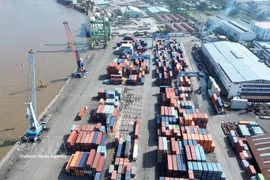
One of the most significant recognitions came from the World Bank Group, which earlier this month reclassified Vietnam as an upper-middle-income economy after its gross national income (GNI) per capita reached 4,970 USD in 2025. The World Bank attributed the upgrade to sustained economic expansion and export growth, with exports increasing by more than 15% over 2024-2025 and GNI rising by an average of around 10% annually during 2021-2025, one of the strongest sustained performances in the region.
Challenges remain
Despite the positive outlook, economists caution that Vietnam still faces considerable challenges in maintaining rapid and sustainable growth.
According to the Ministry of Finance, the economy will need to expand by 11.7% in the second half of the year to achieve the Government's target of at least 10% growth in 2026.
HSBC economist Vu Binh Minh said policymakers should closely monitor three key variables in the months ahead: the trade balance, inflation and the exchange rate, together with interest rates.
Vietnam recorded a trade deficit of 20.46 billion USD by mid-July, according to the Customs Department. While the increase in imports largely reflected strong demand for machinery, equipment and production materials, a prolonged deficit could affect economic growth, the balance of payments and exchange rate stability.
Inflation is also approaching the National Assembly's ceiling, with the average consumer price index (CPI) rising 4.38% in the first six months against the annual target of 4.5%.
The Asian Development Bank (ADB) has warned of mounting macroeconomic risks. Bui Minh Giap, the bank's Chief Economist in Vietnam, said inflationary pressures, faster import growth than exports and the country's reliance on imported production inputs all required close attention.
"The issue is no longer simply achieving high growth, but ensuring that growth is sustainable, of high quality and accompanied by macroeconomic stability," he said.
Giap also stressed that public investment should not only be disbursed faster but allocated more efficiently to projects capable of generating stronger economic spillover effects.
Building foundations for long-term growth
Looking beyond 2026, economists argue that Vietnam's focus should shift from achieving a single year of double-digit growth to creating conditions for sustained high growth over the 2026-2030 period and beyond.
According to ADB Country Director for Vietnam Shantanu Chakraborty, Vietnam's current growth model still depends heavily on capital investment, foreign direct investment, bank credit and relatively low production costs. As competition for global investment intensifies, these traditional advantages will become less effective in supporting long-term expansion.
ADB recommends that Vietnam gradually transition towards a productivity-driven growth model centred on innovation, technology and a stronger domestic private sector. The bank also called for more diversified financing channels, deeper capital markets and increased investment in strategic sectors such as artificial intelligence and semiconductors.
Public investment should continue to prioritise projects with broad economic benefits, including transport infrastructure, logistics, digital infrastructure and healthcare. Such investments would not only support short-term growth but also improve productivity and competitiveness over the long run.
Improving investment efficiency is equally critical. The Government has set a target of disbursing 100% of public investment capital this year. However, Le Thanh Quan, Director General of the Infrastructure Development Department under the Ministry of Finance (MoF), said faster disbursement alone is not enough, stressing that investment quality remains the ultimate goal.
The Government also aims to reduce the Incremental Capital-Output Ratio (ICOR) to 4.5-4.8 during 2026-2030, a significant improvement from 6.43 in the previous five-year period. According to MoF calculations, if investment efficiency does not improve, achieving double-digit growth would require total social investment equivalent to about 70% of GDP, compared with the targeted 40%.
Finance Minister Ngo Van Tuan said improving investment efficiency and turning institutional reforms into a new driver of growth would be essential to sustaining Vietnam's long-term economic development and supporting a new cycle of double-digit growth./.