Hanoi pilots digital consumer protection, e-commerce assurance scheme

Under a blueprint issued on July 27, 2026, the capital city aims to have 500 businesses and organisations participating in or connected to the scheme by 2028. It also targets 1,000 products on dedicated digital storefronts or linked online platforms, with at least 80% of products carrying traceability information or suitable identification codes.

Illustrative photo (Photo: VNA)

Hanoi (VNA) – Hanoi is set to pilot a digital consumer protection and e-commerce assurance scheme aimed at creating a transparent, secure and traceable online shopping environment, while strengthening consumer protection and improving state management of e-commerce activities.

Under a blueprint issued on July 27, 2026, the capital city aims to have 500 businesses and organisations participating in or connected to the scheme by 2028. It also targets 1,000 products on dedicated digital storefronts or linked online platforms, with at least 80% of products carrying traceability information or suitable identification codes. All participating businesses will be guided on mandatory information disclosure requirements.

Hanoi also plans to ensure that 90% of consumer reports and complaints are categorised and referred to appropriate authorities for handling within the prescribed timeframe, while 70% of cases receive a response within the publicly announced processing period.

It will work to organise 20 training courses, develop a central monitoring dashboard, and achieve a participant satisfaction rate of at least 80%.

A key component of the initiative is the establishment of an e-commerce assurance mechanism with a standardised operating framework across the capital. The scheme clearly defines the responsibilities of regulatory agencies, local authorities, e-commerce marketplaces, digital platform operators and business entities.

At the same time, the city will introduce an inter-agency coordination mechanism to strengthen the management and supervision of e-commerce activities.

In terms of technology, it will build an integrated system by leveraging existing digital platforms, including the Hanoi e-government portal, the iHanoi application, the city's public feedback system and shared government databases, thereby avoiding duplication of investment.

The scheme also envisages the creation of a dedicated "capital digital storefront" portal or module, where consumers can access verified information on participating businesses, eligible products, product origins, return policies and official consumer complaint channels. The platform will also be voluntary, in compliance with data protection regulations for e-commerce marketplaces, social media platforms, logistics providers, payment services and product traceability systems.

To strengthen efforts against counterfeit goods, products of unknown origin and commercial fraud, the municipal market surveillance sub-department has been designated as the lead agency for coordinating investigations into suspected violations.

Inspection and enforcement data will be consolidated to build a risk map supporting early warning systems and more effective regulatory oversight. At the same time, Hanoi plans to apply big data and artificial intelligence (AI) to analyse trends, forecast emerging risks and provide early warnings in the digital marketplace.

The initiative also places strong emphasis on public awareness, training and social participation. Hanoi will launch a communications campaign that highlights safe digital consumption, transparent businesses, and products with clear origins. Training programmes will be organised for local officials, market traders, businesses, OCOP (One Commune One Product) producers, traditional craft villages, consumers and community digital transformation teams.

The city will also encourage technology companies, logistics providers, banks, payment service providers, traceability solution providers and educational institutions to contribute technology, expertise and training materials.

However, the blueprint makes clear that partners will not be allowed to influence the Government's recognition criteria, management data or the content of the State-led e-commerce assurance programme./.

VNA

See more

A corner of Phu Quoc special zone in An Giang province (Photo: VNA)

An Giang aims to become leading maritime economic hub

Under the province's master plan for 2021–2030 with a vision to 2050, An Giang will prioritise investment in five strategic sectors: strategic infrastructure; processing industries and clean energy; trade, services, logistics and border-gate economy; high-quality tourism; and high-tech agriculture, ecological development and the circular economy.

Chairman of Da Nang city People's Committee Nguyen Manh Hung and delegates at the opening ceremony of the product showcase space at the International Passenger Terminal of Da Nang International Airport. (Photo: VNA)

Da Nang opens showcase for signature local products at airport

Speaking at the opening ceremony, Deputy Director of the municipal Department of Industry and Trade Do Thi Quynh Tram said Da Nang is home to a wide range of distinctive OCOP products, rural industrial goods and local specialities. The new exhibition spaces will help connect high-quality local products with consumers, particularly tourists, while enhancing brand recognition and promoting the city’s image.

Deputy Prime Minister Ho Quoc Dung speaks at the meeting (Photo: VNA)

Deputy PM calls for long-term strategy for sustainable fisheries development

Localities that have acted decisively have made clear progress while those taking a passive approach continue to see violations, Deputy PM Ho Quoc Dung said, adding that closer coordination among ministries, sectors and local authorities is needed to establish a unified nationwide fisheries management system.

Participants in the business forum held in Veracruz state of Mexico on July 27 (Photo: VNA)

Vietnam, Mexico step up business connectivity

The Trade Office invited Veracruz businesses to attend the Vietnam International Sourcing Expo 2026, a major trade promotion event hosted by Vietnam’s Ministry of Industry and Trade, to explore partnership and sourcing opportunities with Vietnamese manufacturers and exporters.

Deputy PM Nguyen Van Thang (L) meets with WTO Deputy Director-General Jennifer DJ Nordquist (Photo: VNA)

Deputy PM seeks WTO, WEF’s more support to Vietnam

As an active WTO member, Vietnam has been making active contributions to the organisation's agenda, including ratifying the first phase of the Agreement on Fisheries Subsidies, negotiating entry into the expanded Information Technology Agreement (ITA2), and preparing for its next Trade Policy Review scheduled for late 2026, Deputy Prime Minister Nguyen Van Thang said.

A modern commissioning service operation vessel for the offshore wind industry under construction at Ha Long shipyard. (Photo: nhandan.vn)

Shipbuilding helps shape Vietnam's maritime ecosystem, capabilities

Shipbuilding is increasingly viewed as an important component of Vietnam's marine economy. More than simply a manufacturing sector, it forms part of an integrated industrial ecosystem closely linked with metallurgy, mechanical engineering, electrical and electronic industries, automation, information technology and maritime logistics.

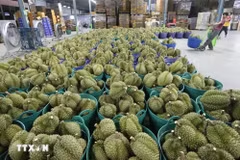
Vietnam's durian exports are expected to exceed 2 billion USD by the end of July. (Photo: VNA)

Durian exports recover despite mounting price pressure

If the Central Highlands harvest proceeds smoothly and pending issues related to growing-area and packing-house codes are resolved promptly, exports could generate an additional 2 billion USD in the remaining months of the year, pushing the whole-year figure beyond 4 billion USD, up from 3.8 billion USD last year.

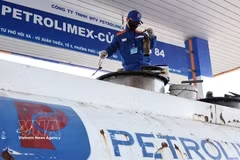
At a Petrolimex station. Petrolimex said it was increasing fuel procurement, adjusting distribution and moving supplies between regions to ensure fuel supply across its system. (Photo: VNA)

Ministry orders fuel supply inspections amid localised shortages

The ministry has taken steps to immediately inspect locations reporting shortages and identify the cause. Localities where shortages are taking place must examine the entire supply chain, including contracts between retailers and wholesalers, actual supply volumes, delivery schedules and the reasons for any failure to provide fuel.

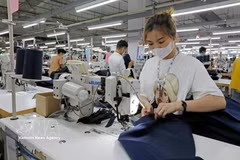
Garment production for export to the US market at TAL Vinh Phuc Garment Company. (Photo: VNA)

New US tariff policy should be based on objective, comprehensive assessment

This progress has been built on mutual respect, transparency and Vietnam's sustained efforts to improve its legal framework and comply with international standards. However, the US' recent tariff decision appears to overlook realities regarding Vietnam's labour environment and manufacturing practices.

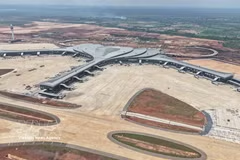
The construction site of Long Thanh International Airport in July 2026. (Photo: VNA)

Long Thanh Airport's second runway to be completed in September

According to the Airports Corporation of Vietnam (ACV), after 14 months of construction, the cement concrete pavement for the runway and taxiways has been substantially completed. Contractors are mobilising hundreds of workers and construction equipment to finish the remaining works on schedule.