Sci-tech seen as lever for Vietnam’s new growth phase

Raising the level of scientific and technological development is the only way to break out of the middle-income trap. Without it, Vietnam will remain stuck in low-value segments, said Dr. Le Xuan Sang, Deputy Director of the Institute of Vietnam and World Economy.

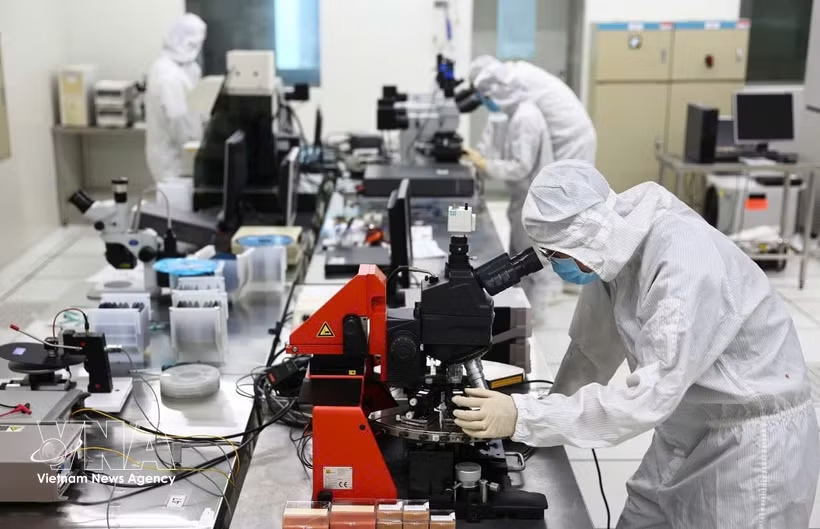
Attracting sci-tech talent plays a critical role. (Photo: VNA)

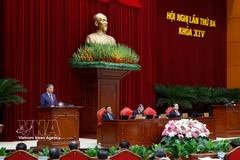
Hanoi (VNA) – The third plenum of the Party Central Committee has adopted a resolution to retool Vietnam’s development model around science – technology and innovation, which are expected to jolt the economy into a higher gear.

Growth model driven by science – technology

Dr. Le Xuan Sang, Deputy Director of the Institute of Vietnam and World Economy under the Vietnam Academy of Social Sciences, said the Vietnamese economy has long thrived on comparative cost advantages such as cheap labour and natural resources. Yet, these edges are gradually eroding as around-the-clock automation and robotics deliver superior productivity.

Raising the level of scientific and technological development is the only way to break out of the middle-income trap. Without it, Vietnam will remain stuck in low-value segments, Sang said.

According to him, rolling out the new development model still hits major roadblocks, including inadequate disbursement mechanisms and cumbersome, lengthy procedures that hamstring researchers. Investment remains too modest, with sci-tech spending still below 2% of GDP, while a management mindset and limited innovation awareness across society and businesses continue to drag.

Notably, the state budget approach is still captive to a “capital preservation” doctrine that treats technology investment as something that must be absolutely safe and loss-proof — a posture directly at odds with the nature of venture investment and innovation, undercutting the willingness of researchers and firms to take risks and chase new ideas.

To make policies like Resolution 57-NQ/TW and Resolution 68-NQ/TW actually work, Vietnam needs breakthrough solutions, Sang said.

First, financial mechanisms must be unlocked fast, with disbursement procedures for sci-tech projects stripped down as much as possible. Management thinking needs to pivot from “cost control” to “development facilitation” while making room for risk in experimental research.

Second, investment must be bold and effective, with a steady rise in the state budget share for science – technology and market-based capital channels opened up. The stock market, in particular, should play a bigger role in pooling medium- and long-term capital for tech firms instead of sitting on the sidelines.

Third, Vietnam needs to build a broad innovation ecosystem. That means technology incubators, startup investment funds and sharper incentives to pull in top talent.

“Only by shifting decisively from a "management" mindset to a "development facilitation" one can Vietnam fully unleash its resources and turn science – technology into a lever that ushers the economy into a new phase,” Sang affirmed.

Shipbuilding charts the course

Engineer Hoang Hung, Chairman of the Vietnam Shipbuilding Industry Association under the Vietnam Union of Science and Technology Associations, said several groups of policies have to move in lockstep.

In science – technology, Vietnam needs mechanisms for commissioning and supporting research as well as technology transfer for the design and construction of hi-tech vessels and ships powered by clean fuels such as liquefied natural gas, methanol and hybrid. Shipyards should also be pushed to digitise design and production and adopt digital simulation and automated production lines.

On the business development front, preferential credit and capital guarantees should help shipbuilders upgrade their infrastructure. At the same time, Vietnam should foster a domestic supporting-industry ecosystem, including steel, machinery, marine equipment, to lift the share of locally made components.

Shipbuilding companies should also be encouraged to strike partnerships with international shipping groups to secure orders and technology transfers, he said.

In his view, training courses for shipbuilding engineers and technical workers need a full overhaul to meet international standards. Scholarships and job commitments can lure students into the field while cooperation among schools, professional associations and enterprises be much tighter, so workers get hands-on training and stay current on new technologies.

Green transition, digital transformation and the push for a sustainable marine economy raise the stakes. The domestic shipbuilding industry must quickly master technologies for building ships that run on alternative and eco-friendly fuels, in line with increasingly tough emissions rules from the International Maritime Organisation (IMO).

On digital transformation, shipyards should gradually digitise the entire design – production – quality chain and tap artificial intelligence for design optimisation and predictive maintenance. That will slash construction times and improve precision.

On workforce and production, the country needs a corps of engineers and workers capable of mastering new technologies. Shipbuilding facilities must be restructured toward specialisation and away from a fragmented approach. Each shipyard should develop its own strengths and go head-to-head with major regional hubs.

At the same time, Vietnam needs a clear market strategy that ties shipbuilding development to domestic demand for maritime transport fleets, oil and gas services and offshore renewable energy. That will create steady orders before Vietnamese builders push into international competition, Hung added./.

VNA

See more

Prof. Nghiem Duc Long from University of Technology Sydney (UTS), who is also Chairman of the Vietnam-Australia Scholars & Experts Association (VASEA) (Photo: VNA)

Science, technology to become new pillar of Vietnam-Australia ties: expert

The visit to Australia by Party General Secretary and State President To Lam will open a new chapter of cooperation, enabling Vietnamese intellectuals and experts in Australia to contribute more effectively to national development and helping science, technology and innovation become an important driver of the Comprehensive Strategic Partnership.

Deputy Director of the Vietnam National Innovation Centre (NIC) Do Tien Thinh speaks at the launch of RE:ACT in Hanoi on August 7. (Photo: NIC)

Youth innovation challenge for sustainable communities launched

Unlike conventional idea-based competitions, RE:ACT focuses on deploying solutions that have already reached the minimum viable product stage through Living Labs – community-based pilot environments where innovations are tested under real-world conditions.

The special national science, technology and innovation programme on strategic technologies targets mastery of at least four strategic technologies for 2026-2030. (Photo: baochinhphu.vn)

Vietnam approves national programme on strategic technologies

The programme seeks to master, develop, perfect and commercialise highly competitive strategic technology products, with priority given to core technologies. It also aims to build a strategic technology ecosystem and strengthen linkages among the State, businesses and science and technology organisations.

FPT Group headquarters ( Photo courtesy of FPT)

FPT named an OpenAI Select Partner

Under the partnership, FPT and OpenAI will work together to help businesses develop AI transformation roadmaps, build AI platforms, strengthen workforce capabilities and deploy responsible AI solutions tailored to their operational needs.

Dak Lak province's Smart City Monitoring and Operations Centre manages and operates the provincial data centre, as well as shared digital platforms and software systems used across the province. (Photo: VNA)

Vietnam draws hyperscalers, cloud titans, AI players

These developments highlight growing confidence in Vietnam as a destination for hyperscale, cloud, and AI infrastructure. The broader digital infrastructure ecosystem also strengthened during the period.

 Da Nang seeks to become a strategic investment destination

Da Nang seeks to become a strategic investment destination

Da Nang is accelerating efforts to attract investment and mobilise social resources for new development models, leveraging expanded development space, special policy mechanisms and institutional reforms to position itself as a strategic investment destination and a pioneer in Vietnam's economic growth in the new era.

PM Le Minh Hung chairs the second meeting of the National Cybersecurity Steering Committee on August 6. (Photo: VNA)

PM urges stronger coordination in cybersecurity response

PM Le Minh Hung pushed for the Regional Counter Cybercrime Hub for Asia-Pacific to be put into operation in 2027, a “Cybersecurity Economy” initiative to be prepped for APEC 2027, stronger specialised cybersecurity agencies, and an expansion of the national cybersecurity operations centre by the second quarter of 2028.

An overview of BSides Hanoi 2026 on August 5 (Photo: baodautu.vn)

Trust emerges as one of modern cybersecurity’s biggest challenges

Speaking at the event, VSEC Chairman Truong Duc Luong said this was the second time BSides has been held in Hanoi, continuing to attract strong interest from the cybersecurity community. BSides Hanoi 2026 was designed as a platform connecting Vietnam’s cybersecurity community with international networks, encouraging knowledge sharing and contributing to the sustainable development of the cybersecurity ecosystem.

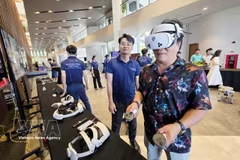
AI Day 2026 product showcase area. (Photo: VNA)

Vietnam positioned to harness AI wave, World Bank report says

The WB report identifies Vietnam as one of the few economies outside the European Union (EU) to have adopted a comprehensive AI regulatory framework as early as 2025. Vietnam applies a risk-tiered approach similar to that of the EU AI Act, imposing different obligations depending on whether an AI system poses “unacceptable,” “high,” “low” or “minimal” risks. The approach is viewed as a strategic step towards ensuring safe and transparent AI governance.

Thai Binh Seed Group JSC is one of Vietnam’s leading crop seed producers, holding rights for 30 varieties and operating three globally certified plants. (Photo: VNA)

Politburo’s Resolution 57-NQ/TW powers new growth momentum

NSO Director Nguyen Thi Huong said alongside foreign investment and the green economy, science – technology, innovation, the digital economy and digital transformation are the new drivers that can can pack a serious second-half punch.

Research lab of the Vietnam National University Ho Chi Minh City. (Illustrative photo published by VNA)

Drastic measures taken to turn Resolution 57 into action

A recent meeting of the Central Steering Committee on science, technology, innovation and digital transformation, chaired by Party General Secretary and State President To Lam, marked a new phase in implementing Resolution 57 following the committee’s restructuring.

A view of Kinh Bac Ward in Bac Ninh Province. (Photo: VNA)

Bac Ninh targets world's top 50 smart cities by 2030

According to Chairman of the provincial People's Committee Pham Hoang Son, the province will pursue a people-centred smart city model driven by science, technology, innovation and digital transformation to improve public services, urban management and competitiveness.

Illustrative photo: VNA

Vietnam expected to fast-track mastery, rollout of 6G technology

Vietnam has so far deployed more than 40,000 5G base transceiver stations (BTSs), providing coverage for about 92% of the population, making it one of the world's fastest countries in this regard. By comparison, many advanced economies typically take two to three years to extend 5G coverage to more than 80% of their populations.