Hanoi accelerates digital economy development, targets 22% of GRDP by end-2026

With Hanoi's overall GRDP growing by 8.2% during the period, the digital economy contributed approximately 1.1 percentage points to the city's economic expansion, underscoring its increasingly substantive role in driving growth rather than remaining merely a policy objective.

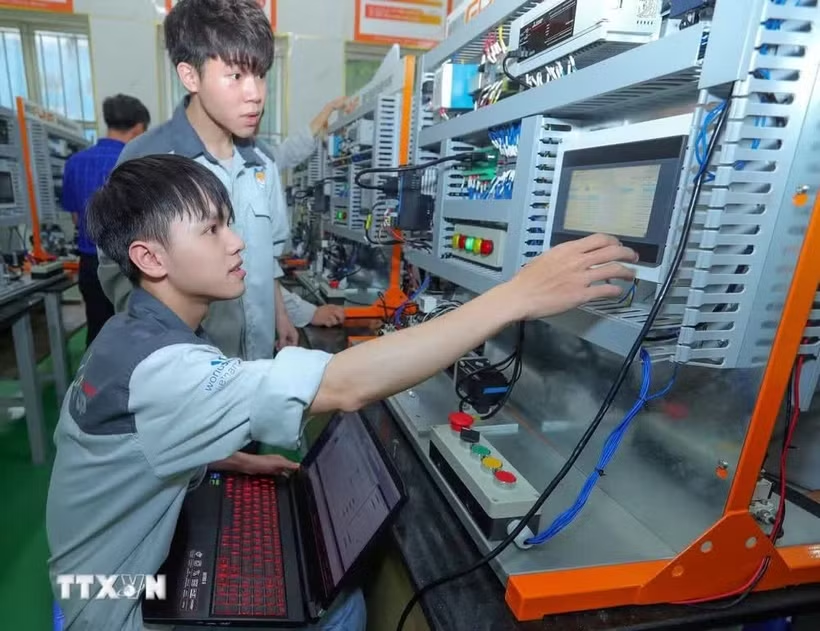
Hanoi prioritises attracting investment in high-tech projects and research and development (R&D) centres. (Photo: VNA)

Hanoi (VNA) – Hanoi is stepping up efforts to make the digital economy a key engine of growth, with an ambitious goal of raising its contribution to 22% of the city's Gross Regional Domestic Product (GRDP) by the end of 2026.

The digital economy has emerged as one of the capital's strongest growth drivers, not only boosting economic output but also transforming governance, production and public services, laying the foundation for a new phase of development.

According to a report presented by the municipal People's Committee, the digital economy accounted for an estimated 16.7% of the city's GRDP, equivalent to about 5.5 billion USD, in the first six months of 2026. The sector expanded by 10.6% year-on-year at current prices.

With Hanoi's overall GRDP growing by 8.2% during the period, the digital economy contributed approximately 1.1 percentage points to the city's economic expansion, underscoring its increasingly substantive role in driving growth rather than remaining merely a policy objective.

To maintain this momentum, Hanoi has continued to strengthen its institutional framework. In June, the municipal People's Council adopted four resolutions under the revised Capital Law, covering high-tech parks, incentives for strategic investors, support for private enterprises and policies to accelerate digital transformation.

Along with approved development plans for e-commerce, the semiconductor industry and the night-time economy, this move creates a more comprehensive legal framework for digital economic development.

Foreign direct investment (FDI) has remained a bright spot. Between the beginning of the year and June 26, science and technology-related sectors attracted 2.22 billion USD, accounting for 68% of Hanoi's total registered FDI. More than 60% of this capital came through share acquisitions and capital contributions, reflecting international investors' confidence in the city's innovation ecosystem.

Hanoi is now home to nearly 11,000 digital technology enterprises, representing around 14% of the national total, with combined revenue estimated at 277.7 trillion VND (10.5 billion USD). Alongside the Hoa Lac Hi-Tech Park, the city is expanding new digital technology zones in Tay Tuu, Phu Dien, Thuong Cat and Dong Ngac to accommodate technology firms and multinational corporations.

Digital transformation is also delivering tangible benefits across multiple sectors. Nearly 9.35 million residents, equivalent to 99% of the population, now have standardised electronic health records, supporting the development of smart healthcare services. Meanwhile, major heritage sites, including the Temple of Literature and Hoa Lo Prison Relic, have adopted 3D mapping and augmented reality technologies to enhance visitor experiences, particularly through night tourism products.

At the grassroots level, digitalisation is helping traditional industries expand their markets. In Chuong My ward, all 63 OCOP (One Commune One Product) items are now sold through e-commerce platforms, boosting revenue by 20-30% while reducing distribution costs. Digital markets and cashless shopping streets in Dong Anh and Thanh Oai have also achieved full QR-code adoption among local businesses.

Despite these gains, Hanoi still needs to increase the digital economy's share of GRDP by another 5.3 percentage points to meet its year-end target. To accelerate progress, the municipal People's Committee has launched a 100-day digital transformation campaign, assigning one-third of its tasks directly to commune- and ward-level authorities while focusing the remainder on supporting businesses, household enterprises and traditional craft villages.

Backed by stronger institutions, continued investment in digital infrastructure and coordinated action across all levels of administration, Hanoi is striving to make the digital economy the primary engine of sustainable growth while reinforcing its position as Vietnam's leading centre for innovation and digital transformation./.

VNA

See more

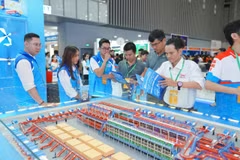
International buyers explore products at the Vietnam International Sourcing Expo 2025. (Photo: VNA)

Nordic businesses look to Vietnam for deeper trade, supply-chain cooperation

VIS 2025 enabled Nordic businesses to directly explore Vietnamese suppliers while facilitating deeper engagements with management agencies, localities, industry associations, seaports, factories and logistics partners. The programme showed that Vietnam-Nordic cooperation is expanding beyond trade to supply-chain development, investment, logistics and digital transformation.

Phu Quoc airport’s 3,300m runway lights up ahead of landmark flight inspections

Phu Quoc airport’s 3,300m runway lights up ahead of landmark flight inspections

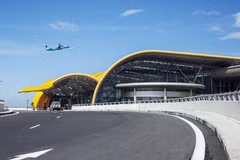
Viewed from above, Runway No. 2 has taken clear shape within the overall layout of Phu Quoc International Airport. Measuring 3,300 metres long and 45 metres wide, the new runway has been built parallel to the existing one. Its pavement and markings have been completed, and the project is now undergoing final technical inspections. At night, the lighting system has been switched on at full intensity for testing.

Villas left unoccupied for years. (Photo: diendandoanhnghiep.vn)

Taxes proposed on vacant land, speculative deals

A key proposal is to introduce a mechanism to regulate windfall gains from differences in land values, while imposing high taxes on vacant land and property transactions conducted within a short period.

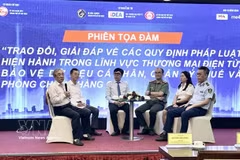
Panellists at the conference (Photo: VNA)

Ho Chi Minh City promotes safe, transparent e-commerce ecosystem

Ho Chi Minh City is stepping up efforts to build a safer and more transparent e-commerce ecosystem as authorities accelerate implementation of the new E-commerce Law, which aims to strengthen consumer protection, enhance platform accountability and support the sustainable growth of Vietnam's digital economy.

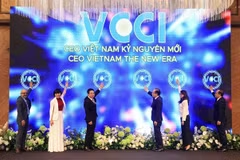
Minister of Foreign Affairs Le Hoai Trung (third, right), VCCI Chairman Ho Sy Hung (third, left), and representatives of government agencies and educational institutions attend the launch ceremony of the programme. (Photo courtesy of VCCI)

Vietnam launches programme to develop globally competitive CEOs

The Vietnam Chamber of Commerce and Industry (VCCI) on July 25 launched a Vietnam business leadership development programme 2026-2030 (CEO Vietnam The New Era), to build a new generation of internationally competitive chief executive officers (CEOs) in Vietnam.

Spokeswoman of the Ministry of Foreign Affairs Pham Thu Hang (Photo: MoFA)

Vietnam strictly prohibits all forms of forced labour: Foreign Ministry

Vietnam will continue working with the US in a constructive and cooperative spirit, while urging the US side to fully take into account the measures Vietnam has adopted when adjusting tariffs on Vietnamese goods, consistent with the actual situation and Vietnam's ongoing legislative and enforcement push.

The fourth Vietnam International Logistics Exhibition (VILOG 2026) will take place in Ho Chi Minh City from July 30 to August 1, 2026. (Illustrative photo: vilog.vn)

Vietnam's flagship logistics exhibition returns with smart, sustainable focus

The exhibition comes as Vietnam cements its position as one of Asia's fastest-growing manufacturing and logistics hubs, with demand increasing for more integrated, technology-driven supply chain solutions. It also reflects the sector's ongoing push towards greater competitiveness and deeper participation in global value chains.

Lien Khuong International Airport is expected to provide a major boost to Lam Dong's tourism after August 19. (Photo published by VNA)

Lien Khuong International Airport set to reopen on August 19

Once operations stabilise, Lien Khuong International Airport in the Central Highlands province of Lam Dong is projected to serve approximately 6,800 passengers a day, nearly 1,000 more than before its temporary closure. Passenger throughput during the final four months of 2026 is forecast to reach around 816,000.

A corner of Buon Ma Thuot ward of Dak Lak province. (Photo: VNA)

Dak Lak focuses on promoting marine-based economy, logistics

With a coastline stretching nearly 189 kilometers, featuring a network of straits, bays, lagoons, and seaports with significant development potential, Dak Lak is well positioned to advance its marine economy, particularly through the harvesting, aquaculture, and processing of high-value seafood products.

At the working session between representatives of the Vietnam Trade Office in Argentina and CMA Paraguay. (Photo: Vietnamese Ministry of Industry and Trade)

Trade office connects South American firms with Vietnamese market

The trade office also highlighted Vietnam’s 100-million-strong consumer market, rising incomes and growing demand for processed, convenience and health-oriented food products. With its strategic location, Vietnam serves not only as a promising market but also as a gateway to Southeast Asia.

Dr Nguyen Thi Bich Nguyet, head of the Office of Environmental Geography and Sustainable Development under the Vietnam Academy of Social Sciences (Photo: VNA)

Integrated marine spatial governance serves sustainable development

When marine spatial governance is implemented through effective cross-sectoral coordination, strengthened by science and technology and supported by expanded international cooperation, the sea will become not only a resource to be exploited but also a long-term development space for the nation.

Experts discuss ways to connect Vietnam's logistics sector with global logistics networks at the forum held in Ho Chi Minh City on July 24. (Photo: VNA)

Global supply chain shift opens new opportunities for Vietnam's logistics

For Vietnam, the current transition presents an opportunity to capitalise on its geo-economic advantages, extensive network of free trade agreements (FTAs) and improving investment climate to attract new investment, expand manufacturing and boost exports, said Deputy Minister of Industry and Trade Phan Thi Thang.