Ho Chi Minh City promotes safe, transparent e-commerce ecosystem

Ho Chi Minh City is stepping up efforts to build a safer and more transparent e-commerce ecosystem as authorities accelerate implementation of the new E-commerce Law, which aims to strengthen consumer protection, enhance platform accountability and support the sustainable growth of Vietnam's digital economy.

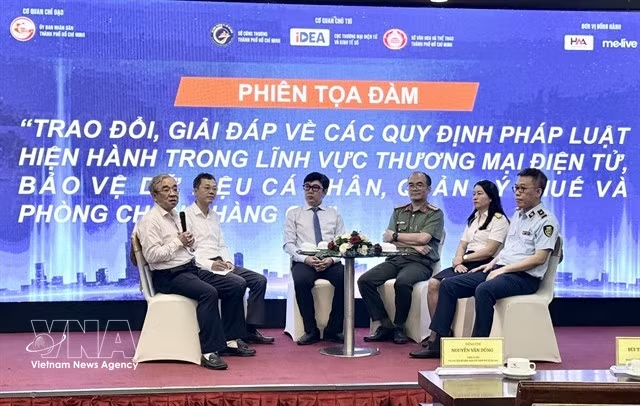
Panellists at the conference (Photo: VNA)

Ho Chi Minh City (VNS/VNA) – Ho Chi Minh City is stepping up efforts to build a safer and more transparent e-commerce ecosystem as authorities accelerate implementation of the new E-commerce Law, which aims to strengthen consumer protection, enhance platform accountability and support the sustainable growth of Vietnam's digital economy.

Ho Chi Minh City’s Department of Industry and Trade, in coordination with the Vietnam E-commerce and Digital Economy Agency under the Ministry of Industry and Trade and other agencies, on July 24 held a conference on implementing the law under the theme "Building a Safe and Transparent E-commerce Ecosystem."

Speaking at the event, Director of the Department of Industry and Trade Bui Ta Hoang Vu said the new law would directly affect businesses and consumers, making it essential for all market participants to understand and comply with the new regulations.

Vietnam's e-commerce market was estimated at around 40 billion USD in 2025, with Ho Chi Minh City accounting for approximately 12 billion USD. The city's online retail sector expanded by more than 30% last year and is expected to maintain strong growth in 2026.

As the market continues to expand, so do the opportunities for businesses. However, only those that understand and comply with the legal framework will be well positioned to fully capitalise on its growth potential, he said.

Introducing the law, Nguyen Huu Tuan, Director of the Centre for E-commerce and Digital Technology Development under the Vietnam E-commerce and Digital Economy Agency, said the law had been designed to protect consumers, ensure fair competition and support the sustainable development of the digital economy.

Among its key provisions are requirements for platforms to disclose product-ranking criteria, improve transparency over recommendation algorithms, strengthen oversight of livestream selling and remove illegal content within 24 hours of receiving requests from authorities.

Cross-border platforms operating Vietnamese-language interfaces or processing at least 100,000 transactions annually in Vietnam must appoint an authorised legal representative in the country and maintain a minimum 20 billion VND security deposit to ensure tax compliance and consumer compensation obligations.

From January 1, 2027, all sellers and livestream hosts operating on intermediary platforms will also be required to complete electronic identity verification (e-KYC).

The law also strengthens protections for merchants by requiring marketplaces to provide advance notice before suspending seller accounts or changing platform policies, while allowing sellers to retain access to transaction data for up to three years.

Speaking on the sidelines of the conference, Tuan said nearly one month after the law took effect, many digital platforms had already begun upgrading their systems to meet the new requirements, including stronger product controls, electronic identity verification, enhanced user data storage and more transparent complaint-handling procedures.

Meanwhile, the Ministry of Industry and Trade is stepping up awareness campaigns to help platforms, merchants and consumers better understand the new legal framework.

"The goal is to create a more transparent e-commerce environment where sellers clearly understand their rights and obligations while consumers enjoy stronger protection," he said.

The conference also introduced amendments to the Advertising Law, which place greater responsibility on KOLs, KOCs and other online influencers to verify product information, clearly identify sponsored content and take responsibility for misleading advertising.

Meanwhile, the city’s police urged businesses to strengthen compliance with personal data protection regulations, tax obligations and cybersecurity requirements amid growing fraud involving fake websites and social media accounts.

Businesses welcomed the new legal framework, saying it would help improve transparency and strengthen confidence in the digital marketplace.

Nguyen Huu Tho, a representative of premium Korean cosmetics brand Be'Balance Vietnam, said the conference had provided valuable guidance on the new E-commerce Law and related regulations, enabling the company to immediately incorporate the new requirements into its operations.

"We believe that transparency and compliance with e-commerce regulations are not only legal obligations but also the foundation of sustainable business development," Tho said.

Regulators, businesses and digital platforms also discussed implementation challenges, stakeholder responsibilities and practical solutions to improve compliance with the new law.

Organisers said stronger collaboration among regulators, businesses, digital platforms and content creators would help build a more transparent digital marketplace and support the sustainable growth of Vietnam's e-commerce sector./.


VNA

See more

An estimated 6,300 workers are needed by the semiconductor industry in Bac Giang province during the 2025-2030 period. (Photo: VNA)

India's semiconductor strategy complementary to Vietnam's chip sector: expert

Sudhanshu Mittal, Director of Engineering Solutions at the National Association of Software and Service Companies (Nasscom) of India, noted that during the state visit to India by General Secretary of the Communist Party of Vietnam Central Committee and President To Lam in May, the two countries signed a number of cooperation agreements, with semiconductors identified as a priority area alongside artificial intelligence (AI), cybersecurity, and advanced technologies.

At the working session between Vietnamese Minister of Finance Ngo Van Tuan (right) and RMIT University’s Vice-Chancellor and President Professor Alec Cameron in Sydney on August 10 (Photo: tapchikinhtetaichinh.vn)

Vietnam, Australia seek to expand investment in rice value chain

During General Secretary of the Communist Party of Vietnam Central Committee and President To Lam’s state visit to Australia from August 9-12, Vietnamese Minister of Finance Ngo Van Tuan, authorised by the General Secretary and President, held working sessions with SunRice Group CEO Paul Serra and RMIT University’s Vice-Chancellor and President Professor Alec Cameron in Sydney on August 10.

Students practice microcontroller programming at the Vietnam-Korea College of Technology in Bac Ninh province (Photo: VNA)

Vietnam – one of most attractive destinations for leading US semiconductor companies: expert

Vietnam has built a solid semiconductor and electronics industry before joining ITSI, attracting major US semiconductor companies. Intel Products Vietnam is one of Intel's largest assembly and testing facilities worldwide, while chip design companies such as Synopsys, Cadence, Marvell and Qualcomm have established engineering and research centres in the Southeast Asian country.

Lawmakers on August 9 discuss a draft law amending and supplementing a number of articles of the Law on the State Bank of Vietnam, the Law on Anti-Money Laundering and the Law on Credit Institutions. (Photo: VNA)

Lawmakers discuss measures to ensure banking system safety, support digital economy

The draft law sets out provisions to control conflicts of interest when commercial banks act as agents managing collateral for corporate bonds. In this regard, Deputy Le Van The of Ninh Binh province said he supported the move, noting that it could provide a more professional approach to collateral management and help strengthen investor confidence if properly regulated.

A company in Da Nang operates a customer relationship management system supported by AI chatbots. (Photo: VNA)

AI drives rise of sleepless enterprises in Vietnam

The concept of a sleepless enterprise does not necessarily mean making employees stay on the job all the time. Instead, it's about building intelligent systems that can respond to customers, process transactions, monitor operations, analyse data and flag risks continuously.

Head of the Vietnam Trade Office in Australia Tran Thi Thanh My (Photo: VNA)

Vietnam, Australia eye 20 bln USD trade target

The head of the Vietnam Trade Office in Australia hoped that the visit by Party General Secretary and State President To Lam will mark a new milestone, opening the door for firms on both sides to forge stronger links and launch concrete cooperation agendas, helping hit that 20 billion USD trade goal sooner rather than later.

Phu Quoc pepper products, granted three stars under the OCOP programme in An Giang province, are displayed at an exhibition of outstanding OCOP products from the Mekong Delta. (Photo: VNA)

Phu Quoc leverages OCOP programme to take local specialities global

Better known as one of Vietnam’s premier island destinations, Phu Quoc is leveraging its “One Commune, One Product” (OCOP) programme to transform traditional specialities into internationally recognised products, integrating local agriculture, food processing and tourism to promote sustainable economic growth.

Production at an FDI enterprise in Tay Ninh province. (Photo: VNA)

FTA Index 2025 to be unveiled later this month

The index is designed to provide valuable information not only for State management agencies but also as an important reference for businesses, foreign investors, and industry associations in planning investment and business activities in Vietnam.