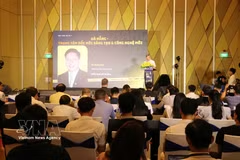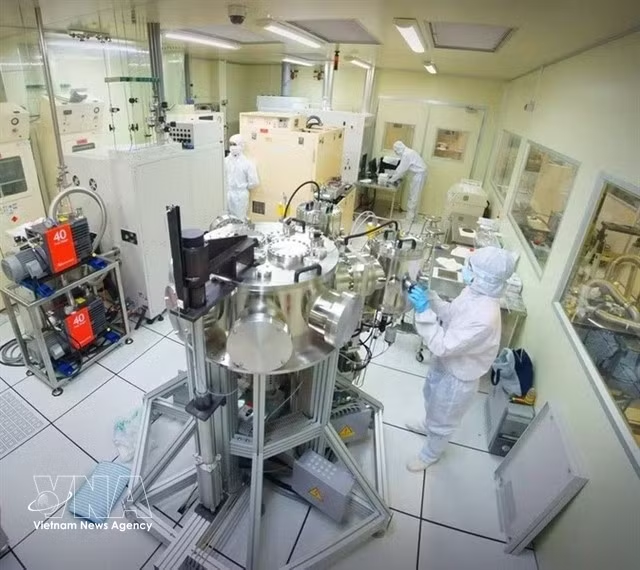
Ho Chi Minh City (VNS/VNA) - As a leading centre for science, technology, and innovation, Ho Chi Minh City is taking proactive steps to build capacity for the quantum computing era, with a strong focus on developing talents to seize arising technological opportunities.
Quantum technology and cybersecurity have been designated among 10 national strategic technology pillars.
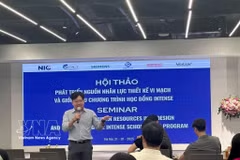
To turn that into reality, local authorities and leading academic institutions are working together to tackle the shortage of skilled workers, build research networks, and prepare the city's digital infrastructure for the transition to post-quantum security.
Experts agreed that the greatest obstacle to the development of quantum technology is not hardware, but human resources.
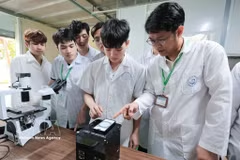
Because quantum science sits at the intersection of physics, mathematics, and computer science, the city is pursuing a comprehensive, multi-tiered training strategy rather than focusing solely on producing elite specialists.
Professor Do Phuc of the University of Information Technology, Vietnam National University-Ho Chi Minh City, proposed a four-tier training model:
Tier 1 (Awareness): Build a basic understanding of quantum technology among leaders, managers, and IT students so they can recognise both its opportunities and systemic risks.
Tier 2 (Application): Train engineers to use existing quantum tools and understand post-quantum cryptography.
Tier 3 (Education): Develop a strong cohort of lecturers capable of integrating quantum modules into university curriculums.
Tier 4 (Specialisation): Cultivate elite research groups and centres of excellence to tackle highly complex, specialised problems.
Concurring with the approach, Associate Professor Dinh Trung Hoa, head of training at Vietnam Quantum Computing (VNQuantum), said preparing for the quantum era must begin with people.
"Many advanced nations did not begin with massive laboratory investments. Instead, they started by raising public awareness, training educators, and gradually embedding quantum concepts into the education system."
To build a long-term talent pipeline, he recommended introducing quantum education through high school STEM clubs and summer camps, followed by introductory university modules, professional certificates, postgraduate research, and, ultimately, a city-level quantum hub.
Rather than confining quantum science to research laboratories, the city aims to apply quantum computing to pressing urban challenges.
Dr Tran Nguyen Lan, Head of QuantumLab at the University of Science, Vietnam National University–Ho Chi Minh City, said quantum computing could optimise logistics, traffic management, financial systems, and urban data management.
However, translating real-world problems into quantum models would require specialist expertise that is in short supply, he said.
"The city should focus on fostering a quantum mindset among technical personnel.
"It is vital to train engineers who can translate urban and logistics challenges into quantum optimisation models, ensuring the city is ready to harness the technology when quantum computing matures."
Vietnam National University-Ho Chi Minh City has made quantum technology one of its core strategic priorities, alongside AI, semiconductors, and cybersecurity.
President of Vietnam National University–Ho Chi Minh City Professor Nguyen Thi Thanh Mai said attracting global talents would be crucial to accelerating the transition.
"A crucial approach is attracting high-level brainpower from around the world, particularly overseas Vietnamese experts and scientists who have studied and worked at major global technology hubs."
To strengthen the domestic talent pipeline, the university introduced a quantum computing specialisation within its bachelor of physics programme at the University of Science for the 2025 intake, she said.
It planned to launch a dedicated quantum technology degree at the University of Science and a quantum engineering degree at the University of Technology by 2027.
At the postgraduate level, programmes would focus on practical applications in simulation, algorithms, post-quantum cryptography, machine learning, and systems optimisation, she said.
By expanding its high-performance computing infrastructure and strengthening collaboration across universities, the institution aimed to become the hub linking academia and industry, laying the foundations for a sustainable quantum technology ecosystem in southern Vietnam, she added./.
See more
VAST expands global partnerships through science and people-to-people diplomacy
During a working visit to Austria from July 19-23, a VAST delegation led by Vice President Prof. Dr. Tran Tuan Anh held a series of meetings with leading research institutions and international organisations, including the International Institute for Applied Systems Analysis (IIASA), the Austrian Academy of Sciences, the Vienna University of Technology (TU Wien), and the International Atomic Energy Agency.
Technology forum to spotlight digital transformation in hospitality, tourism
HORECFEX Vietnam 2026 will take place on August 20–21 at the Ariyana International Convention Centre in the central city of Da Nang, showcase digital solutions and innovation aimed at improving efficiency and competitiveness across Vietnam's hospitality and tourism industry.
Global Vietnamese expertise drives competitive homegrown technologies
For Assoc. Prof. Ta Duc Tung, the biggest gift overseas researchers can give isn’t simply handing over technology; it’s linking up knowledge, people and entire research ecosystems.
Data security, innovation ecosystem key to strengthening Vietnam’s competitiveness
For digital government, stronger investment is needed in shared digital infrastructure, particularly critical infrastructure, AI infrastructure and high-performance connectivity.
Digital transformation lays foundation for Hanoi’s new growth model
The capital city of Hanoi aims for the digital economy to contribute around 40% of its Gross Regional Domestic Product (GRDP) by 2030, with the Hoa Lac Hi-Tech Park serving as the core research and development hub.
Vietnam, Japan launch five joint semiconductor research projects
The signing and implementation of the five projects mark a concrete step toward realising the Party and State’s policies on science – technology development, innovation and digital transformation, with the semiconductor industry identified as one of strategic technologies fundamental to national competitiveness and technological autonomy.
Vietnam urged to develop sovereign AI in digital era
Data has become a strategic asset and a key resource for socio-economic development, as well as a foundation of national competitiveness. As a result, effective data governance, utilisation and protection have become increasingly urgent for organisations and businesses.
Talent strategy seen as key to Vietnam's next growth phase
Building a national talent ecosystem is a long-term development strategy that will underpin Vietnam's competitiveness and innovation-driven growth.
Expert calls for secure national digital archives system
Building a national electronic archives system is not merely a matter of investing in technological infrastructure. It must be designed in an integrated manner from the outset, encompassing system architecture, governance procedures, and data protection mechanisms, to ensure long-term security, integrity, and data sovereignty.
Vietnam can deepen role in global semiconductor supply chain: Taiwan-based expert
Vietnam’s biggest takeaway from Taiwan isn’t just cutting-edge technology alone, but how to build an entire semiconductor ecosystem from the ground up, said Dr. Vo Duc Thang, Assistant Professor at the National Taiwan University of Science and Technology (Taiwan Tech) and President of the Vietnam Innovative and Intellectual Network in Taiwan (China) (VIN Taiwan) told the Vietnam News Agency.
Vietnam needs tens of thousands of nuclear power workers by 2035
According to the Agency for Radiation and Nuclear Safety under the Ministry of Science and Technology, human resources will be among the decisive factors determining whether the country can successfully implement its nuclear power programme on schedule.
Ho Chi Minh City to complete 1st recruitment drive for top science, technology experts in Q3
To strengthen its competitiveness in attracting global talent, the city has introduced a comprehensive package of incentives, including housing assistance, transportation support, streamlined immigration and work permit procedures, improved research facilities, and favourable working conditions.
Vietnam approves national digital transformation strategy for 2026 - 2030
Vietnam aims to become a developed digital nation where digital transformation is implemented comprehensively across all sectors and serves as the country's principal development model. The strategy envisions a modern system of national governance powered by data and AI, strong domestic capabilities in strategic digital technologies, platforms and products, and firm protection of national digital sovereignty.
Vietnam needs “open technological sovereignty” to strengthen position in AI era: expert
Vietnam possesses significant advantages for deeper participation in the global technology value chain. Its young engineering workforce, strong capacity to absorb new technologies and strategic location have made the country an increasingly attractive destination for technology-related foreign direct investment.
Vietnam AI Innovation Challenge 2026 spotlights real-world AI solutions
The Vietnam AI Innovation Challenge 2026 showcased a new generation of AI solutions with the potential to move beyond the lab and into real-world use.
More than 80% of Vietnam's population uses smartphones
The 2025 household living standards survey showed that 87.3% of the population used mobile phones, up 2.5 percentage points from 84.8% in 2024. Of those, 80.3% used smartphones, while the proportion of people using feature phones fell to 8.5%.
Vietnam RWA Summit 2026 highlights need to balance innovation with risk management
A healthy tokenised asset market must be built on reliable data, verifiable identities, transparent information on assets and cash flows, and effective disclosure and supervision mechanisms, an expert has said.
Vietnam seeks safe, regulated development of tokenised asset market
The two-day event, organised by the Vietnam Blockchain Association in partnership with the National Cybersecurity Association and the Vietnam National Real Estate Association, aims to foster policy dialogue, attract investment and position Vietnam as a regional hub for real-world asset (RWA) tokenisation during 2026-2030.
Vietnam pushes stronger basic research to drive innovation, self-reliance
Prof. Dr. Nguyen Van Minh, former rector of the Hanoi National University of Education, said basic research not only generates new knowledge but also fosters innovation and improves the quality of economic growth. Vietnam's growing research capacity has enhanced its regional and international standing while contributing to sustainable development, strategic autonomy, national defence and governance.
Global technology firms partner with Da Nang to develop AI infrastructure
Da Nang is committed to supporting businesses, particularly small- and medium-sized enterprises (SMEs), in digital transformation, AI adoption, and workforce development, with the goal of becoming a hub for innovation and AI development in central Vietnam, said a local official.