VAST expands global partnerships through science and people-to-people diplomacy

During a working visit to Austria from July 19-23, a VAST delegation led by Vice President Prof. Dr. Tran Tuan Anh held a series of meetings with leading research institutions and international organisations, including the International Institute for Applied Systems Analysis (IIASA), the Austrian Academy of Sciences, the Vienna University of Technology (TU Wien), and the International Atomic Energy Agency.

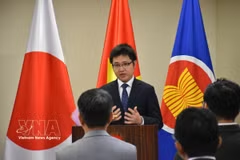
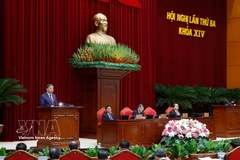
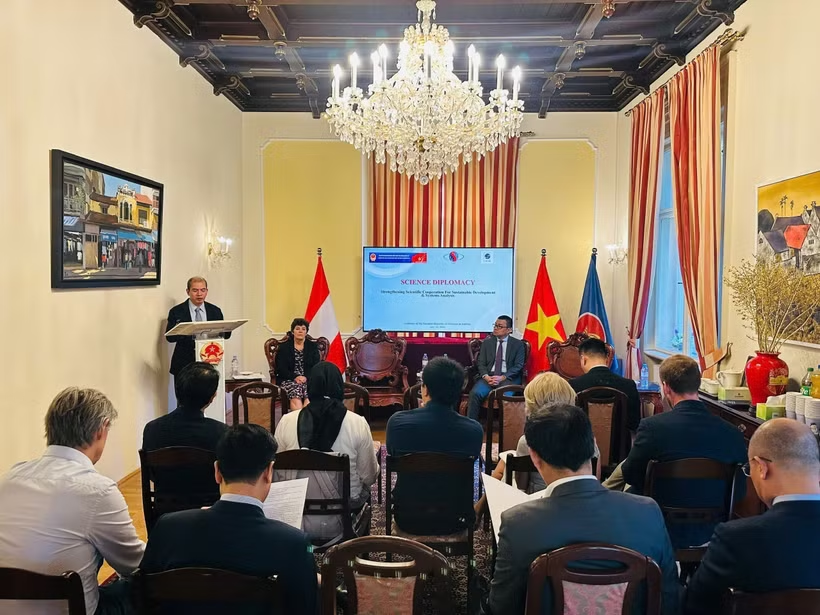
VAST Vice President Prof. Dr. Tran Tuan Anh speaks at an event in Vienna. (Photo published by VNA)

Hanoi, July 25 (VNA) – The Vietnam Academy of Science and Technology (VAST) is strengthening its international integration by combining science diplomacy with people-to-people diplomacy, laying the groundwork for new research partnerships and stronger links between science and policymaking.

During a working visit to Austria from July 19-23, a VAST delegation led by Vice President Prof. Dr. Tran Tuan Anh held a series of meetings with leading research institutions and international organisations, including the International Institute for Applied Systems Analysis (IIASA), the Austrian Academy of Sciences, the Vienna University of Technology (TU Wien), and the International Atomic Energy Agency. The delegation also met representatives of the Vietnamese Embassy in Austria, friendship organisations and the Vietnamese intellectual community in the country.

VAST, as Vietnam's national member organisation at IIASA, co-hosted a seminar on science diplomacy with the Vietnamese Embassy and IIASA at the embassy in Vienna. The event brought together representatives of national and international research institutions and the diplomatic community.

Addressing the seminar, Tuan Anh said that as global challenges become increasingly complex and cross-border in nature, research institutions should do more than conduct scientific studies. They should also serve as platforms for knowledge exchange, connect scientists and strengthen dialogue between science and policymaking.

He said VAST aims to promote the application of systems analysis in policymaking through its role at IIASA while connecting Vietnamese researchers with international programmes on strategic technologies and sustainable development. The academy also hopes to expand scientific cooperation across Southeast Asia, a region facing significant development challenges.

Vietnamese Ambassador Vu Le Thai Hoang shared the view, describing science and technology as an increasingly important pillar of modern diplomacy. He noted that no country can address today's global challenges alone, making science diplomacy an essential bridge linking scientists, research institutions and policymakers on the basis of knowledge and mutual trust.

The ambassador said Austria, home to many international organisations including IIASA and the IAEA, is well positioned to connect Vietnam with European and global scientific networks. In recent years, the embassy has organised a series of technology forums focusing on artificial intelligence, semiconductors, cybersecurity, humanoid robotics, nanotechnology and quantum technologies, bringing together scientists, businesses, investors and policymakers from Vietnam, Austria and across Europe.

Karen Lips, representing IIASA, said the institute's core mission over the past five decades has been to create a space where science brings countries together through interdisciplinary research and international cooperation.

Susie Kitchens, IIASA's Director of Science Diplomacy, stressed that building trust between people is the foundation of science diplomacy, with academic exchanges and expert networks paving the way for long-term cooperation and evidence-based policymaking.

Alongside science diplomacy, VAST also promoted people-to-people exchanges during the visit through meetings with the Vietnam-Austria Friendship Association, the Austria-Vietnam Friendship Association and Vietnamese scholars and scientists living and working in Austria.

As President of the Vietnam-Austria Friendship Association, Prof. Dr. Tran Tuan Anh said cooperation in science, technology and education not only generates research outcomes but also strengthens mutual understanding and trust between the peoples of the two countries. He highlighted discussions with Dr. Nguyen Duy Ha, a Vietnamese quantum physicist at TU Wien, and other overseas Vietnamese researchers on connecting research groups, jointly supervising doctoral students, expanding academic exchanges and participating in collaborative research projects.

VAST said it will continue combining science diplomacy with people-to-people diplomacy to deepen international cooperation, develop high-quality human resources, enhance research capacity and mobilise global resources for Vietnam's development, contributing to the implementation of the Party's resolutions on breakthroughs in science, technology, innovation, digital transformation and international integration./.
VNA

See more

The Quantum Hackathon for Social Good 2026 (QC4SG 2026) kicks off in Quy Nhon, Gia Lai province, on July 24. (Photo: VNA)

Int’l quantum computing hackathon kicks off in Gia Lai

As a key activity within the technology component of the Gia Lai Quantum Year 2026, the event brings together nearly 100 contestants across 26 teams, including students, PhD candidates, young researchers, startups, and tech talents, alongside 50 domestic and international experts, mentors, and judges.

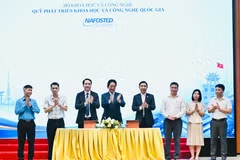
The National Foundation for Science and Technology Development under the Ministry of Science and Technology signs funding agreements for five Vietnam-Japan joint research projects in semiconductors for 2026 at a ceremony on July 22 (Photo: https://baochinhphu.vn/)

Vietnam, Japan launch five joint semiconductor research projects

The signing and implementation of the five projects mark a concrete step toward realising the Party and State’s policies on science – technology development, innovation and digital transformation, with the semiconductor industry identified as one of strategic technologies fundamental to national competitiveness and technological autonomy.

Speakers at the workshop held in Ho Chi Minh City on July 22 (Photo: VNA)

Vietnam urged to develop sovereign AI in digital era

Data has become a strategic asset and a key resource for socio-economic development, as well as a foundation of national competitiveness. As a result, effective data governance, utilisation and protection have become increasingly urgent for organisations and businesses.

(Illustrative photo; VietnamPlus)

Expert calls for secure national digital archives system

Building a national electronic archives system is not merely a matter of investing in technological infrastructure. It must be designed in an integrated manner from the outset, encompassing system architecture, governance procedures, and data protection mechanisms, to ensure long-term security, integrity, and data sovereignty.

Dr. Vo Duc Thang, Assistant Professor at the National Taiwan University of Science and Technology and President of the Vietnam Innovative and Intellectual Network in Taiwan (China), speaks at a seminar on the semiconductor industry. (Photo: VNA)

Vietnam can deepen role in global semiconductor supply chain: Taiwan-based expert

Vietnam’s biggest takeaway from Taiwan isn’t just cutting-edge technology alone, but how to build an entire semiconductor ecosystem from the ground up, said Dr. Vo Duc Thang, Assistant Professor at the National Taiwan University of Science and Technology (Taiwan Tech) and President of the Vietnam Innovative and Intellectual Network in Taiwan (China) (VIN Taiwan) told the Vietnam News Agency.

The need to develop human resources for the atomic energy and nuclear power sectors is becoming increasingly urgent. (Illustrative photo from the Vietnam Government Portal)

Vietnam needs tens of thousands of nuclear power workers by 2035

According to the Agency for Radiation and Nuclear Safety under the Ministry of Science and Technology, human resources will be among the decisive factors determining whether the country can successfully implement its nuclear power programme on schedule.

Technologies for developing digital government infrastructure and cashless payment solutions are showcased at an exhibition. (Photo: VNA)

Vietnam approves national digital transformation strategy for 2026 - 2030

Vietnam aims to become a developed digital nation where digital transformation is implemented comprehensively across all sectors and serves as the country's principal development model. The strategy envisions a modern system of national governance powered by data and AI, strong domestic capabilities in strategic digital technologies, platforms and products, and firm protection of national digital sovereignty.

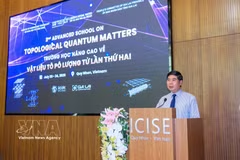
Vice Chairman of the Gia Lai provincial People’s Committee Lam Hai Giang speaks at the event. (Photo: VNA)

Int’l scientists gather at 2nd advanced school on topological quantum matters in Gia Lai

Jointly organised by the Rencontres du Vietnam (Meeting Vietnam) association and the International Centre for Interdisciplinary Science and Education (ICISE), the five-day event features lectures by leading professors and scientists in quantum physics and materials science, providing participants with a solid theoretical foundation. They are also updated on the latest research advances in quantum topological materials.

The survey found that mobile phones, particularly smartphones, have become an essential part of daily life in Vietnam. (Photo: VietnamPlus)

More than 80% of Vietnam's population uses smartphones

The 2025 household living standards survey showed that 87.3% of the population used mobile phones, up 2.5 percentage points from 84.8% in 2024. Of those, 80.3% used smartphones, while the proportion of people using feature phones fell to 8.5%.

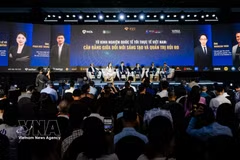
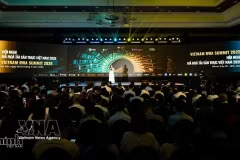
An overview of the inaugural Vietnam RWA Summit 2026 in Hanoi on July 18 (Photo: VNA)

Vietnam seeks safe, regulated development of tokenised asset market

The two-day event, organised by the Vietnam Blockchain Association in partnership with the National Cybersecurity Association and the Vietnam National Real Estate Association, aims to foster policy dialogue, attract investment and position Vietnam as a regional hub for real-world asset (RWA) tokenisation during 2026-2030.

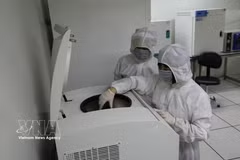
Scientists conduct experiments in the cleaning room at the Institute of Materials Science under the Vietnam Academy of Science and Technology. (Photo: VNA)

Vietnam pushes stronger basic research to drive innovation, self-reliance

Prof. Dr. Nguyen Van Minh, former rector of the Hanoi National University of Education, said basic research not only generates new knowledge but also fosters innovation and improves the quality of economic growth. Vietnam's growing research capacity has enhanced its regional and international standing while contributing to sustainable development, strategic autonomy, national defence and governance.