Phu Quoc airport’s 3,300m runway lights up ahead of landmark flight inspections

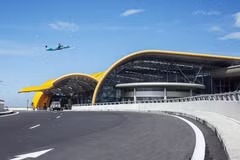
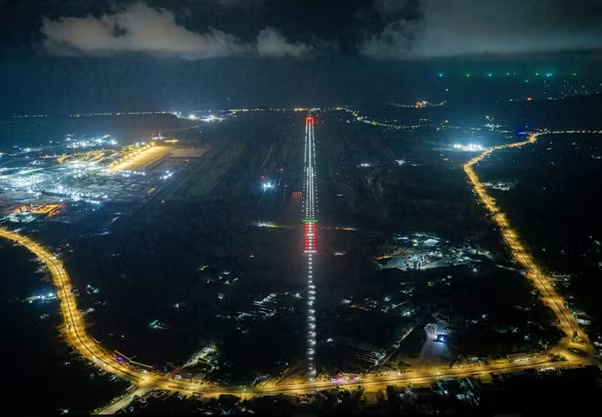
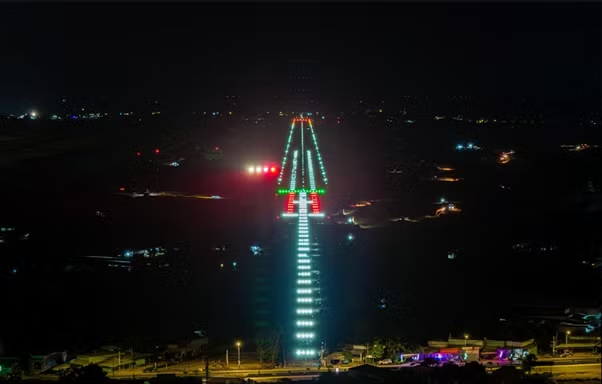
Viewed from above, Runway No. 2 has taken clear shape within the overall layout of Phu Quoc International Airport. Measuring 3,300 metres long and 45 metres wide, the new runway has been built parallel to the existing one. Its pavement and markings have been completed, and the project is now undergoing final technical inspections. At night, the lighting system has been switched on at full intensity for testing.

Hanoi (VNA) - From the final installation and inspection work under the daytime sun to the moment nearly 1,500 airfield lights illuminate the runway after nightfall, Runway No. 2 at Phu Quoc International Airport is entering its final stage of completion ahead of calibration flights scheduled for July 27–28.
picture1.png

Viewed from above, Runway No. 2 has taken clear shape within the overall layout of Phu Quoc International Airport. Measuring 3,300 metres long and 45 metres wide, the new runway has been built parallel to the existing one. Its pavement and markings have been completed, and the project is now undergoing final technical inspections. At night, the lighting system has been switched on at full intensity for testing.
picture2.png

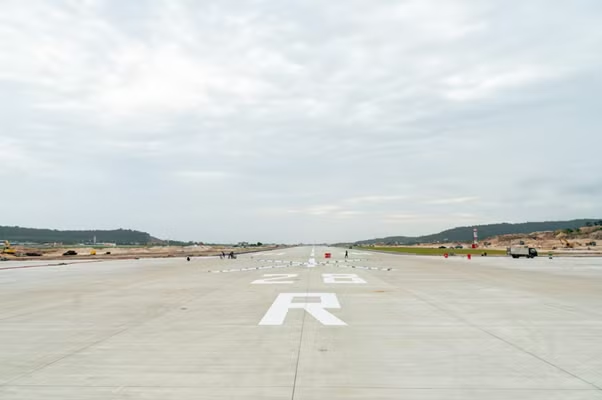
The concrete surface, painted markings and aviation symbols have been largely completed. The runway is designed to regularly accommodate modern wide-body aircraft such as the Boeing 787, Airbus A350 and Boeing 777.
picture3.jpg

The project was completed in approximately eight months, including six months for the foundation, structural works and concrete pavement, followed by two months for the installation, connection, inspection and calibration of equipment.​

According to aviation expert Trinh Nhu Long, this is “an unprecedented achievement in the history of Vietnam’s aviation infrastructure construction.” He noted that runways of a similar scale at mainland projects such as Long Thanh and Van Don typically take two to three years to complete, while the Phu Quoc project also faced numerous challenges associated with an island environment.
picture4.jpg

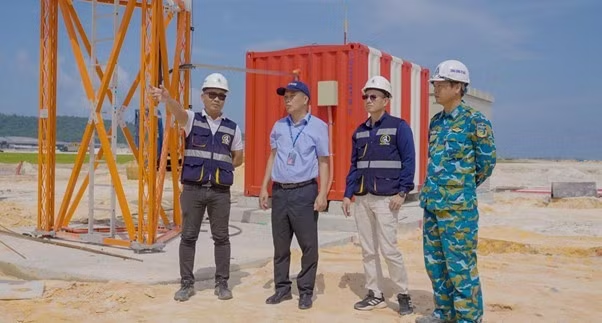
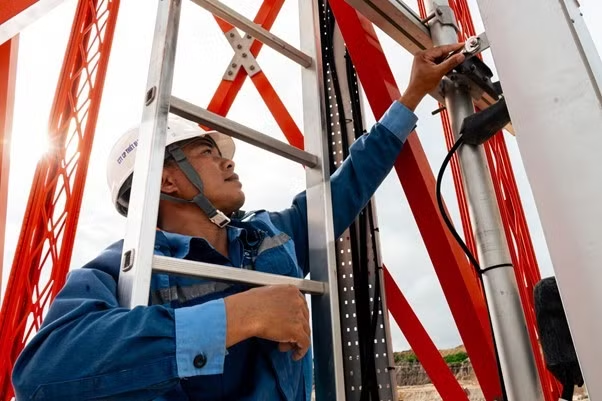
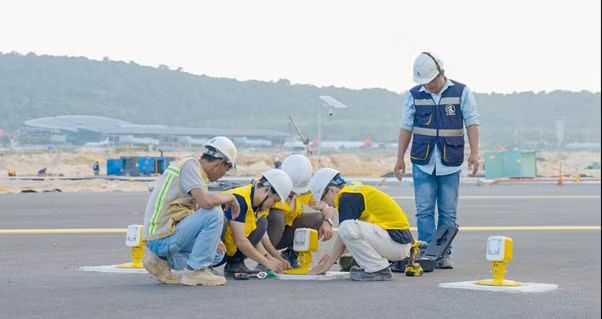
Before installing the equipment, engineers precisely determined each coordinate, checked elevations and marked installation positions on the runway surface. Even a minor deviation at an installation point could affect pilots’ ability to recognise signals while approaching the runway or moving within the airfield.
picture5.jpg

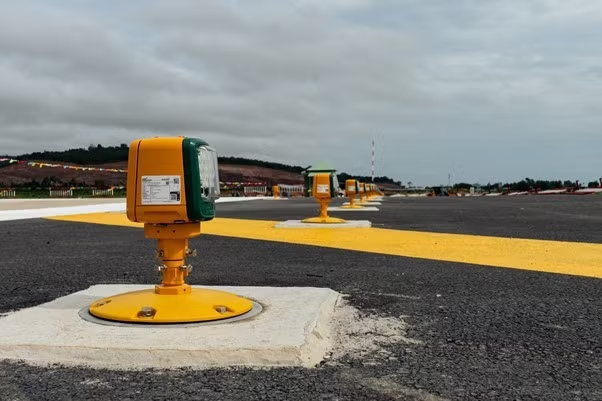
For inset lights, construction teams drilled and cut into the pavement, installed the light bases, connected the cables and secured the equipment using specialised materials. Each light had to be installed at the correct elevation while being able to withstand the loads and forces generated during aircraft take-offs and landings.
picture6.png

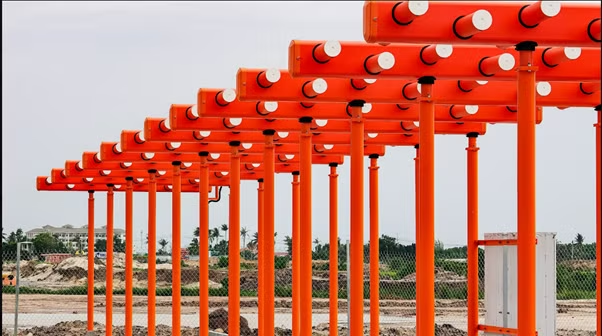
Along the runway, elevated lights and signs were positioned at strictly calculated intervals. Once the pavement was completed, the next complex task was to install nearly 1,500 airfield lights, almost 400 signs, and precision navigation and landing systems. Every piece of equipment had to be placed at the correct coordinates, elevation and beam direction, while being synchronised with the power supply and control systems.
picture7.png

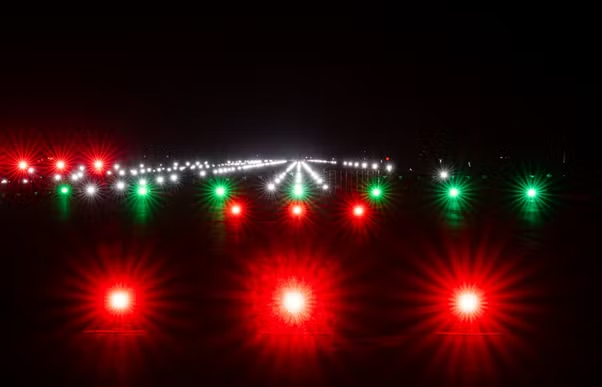
After installation, engineers used specialised equipment to measure the brightness, colour, beam direction and synchronised operation of each lighting cluster. The CAT II lighting system uses LED technology, has a designed lifespan of approximately 50,000 hours and supports operations in limited-visibility conditions.
picture8.png

When night fell, nearly 1,500 airfield lights were switched on simultaneously, creating a 3,300-metre guidance axis. Combined with the ILS/DME, the CAT II lighting system provides flight crews with information on the approach course, descent angle and distance to the runway.

The calibration flights scheduled for July 27–28 will test the accuracy and stability of the entire system under real flight conditions. The results will provide a basis for further adjustments, the completion of technical documentation and procedures to obtain an operating licence.
picture9.png

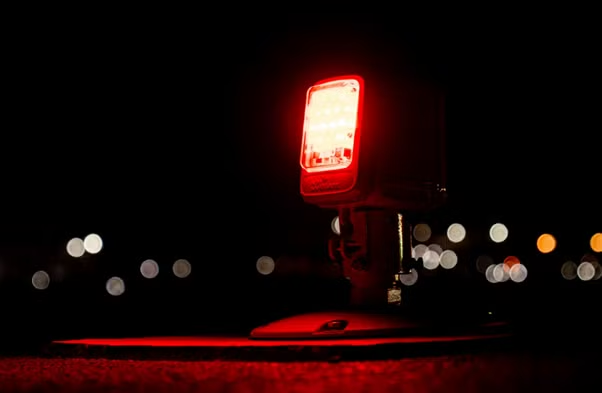
Two Precision Approach Path Indicator (PAPI) systems have been installed for the runway’s two landing directions. Each system comprises four light units that emit red and white signals, allowing pilots to quickly determine whether the aircraft is on, above or below the standard approach path.
picture10.png

Nguyen Ba Quan, Director of Phu Quoc International Airport under Sun Airport Corporation, a member of Sun Group, said Runway No. 2 is a crucial component of the airport’s comprehensively planned and synchronously developed infrastructure.​

“We have developed an integrated operational plan linking Runway No. 2 with the existing taxiway and apron system, Terminal 2, the VIP terminal and the VIP apron. This will ensure the safe and seamless handling of modern wide-body aircraft such as the Boeing 787, Airbus A350 and Boeing 777, as well as Code F aircraft when required. The airport will therefore be able to meet the demands of regular operations while also serving special flights during APEC 2027,” Quan said./.

VNA

See more

Villas left unoccupied for years. (Photo: diendandoanhnghiep.vn)

Taxes proposed on vacant land, speculative deals

A key proposal is to introduce a mechanism to regulate windfall gains from differences in land values, while imposing high taxes on vacant land and property transactions conducted within a short period.

Panellists at the conference (Photo: VNA)

Ho Chi Minh City promotes safe, transparent e-commerce ecosystem

Ho Chi Minh City is stepping up efforts to build a safer and more transparent e-commerce ecosystem as authorities accelerate implementation of the new E-commerce Law, which aims to strengthen consumer protection, enhance platform accountability and support the sustainable growth of Vietnam's digital economy.

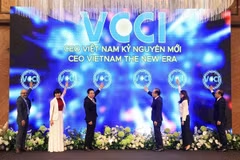
Minister of Foreign Affairs Le Hoai Trung (third, right), VCCI Chairman Ho Sy Hung (third, left), and representatives of government agencies and educational institutions attend the launch ceremony of the programme. (Photo courtesy of VCCI)

Vietnam launches programme to develop globally competitive CEOs

The Vietnam Chamber of Commerce and Industry (VCCI) on July 25 launched a Vietnam business leadership development programme 2026-2030 (CEO Vietnam The New Era), to build a new generation of internationally competitive chief executive officers (CEOs) in Vietnam.

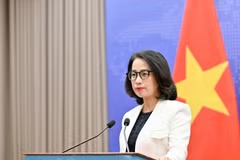
Spokeswoman of the Ministry of Foreign Affairs Pham Thu Hang (Photo: MoFA)

Vietnam strictly prohibits all forms of forced labour: Foreign Ministry

Vietnam will continue working with the US in a constructive and cooperative spirit, while urging the US side to fully take into account the measures Vietnam has adopted when adjusting tariffs on Vietnamese goods, consistent with the actual situation and Vietnam's ongoing legislative and enforcement push.

The fourth Vietnam International Logistics Exhibition (VILOG 2026) will take place in Ho Chi Minh City from July 30 to August 1, 2026. (Illustrative photo: vilog.vn)

Vietnam's flagship logistics exhibition returns with smart, sustainable focus

The exhibition comes as Vietnam cements its position as one of Asia's fastest-growing manufacturing and logistics hubs, with demand increasing for more integrated, technology-driven supply chain solutions. It also reflects the sector's ongoing push towards greater competitiveness and deeper participation in global value chains.

Lien Khuong International Airport is expected to provide a major boost to Lam Dong's tourism after August 19. (Photo published by VNA)

Lien Khuong International Airport set to reopen on August 19

Once operations stabilise, Lien Khuong International Airport in the Central Highlands province of Lam Dong is projected to serve approximately 6,800 passengers a day, nearly 1,000 more than before its temporary closure. Passenger throughput during the final four months of 2026 is forecast to reach around 816,000.

A corner of Buon Ma Thuot ward of Dak Lak province. (Photo: VNA)

Dak Lak focuses on promoting marine-based economy, logistics

With a coastline stretching nearly 189 kilometers, featuring a network of straits, bays, lagoons, and seaports with significant development potential, Dak Lak is well positioned to advance its marine economy, particularly through the harvesting, aquaculture, and processing of high-value seafood products.

At the working session between representatives of the Vietnam Trade Office in Argentina and CMA Paraguay. (Photo: Vietnamese Ministry of Industry and Trade)

Trade office connects South American firms with Vietnamese market

The trade office also highlighted Vietnam’s 100-million-strong consumer market, rising incomes and growing demand for processed, convenience and health-oriented food products. With its strategic location, Vietnam serves not only as a promising market but also as a gateway to Southeast Asia.

Dr Nguyen Thi Bich Nguyet, head of the Office of Environmental Geography and Sustainable Development under the Vietnam Academy of Social Sciences (Photo: VNA)

Integrated marine spatial governance serves sustainable development

When marine spatial governance is implemented through effective cross-sectoral coordination, strengthened by science and technology and supported by expanded international cooperation, the sea will become not only a resource to be exploited but also a long-term development space for the nation.

Experts discuss ways to connect Vietnam's logistics sector with global logistics networks at the forum held in Ho Chi Minh City on July 24. (Photo: VNA)

Global supply chain shift opens new opportunities for Vietnam's logistics

For Vietnam, the current transition presents an opportunity to capitalise on its geo-economic advantages, extensive network of free trade agreements (FTAs) and improving investment climate to attract new investment, expand manufacturing and boost exports, said Deputy Minister of Industry and Trade Phan Thi Thang.

Illustrative photo (Source: VNA)

Vietnam records 16.65 billion USD trade deficit in first half

A comprehensive package of measures is needed to maintain and gradually expand Vietnam's trade surplus. This will provide a solid foundation for the agricultural sector to further strengthen its role as a pillar of the economy and make a more substantial contribution to Vietnam's overall economic growth.