Shipbuilding helps shape Vietnam's maritime ecosystem, capabilities

Shipbuilding is increasingly viewed as an important component of Vietnam's marine economy. More than simply a manufacturing sector, it forms part of an integrated industrial ecosystem closely linked with metallurgy, mechanical engineering, electrical and electronic industries, automation, information technology and maritime logistics.

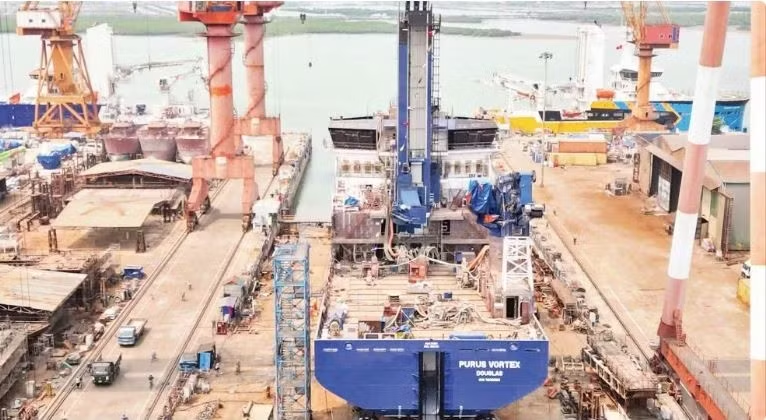
A modern commissioning service operation vessel for the offshore wind industry under construction at Ha Long shipyard. (Photo: nhandan.vn)

Hanoi (VNA) – In an era of deeper global integration, the shipbuilding industry is regarded as a strategic pillar in Vietnam's long-term vision of becoming a strong maritime nation. Beyond its economic contribution, the sector plays a vital role in strengthening the country's maritime capabilities, and supporting the objectives of economic development, national defence, self-reliance in maritime transport, logistics and supply chains security.

With a coastline stretching nearly 3,300 kilometres and an exclusive economic zone of around 1 million square kilometres, strategically located along key international shipping routes in the Asia-Pacific, Vietnam is well positioned to harness its maritime advantages and develop a comprehensive national maritime industrial ecosystem over the long term.

The 12th Party Central Committee's Resolution No. 36-NQ/TW, adopted on October 22, 2018, on the strategy for sustainable marine economic development, underscores the need for the coordinated development of related industries, including marine transport, shipbuilding, logistics services and seaport infrastructure.

A new engine of industrial growth

Shipbuilding is increasingly viewed as an important component of Vietnam's marine economy. More than simply a manufacturing sector, it forms part of an integrated industrial ecosystem closely linked with metallurgy, mechanical engineering, electrical and electronic industries, automation, information technology and maritime logistics.

According to the Vietnam Maritime and Waterway Administration, the country is home to nearly 90 ocean-going shipbuilding enterprises and more than 400 inland watercraft manufacturers, with a combined newbuilding capacity of around 3.5 million deadweight tonnes (DWT). Nearly 120 facilities are capable of building and repairing vessels exceeding 1,000 tonnes.

Vietnam has steadily established itself as a competitive player in several shipbuilding segments, particularly medium-sized commercial vessels. The country also benefits from a sizeable skilled workforce, labour costs that remain competitive within the region, and government policies aimed at supporting the industry's development through international partnerships, infrastructure investment and technological modernisation.

Despite these advantages, the sector continues to face challenges, particularly in technology, production capability and global competitiveness. Vietnam currently captures only around 20–30% of the overall shipbuilding value chain.

Maritime experts believe that if supported by a well-developed domestic supply chain together with stronger design capabilities and financial capacity, shipbuilding could emerge as a new industrial growth engine, contributing an estimated 2.2-4% of the country's GDP and supporting Vietnam's ambition of achieving double-digit economic growth.

Building an integrated ecosystem

Dr Pham Hoai Chung, Chairman of the Members' Council of the Shipbuilding Industry Corporation (SBIC) and Vice Chairman of the Vietnam Shipbuilding Industry Association (VISIA), said Vietnam has established a clear long-term direction for developing the industry through an ecosystem approach.

Rather than developing individual shipyards, localities or isolated product lines, he said, the strategy focuses on integrating shipbuilding with the merchant fleet, inland waterway transport, port infrastructure, logistics, supporting industries and services throughout a vessel's entire lifecycle.

He added that the industry's development should not be pursued through isolated shipyards, individual localities or standalone product lines. Instead, planning and policymaking must foster an integrated value chain, ensure stable market demand, and promote an efficient division and overall performance.

SBIC's shipbuilding subsidiaries are currently pursuing a dual mission: maintaining production, safeguarding jobs and incomes for workers, while simultaneously implementing corporate restructuring in line with Government resolutions. Many shipyards have already secured order books through the end of 2028, while several have signed newbuilding contracts extending to 2030. These companies are also working to accelerate production schedules, reduce costs and improve profit margins.

SBIC General Director Tran Manh Ha said that despite facing considerable challenges in recent years, the corporation's member companies have largely succeeded in retaining their workforce while continuing to train managers and technical specialists, preserving the industry's core human resources for future development.

Ha called on the Government to introduce a comprehensive development strategy with breakthroughs in institutional reform, industrial finance, technology, supporting industries and workforce development. Such measures would provide the foundation for building a modern, environmentally sustainable and internationally competitive shipbuilding industry in the years ahead./.

VNA

See more

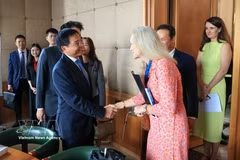
Deputy PM Nguyen Van Thang (L) meets with WTO Deputy Director-General Jennifer DJ Nordquist (Photo: VNA)

Deputy PM seeks WTO, WEF’s more support to Vietnam

As an active WTO member, Vietnam has been making active contributions to the organisation's agenda, including ratifying the first phase of the Agreement on Fisheries Subsidies, negotiating entry into the expanded Information Technology Agreement (ITA2), and preparing for its next Trade Policy Review scheduled for late 2026, Deputy Prime Minister Nguyen Van Thang said.

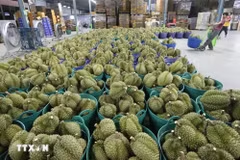
Vietnam's durian exports are expected to exceed 2 billion USD by the end of July. (Photo: VNA)

Durian exports recover despite mounting price pressure

If the Central Highlands harvest proceeds smoothly and pending issues related to growing-area and packing-house codes are resolved promptly, exports could generate an additional 2 billion USD in the remaining months of the year, pushing the whole-year figure beyond 4 billion USD, up from 3.8 billion USD last year.

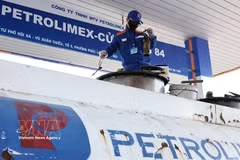
At a Petrolimex station. Petrolimex said it was increasing fuel procurement, adjusting distribution and moving supplies between regions to ensure fuel supply across its system. (Photo: VNA)

Ministry orders fuel supply inspections amid localised shortages

The ministry has taken steps to immediately inspect locations reporting shortages and identify the cause. Localities where shortages are taking place must examine the entire supply chain, including contracts between retailers and wholesalers, actual supply volumes, delivery schedules and the reasons for any failure to provide fuel.

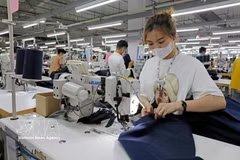
Garment production for export to the US market at TAL Vinh Phuc Garment Company. (Photo: VNA)

New US tariff policy should be based on objective, comprehensive assessment

This progress has been built on mutual respect, transparency and Vietnam's sustained efforts to improve its legal framework and comply with international standards. However, the US' recent tariff decision appears to overlook realities regarding Vietnam's labour environment and manufacturing practices.

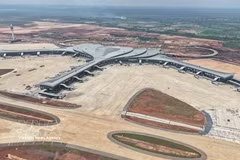
The construction site of Long Thanh International Airport in July 2026. (Photo: VNA)

Long Thanh Airport's second runway to be completed in September

According to the Airports Corporation of Vietnam (ACV), after 14 months of construction, the cement concrete pavement for the runway and taxiways has been substantially completed. Contractors are mobilising hundreds of workers and construction equipment to finish the remaining works on schedule.

Illustrative image (Photo: VNA)

Vietnam introduces special policies to strengthen anti-money laundering framework

Issued on July 24, Resolution No. 66.23/2026/NQ-CP amends and supplements a number of provisions in the 2022 Law on Anti-Money Laundering and related guiding documents. The revisions focus on key areas, including the definition of beneficial ownership, verification of customer information, transparency of legal arrangements, risk-based customer classification and the frequency of updating customer information.

International buyers explore products at the Vietnam International Sourcing Expo 2025. (Photo: VNA)

Nordic businesses look to Vietnam for deeper trade, supply-chain cooperation

VIS 2025 enabled Nordic businesses to directly explore Vietnamese suppliers while facilitating deeper engagements with management agencies, localities, industry associations, seaports, factories and logistics partners. The programme showed that Vietnam-Nordic cooperation is expanding beyond trade to supply-chain development, investment, logistics and digital transformation.

Phu Quoc airport’s 3,300m runway lights up ahead of landmark flight inspections

Phu Quoc airport’s 3,300m runway lights up ahead of landmark flight inspections

Viewed from above, Runway No. 2 has taken clear shape within the overall layout of Phu Quoc International Airport. Measuring 3,300 metres long and 45 metres wide, the new runway has been built parallel to the existing one. Its pavement and markings have been completed, and the project is now undergoing final technical inspections. At night, the lighting system has been switched on at full intensity for testing.

Villas left unoccupied for years. (Photo: diendandoanhnghiep.vn)

Taxes proposed on vacant land, speculative deals

A key proposal is to introduce a mechanism to regulate windfall gains from differences in land values, while imposing high taxes on vacant land and property transactions conducted within a short period.

Ambassador Mai Phan Dung, Permanent Representative of Vietnam to the United Nations, the World Trade Organisation (WTO) and other international organisations in Geneva, speaks at the eight WTO Trade Policy Review of India. (Photo: VNA)

Vietnam attends India’s 8th WTO Trade Policy Review

India is one of Vietnam’s leading economic partners in South Asia and its eighth-largest trading partner of the Southeast Asian nation. Bilateral trade accounts for about 80% of Vietnam’s total trade with other South Asian countries. Meanwhile, Vietnam is currently India’s 22nd-largest trading partner globally and the fourth-largest in ASEAN.