Ho Chi Minh City prioritises logistics infrastructure to raise direct import-export throughput above 80%

With measures revolving around investment in integrated logistics infrastructure, multimodal transport expansion and digital transformation acceleration, the strategy is intended to reduce logistics costs, enhance competitiveness and support sustainable growth in external trade.

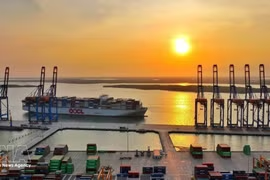
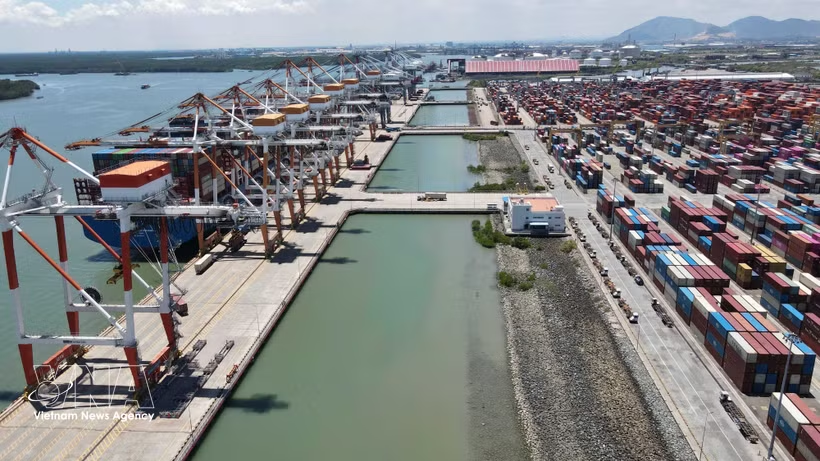
A view of CMIT port in Ho Chi Minh City (Photo: VNA)

Ho Chi Minh City (VNA) – Ho Chi Minh City aims to increase the proportion of imports and exports handled directly through its seaports, airports, railway terminals and inland container depots (ICDs) to more than 80% during the 2026–2030 period.

With measures revolving around investment in integrated logistics infrastructure, multimodal transport expansion and digital transformation acceleration, the strategy is intended to reduce logistics costs, enhance competitiveness and support sustainable growth in external trade.

Under its newly issued action plan for implementing the national import-export strategy for 2026–2030, Ho Chi Minh City targets average annual export growth of 10–11% and import growth of 9–10% over the period. The plan also aims to keep the trade deficit under control while moving towards a sustainable trade surplus to better serve key manufacturing industries and export-oriented production.

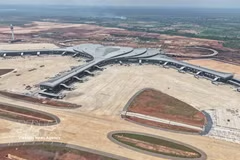
In terms of logistics infrastructure and services, the southern economic hub expects more than 80% of import-export cargo to be handled directly through its seaports, airports, railway terminals and ICDs once its major regional connectivity projects, including the Cai Mep–Thi Vai port complex, Long Thanh International Airport, and key ring roads and expressways, become operational as scheduled.

By 2030, the metropolis aims for annual revenue growth of 13–16% in the logistics services sector, while increasing the sector's contribution to the city's Gross Regional Domestic Product (GRDP) to 8–10%. It also plans to reduce logistics costs to 11–14% of GRDP, establish the Vietnam International Financial Centre, develop next-generation free trade zones linked with modern smart logistics hubs, international transshipment port clusters and dedicated air cargo facilities.

To achieve these goals, the municipal People's Committee has instructed departments and agencies to integrate priority projects supporting import-export activities, logistics, warehousing infrastructure, logistics centres, testing and laboratory facilities, information systems and digital transformation into the city's socio-economic development plans, as well as its medium-term and annual public investment programmes.

The city will also encourage major domestic and multinational corporations to invest in manufacturing and export projects, with priority given to those employing advanced technologies, producing highly competitive products and capable of integrating into global value chains.

In addition, Ho Chi Minh City plans to upgrade, reorganise and redefine the functions of its satellite port system, ports along the Saigon River and inland container depots to create an integrated regional logistics network. It will also promote logistics models tailored to cross-border e-commerce.

At the same time, the city will study the development of a network of logistics centres, inland container depots, freight terminals and key cargo transshipment hubs, while expanding multimodal transport, container transport and inland waterway shipping linked with the Southeast Region and the Mekong Delta to reduce transport costs and delivery times for businesses.

It also plans to step up the application of information technology and digital transformation in traffic management, vehicle operations, port administration and parking management. Smart transport solutions will be introduced, with priority freight corridors established at major gateways and transport hubs to ensure the smooth, safe and efficient movement of goods./.

VNA
See more

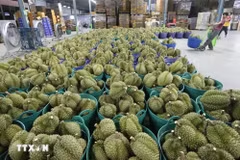
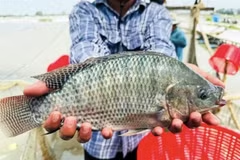
Vietnam's durian exports are expected to exceed 2 billion USD by the end of July. (Photo: VNA)

Durian exports recover despite mounting price pressure

If the Central Highlands harvest proceeds smoothly and pending issues related to growing-area and packing-house codes are resolved promptly, exports could generate an additional 2 billion USD in the remaining months of the year, pushing the whole-year figure beyond 4 billion USD, up from 3.8 billion USD last year.

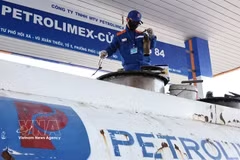
At a Petrolimex station. Petrolimex said it was increasing fuel procurement, adjusting distribution and moving supplies between regions to ensure fuel supply across its system. (Photo: VNA)

Ministry orders fuel supply inspections amid localised shortages

The ministry has taken steps to immediately inspect locations reporting shortages and identify the cause. Localities where shortages are taking place must examine the entire supply chain, including contracts between retailers and wholesalers, actual supply volumes, delivery schedules and the reasons for any failure to provide fuel.

Garment production for export to the US market at TAL Vinh Phuc Garment Company. (Photo: VNA)

New US tariff policy should be based on objective, comprehensive assessment

This progress has been built on mutual respect, transparency and Vietnam's sustained efforts to improve its legal framework and comply with international standards. However, the US' recent tariff decision appears to overlook realities regarding Vietnam's labour environment and manufacturing practices.

The construction site of Long Thanh International Airport in July 2026. (Photo: VNA)

Long Thanh Airport's second runway to be completed in September

According to the Airports Corporation of Vietnam (ACV), after 14 months of construction, the cement concrete pavement for the runway and taxiways has been substantially completed. Contractors are mobilising hundreds of workers and construction equipment to finish the remaining works on schedule.

Illustrative image (Photo: VNA)

Vietnam introduces special policies to strengthen anti-money laundering framework

Issued on July 24, Resolution No. 66.23/2026/NQ-CP amends and supplements a number of provisions in the 2022 Law on Anti-Money Laundering and related guiding documents. The revisions focus on key areas, including the definition of beneficial ownership, verification of customer information, transparency of legal arrangements, risk-based customer classification and the frequency of updating customer information.

International buyers explore products at the Vietnam International Sourcing Expo 2025. (Photo: VNA)

Nordic businesses look to Vietnam for deeper trade, supply-chain cooperation

VIS 2025 enabled Nordic businesses to directly explore Vietnamese suppliers while facilitating deeper engagements with management agencies, localities, industry associations, seaports, factories and logistics partners. The programme showed that Vietnam-Nordic cooperation is expanding beyond trade to supply-chain development, investment, logistics and digital transformation.

Phu Quoc airport’s 3,300m runway lights up ahead of landmark flight inspections

Phu Quoc airport’s 3,300m runway lights up ahead of landmark flight inspections

Viewed from above, Runway No. 2 has taken clear shape within the overall layout of Phu Quoc International Airport. Measuring 3,300 metres long and 45 metres wide, the new runway has been built parallel to the existing one. Its pavement and markings have been completed, and the project is now undergoing final technical inspections. At night, the lighting system has been switched on at full intensity for testing.

Villas left unoccupied for years. (Photo: diendandoanhnghiep.vn)

Taxes proposed on vacant land, speculative deals

A key proposal is to introduce a mechanism to regulate windfall gains from differences in land values, while imposing high taxes on vacant land and property transactions conducted within a short period.

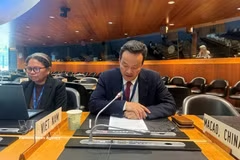
Ambassador Mai Phan Dung, Permanent Representative of Vietnam to the United Nations, the World Trade Organisation (WTO) and other international organisations in Geneva, speaks at the eight WTO Trade Policy Review of India. (Photo: VNA)

Vietnam attends India’s 8th WTO Trade Policy Review

India is one of Vietnam’s leading economic partners in South Asia and its eighth-largest trading partner of the Southeast Asian nation. Bilateral trade accounts for about 80% of Vietnam’s total trade with other South Asian countries. Meanwhile, Vietnam is currently India’s 22nd-largest trading partner globally and the fourth-largest in ASEAN.

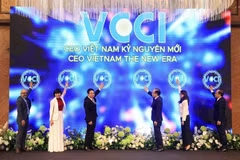
Minister of Foreign Affairs Le Hoai Trung (third, right), VCCI Chairman Ho Sy Hung (third, left), and representatives of government agencies and educational institutions attend the launch ceremony of the programme. (Photo courtesy of VCCI)

Vietnam launches programme to develop globally competitive CEOs

The Vietnam Chamber of Commerce and Industry (VCCI) on July 25 launched a Vietnam business leadership development programme 2026-2030 (CEO Vietnam The New Era), to build a new generation of internationally competitive chief executive officers (CEOs) in Vietnam.

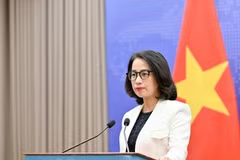
Spokeswoman of the Ministry of Foreign Affairs Pham Thu Hang (Photo: MoFA)

Vietnam strictly prohibits all forms of forced labour: Foreign Ministry

Vietnam will continue working with the US in a constructive and cooperative spirit, while urging the US side to fully take into account the measures Vietnam has adopted when adjusting tariffs on Vietnamese goods, consistent with the actual situation and Vietnam's ongoing legislative and enforcement push.