Jakarta (VNA) – Over more than three decades of ASEAN membership, Vietnam has not only affirmed its role as an active and responsible member but also made increasingly substantive contributions to the building of the ASEAN Community, an Indonesian expert has said.
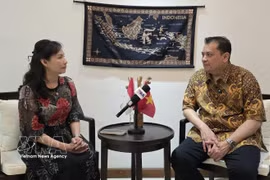
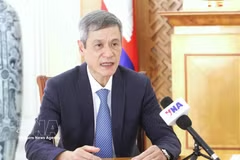
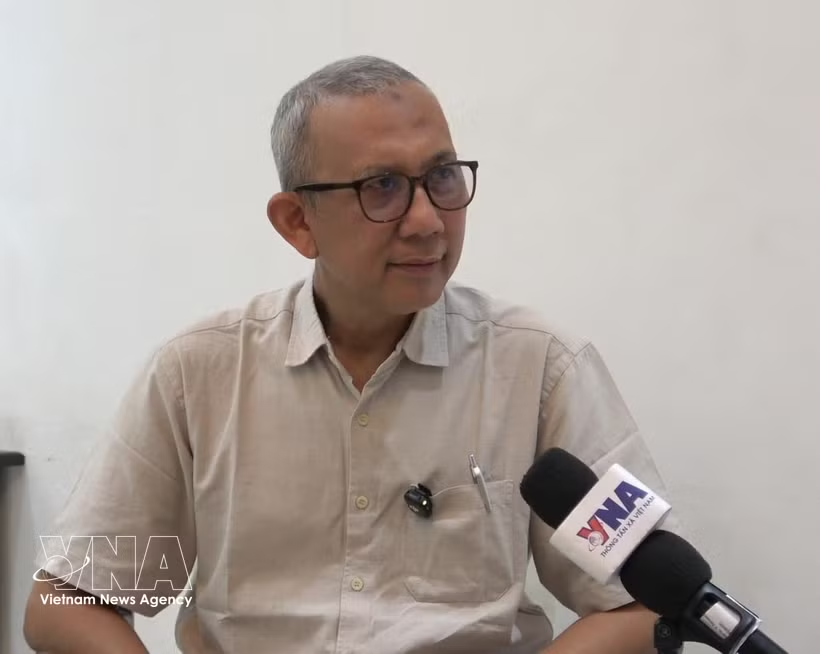
In an interview granted to the Vietnam News Agency, Beni Sukadis, Senior Coordinator at the Indonesian Institute for Defence and Strategic Studies (LESPERSSI), said that Vietnam's most important imprint is its unwavering commitment to promoting internal solidarity and protecting ASEAN's central role in an evolving regional architecture.
Vietnam has consistently championed ASEAN's core principles, including respect for sovereignty, consensus, the peaceful settlement of disputes, and adherence to international law.
He highlighted Vietnam's active role in promoting the settlement of East Sea issues in accordance with international law, helping maintain regional peace and stability while enhancing ASEAN's credibility.
Beni also praised Vietnam's contributions to advancing regional economic integration and expanding ASEAN's relations with external partners. He noted that the country's successful chairmanship of ASEAN in 2020, amid the outbreak of the COVID-19 pandemic, ensured the continuity of regional cooperation mechanisms and demonstrated both ASEAN's adaptability and Vietnam's effective coordinating capacity in the face of unprecedented challenges.
According to the Indonesian expert, these contributions have not only elevated Vietnam's international standing but also reinforced ASEAN's role as a regional organisation capable of maintaining stability, promoting cooperation, and preserving its centrality.
Looking ahead to the implementation of the ASEAN Community Vision 2045, Beni said the country is set to play an increasingly important role in strengthening regional solidarity and enhancing the bloc's centrality. As a proactive and responsible member, it has demonstrated its ability to build consensus, foster cooperation, and maintain balance amid an increasingly complex geopolitical environment in the region.
He said ASEAN is likely to expand cooperation in emerging areas such as digital transformation, the green economy, climate change response, cybersecurity, maritime security, and non-traditional security challenges. These, he noted, are fields in which Vietnam has considerable potential to contribute to and could even assume a leading role in some areas.
Vietnam's achievements in developing a green economy and promoting the electric vehicle industry, he added, offer valuable experience that can be shared with other ASEAN members to support the region's green transition.
More importantly, Vietnam's continued commitment to ASEAN's centrality, multilateralism, and international law will help strengthen regional solidarity, improve the effectiveness of ASEAN cooperation, and enhance the bloc's standing amid ongoing regional and global uncertainties.
Regarding Vietnam–Indonesia cooperation within the ASEAN framework, Beni said bilateral ties have become increasingly substantive and complementary. The two countries share common interests in maintaining regional peace and stability, reinforcing ASEAN's centrality, and promoting cooperation based on international law.
He said there remains ample room for expanding bilateral and ASEAN-based partnerships, particularly in trade, investment, agriculture, food security, the digital economy, energy transition, green industry, sustainable fisheries, climate change response, cybersecurity, as well as maritime affairs, including maritime security, to ensure peace and safety along regional sea lanes.
The expert expressed confidence that closer coordination in these areas will not only deepen Vietnam–Indonesia relations but also considerably help boost ASEAN's competitiveness, strengthen intra-bloc solidarity, and reinforce the grouping's central role, thereby contributing to peace, stability, and sustainable development in Southeast Asia./.