Vietnam at forefront of driving ASEAN Community Vision 2045: Ambassador

Ambassador Ton Thi Ngoc Huong said Vietnamese ministries and agencies are coming up with plans under their respective mandates to realise the vision while shaping ASEAN-wide monitoring and evaluation mechanisms to fortify cross-sector and cross-pillar coordination.

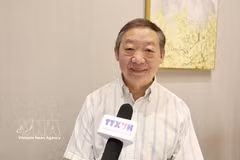
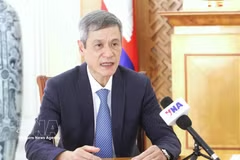
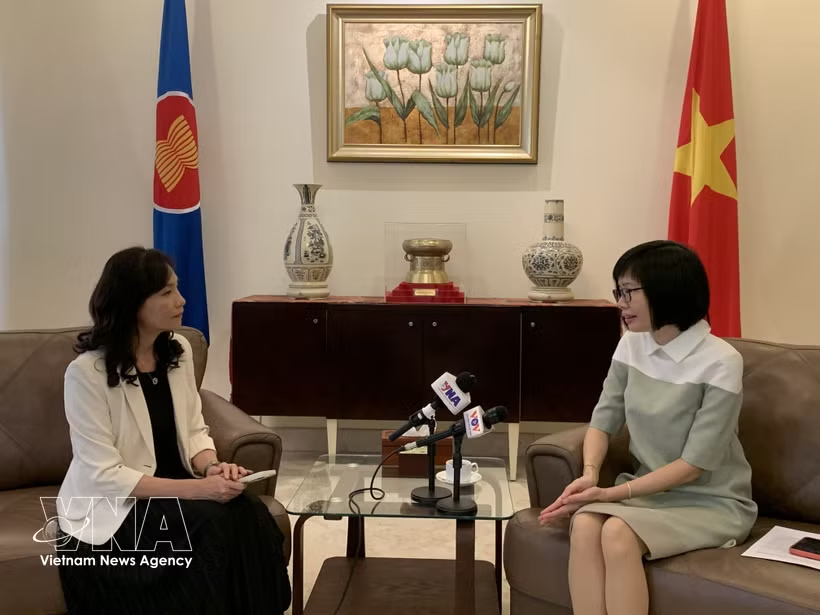
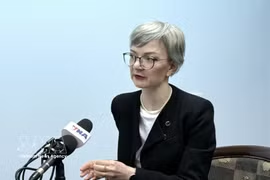
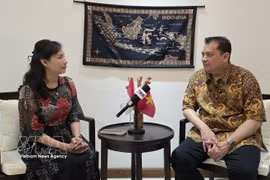
Ambassador Ton Thi Ngoc Huong (right), Permanent Representative of Vietnam to ASEAN, grants an interview to the Vietnam News Agency. (Photo: VNA)

Jakarta (VNA) – With a serious commitment, contributions and a high sense of responsibility in fulfilling its obligations, Vietnam is working closely with other member states to turn the ASEAN Community Vision 2045’s strategic plans into concrete cooperation, Ambassador Ton Thi Ngoc Huong, Permanent Representative of Vietnam to ASEAN, told the Vietnam News Agency.

This roadmap carries both new opportunities and challenges, she said in an interview with Vietnam News Agency correspondents in Jakarta on the occasion of Vietnam's 31st anniversary of joining ASEAN (July 28) and the bloc's first year of implementing the ASEAN Community Vision 2045.

Ambassador Huong said Vietnamese ministries and agencies are coming up with plans under their respective mandates to realise the vision while shaping ASEAN-wide monitoring and evaluation mechanisms to fortify cross-sector and cross-pillar coordination.

At the same time, Vietnam has introduced initiatives to strengthen ASEAN unity, bridge development gaps, accelerate digital transformation and green transition, tackle climate change, ensure food and energy security, and enhance regional capacity to address emerging threats.

Domestically, Vietnam has embedded the realisation of the ASEAN Community Vision 2045 directly into its socio-economic development planning across sectors to create synergies and deliver measurable outcomes. Vietnam is among the first ASEAN members to formulate and launch a National Plan of Action for 2026-2030 aligned with the vision and its strategic plans.

As coordinator of the ASEAN-New Zealand and ASEAN-UK ties for the 2024-2027 period, Vietnam has also pooled support from these partners for the vision.

Vietnam must fully harness the ASEAN Economic Community and the bloc’s network of free trade agreements with external partners, she said.

With a 700-million-strong ASEAN market, the Regional Comprehensive Economic Partnership (RCEP) covering roughly 2.3 billion consumers, and ASEAN+1 free trade agreements, Vietnamese enterprises have a powerful opening to break into new markets, integrate into global supply chains, and expand production capacity.

ASEAN also acts as a critical channel to pool development resources, especially in high technology, infrastructure and pillar industries. Annual foreign direct investment inflows into ASEAN stayed robust at 244 billion USD in 2025, with a growing share flowing to hi-tech manufacturing.

Vietnam can leverage investment facilitation mechanisms under the ASEAN Comprehensive Investment Agreement (ACIA) and the bloc’s broad FTA network to move up regional value chains, moving from an assembly-driven manufacturing base to a key production hub with higher technological added value in global supply chains.

Major regional infrastructure initiatives spearheaded by ASEAN, including the ASEAN Power Grid, will gradually integrate regional electricity systems, facilitate cross-border electricity trade, bolster energy security and improve energy supply complementarity among ASEAN member states, including Vietnam.

The ASEAN Connectivity Strategic Plan 2045, spanning transport and digital infrastructure, will support sustainable infrastructure development, digital connectivity and deeper integration of trade and investment across the region.

Notably, the ASEAN Digital Economy Framework Agreement (DEFA), expected to be signed later this year, will become the world’s first comprehensive regional digital economy pact. It will establish a unified ASEAN digital market, promote e-commerce, secure cross-border data flows and digital payments, and expand opportunities for businesses, especially micro, small and medium-sized enterprises, to embed themselves more deeply in the regional digital economy.

Beyond these frameworks, ASEAN cooperation in areas such as artificial intelligence (AI), semiconductors, quantum technologies, green transition, renewable energy, circular economy, and responses to climate change, natural disasters and pandemics will allow Vietnam to better tap international resources, technology and expertise in support of sustainable development.

In her view, ASEAN’s centrality and continued relevance can only be sustained if the bloc keeps a common voice, collective responsiveness and the effectiveness of ASEAN-led mechanisms.

The foremost challenge is maintaining unity and consensus while balancing the diverse interests of member states as strategic competition among major powers intensifies. To overcome this, ASEAN member states must continue upholding dialogue, consultation and trust-building grounded in mutual respect for legitimate interests and the alignment of regional and national interests.

Above all, ASEAN must preserve its independence and strategic autonomy, ensuring that major-power rivalry does not fracture the bloc’s unity or common voice.

ASEAN-led dialogue and cooperation platforms must also be renewed. Hence, they continue to serve as venues for engaging external partners, including major powers, in trust-building, practical cooperation and conflict resolution.

At the same time, ASEAN should keep broadening and diversifying its partnerships with countries and regions around the world to unlock new cooperation opportunities while deepening existing strategic partnerships.

Another major challenge is implementation capacity, particularly the availability of resources needed to deliver on ASEAN commitments and respond effectively to emerging threats.

The bloc’s new goals demand substantial resources, while member states differ sharply in their development levels and ability to contribute.

ASEAN should, on one hand, ensure resource self-reliance, especially in priority areas, and reduce excessive dependence on external assistance. On the other hand, it should adopt an open, flexible and pragmatic approach to pooling diverse funding sources to meet its growing cooperation needs.

ASEAN must also keep improving its institutional effectiveness by refining operational mechanisms, launching joint activities and ensuring more efficient use of available resources.

Working alongside ASEAN to identify and address these challenges, Vietnam will continue to develop both short- and long-term solutions that consolidate the values of the ASEAN Community, she concluded./.
VNA

See more

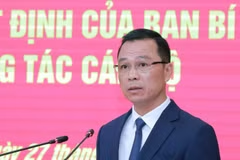
Deputy Secretary of the Party Committee and Chairman of the People’s Committee of Thanh Hoa province To Anh Dung speaks at the conference on July 27. (Photo published by VNA)

Thanh Hoa provincial People’s Committee has new Chairman

Dung pledged to continue improving his political mettle, ethics and leadership capacity, while working with the provincial leadership to strengthen solidarity, promote collective intelligence and reform leadership mindset and governance methods, proactively seize opportunities and overcome difficulties and challenges to realise the set targets.

Professor Zhu Chenming, Honourary Director of the Institute of South and Southeast Asian Studies under the Yunnan Academy of Social Sciences (Photo: VNA)

Four strategic priorities signal Vietnam’s next phase of development: Chinese scholar

According to Professor Zhu Chenming, Honourary Director of the Institute of South and Southeast Asian Studies under the Yunnan Academy of Social Sciences, the Vietnamese Party and State leader’s decision to outline new strategic directions immediately after the restructuring process reflects a clear understanding of Vietnam’s evolving development needs. Simply completing institutional reorganisation could create the misconception that the reform mission has been accomplished, while significant governance and development challenges remain.

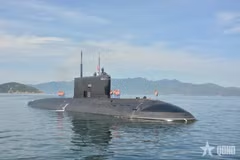
A Russian Navy submarine arrives at Cam Ranh Port. (Photo: qdnd.vn)

Russian naval flotilla begins visit to Vietnam

The visit is part of ongoing efforts to implement bilateral defence cooperation agreements between Vietnam and Russia, while advancing outcomes of the official visit to Russia by General Phan Van Giang, Deputy Prime Minister and Minister of National Defence, in May. It is expected to further strengthen the two countries' longstanding friendship and deepen defence collaboration, particularly between their navies.

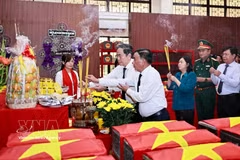
Vice State President Vo Thi Anh Xuan offers incense at the graves of fallen soldiers at the Vietnam–Laos Martyrs' Cemetery. (Photo: VNA)

National candle-lighting ceremony honours fallen heroes

Speaking at the event, First Secretary of the Ho Chi Minh Communist Youth Union Central Committee Bui Quang Huy described Vietnam's history as a testament to patriotism, the pursuit of independence and the aspiration for peace. He paid tribute to the millions of Vietnamese who devoted their youth and sacrificed their lives for the nation's freedom.

Party General Secretary and State President To Lam; Politburo member and Prime Minister Le Minh Hung; and delegates attend the programme at the Bac Son Monument in Hanoi. (Photo: VNA)

Key Party, State leaders attend live television programme honouring fallen heroes

Jointly organised by Vietnam Television (VTV) and the People's Committees of Hanoi, Ho Chi Minh City, Tuyen Quang and Quang Tri provinces, the programme paid tribute to heroic martyrs who sacrificed their lives for the nation while honouring the forces engaged in the search, recovery and identification of fallen soldiers' remains.

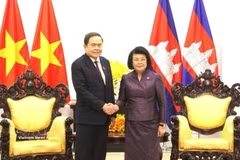
National Assembly Chairman Tran Thanh Man, Permanent member of the Party Central Committee's Secretariat Tran Cam Tu and delegates offer incense in tribute to fallen soldiers at the Martyrs' Remains House. (Photo: VNA)

NA Chairman pays tribute to fallen heroes in Ho Chi Minh City

Chairman of the National Assembly (NA) Tran Thanh Man on July 26 offered flowers and incense in tribute to fallen heroes at memorial sites in Ho Chi Minh City, on the occasion of the 79th anniversary of War Invalids and Martyrs' Day (July 27, 1947–2026).

The Moncada Barracks revolutionary historical site in Cuba (Source: granma.cu)

Vietnamese leaders congratulate Cuba on 73rd anniversary of Moncada Barracks attack

General Secretary of the Communist Party of Vietnam (CPV) Central Committee and State President To Lam on July 26 sent a congratulatory message to Miguel Díaz-Canel Bermúdez, First Secretary of the Communist Party of Cuba and President of Cuba on the occasion of the 73rd anniversary of the attack on the Moncada Barracks (July 26, 1953 – 2026).

Chairman of the Hue City People’s Committee Le Tri Thanh speaks at the session. (Photo: VNA)

Hue City People’s Committee has new Chairman

Thanh pledged to make every effort and work with dedication, together with the municipal People’s Committee, to lead and implement all areas of work, particularly implementing resolutions of the municipal Party Organisation and People’s Council, action programmes and plans, contributing to promoting the city’s development.

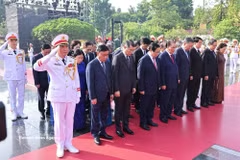
Incumbent and former leaders of the Party and the State pay tribute to fallen soldiers at the Monument to Heroic Martyrs on Bac Son street in Hanoi. (Photo: VNA)

Party and State leaders pay tribute to heroic martyrs, President Ho Chi Minh

Over the past 79 years, the Party, the State, and the people of Vietnam have always paid attention to and cared for those who have contributed to the revolution and the families of martyrs, thereby spreading the traditional values ​​and good morals of the nation, expressing the gratitude of the entire political system with all their hearts and the highest responsibility, contributing to improving the material and spiritual lives of policy beneficiaries, and creating great spiritual motivation for the cause of national construction and protection.

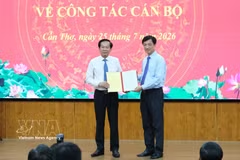
Head of the Party Central Committee's Organisation Commission Nguyen Duy Ngoc presents the Politburo's decision to Do Thanh Binh (left) (Photo: VNA)

Do Thanh Binh named Secretary of Can Tho municipal Party Committee

Under the decision, the Politburo relieved Binh, member of the Party Central Committee, of his roles as deputy head of the Party Central Committee's Organisation Commission, member of the Government Party Committee’s standing board, and relevant positions. He was appointed to the standing board of the Can Tho Party Committee.

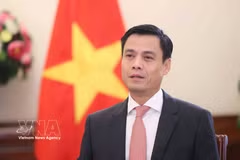
Deputy Minister of Foreign Affairs Dang Hoang Giang (Photo: VNA)

Vietnam leaves lasting imprint at AMM-59: Deputy FM

The Vietnamese delegation led by Foreign Minister Le Hoai Trung embodied the foreign policy line of the 14th National Party Congress by acting proactively, responsibly and with leadership inside ASEAN.

Illustrative photo (Source: baochinhphu.vn)

Guidelines issued for Apostille certification of Vietnamese public documents

Decree No. 293/2026/ND-CP dated July 23, 2026 stipulates the authority, procedures, and processes for issuing Apostille certifications to Vietnamese public documents; the receipt and use in Vietnam of public documents certified by Apostille member states; the verification of such certifications and state management of the implementation of the convention.