Party Central Committee’s third plenum: Unified governance identified as new source of national strength

Administrative restructuring would be hollow if administrative borders continue to shackle development mindset through fragmented, localised decision-making, the top leader warned.

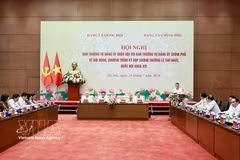
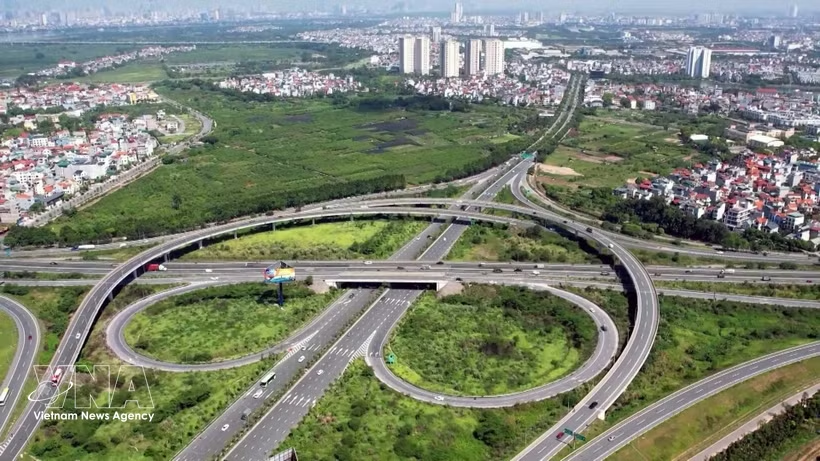
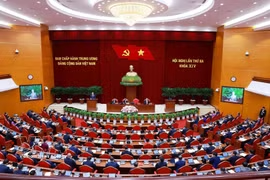
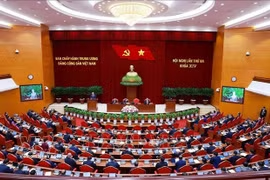
Illustrative image (Photo: VNA)

Hanoi (VNA) – Land, sea, urban areas, infrastructure, natural resources, and data must be treated as an integrated whole and managed in lockstep with a national development strategy, regional advantages, and overall efficiency, Party General Secretary and State President To Lam said in his keynote address at the recent third plenum of the 14th Party Central Committee.

Moving from fragmented management to integrated governance of national development space and resources marks the second great transformation Vietnam needs to enter a new era, he said, adding that the targets are developing-country status with modern industry and upper-middle income by 2030, followed by developed, high-income socialist economy by 2045.

Administrative restructuring would be hollow if administrative borders continue to shackle development mindset through fragmented, localised decision-making, the top leader warned.

Fragmented management of national development space means governing territory through compartmentalised logic, sliced by administrative lines or single sectors. The result is overlapping authority, regional disintegration, wasteful use of national resources, weak connectivity, and piecemeal allocation of capital and land that blocks the rise of major growth poles. It also drives up logistics costs, erodes competitiveness, and stalls strategic national infrastructure.

Vietnam’s approach to managing space and resources has evolved across development stages to match changing realities.

Starting with the 6th National Party Congress, the mindset about land and space anchored tightly to food security, with primacy placed on farm output and self-sufficiency.

From the 8th through 11th congresses, the mindset pivoted sharply toward enabling rapid expansion. Land became a capital source fueling infrastructure, luring investment, expanding urban areas, and carving out industrial parks and export processing zones.

Under the 12th and 13th congresses, planning philosophy leaned decisively toward sustainability, long-term returns, and balancing economic, social, and environmental goals. Land was reclassified as an internal-strength asset, a special national resource to be managed under the socialist-oriented market mechanism.

Spatial planning broadened beyond land allocation into organising development regions based on connectivity, comparative edges, climate resilience, and multi-sector integration. Still, governance remained largely fragmented, even as the constraints of administrative boundary logic became sharper.

he 14th National Party Congress introduced a new spatial vision that breaks free of administrative borders and the physical surface. It adopts a multi-layered architecture spanning underground space, surface territory, maritime domain, low-altitude airspace, high-altitude airspace, outer space, and digital space. Land is no longer just a tangible physical asset but carries data, multi-dimensional spatial, ecological, and innovation values.

Governance is increasingly displacing the old notion of management in describing how the state administers society - a change in terminology that signals a fundamental rethinking of how political authority is conceived and exercised. Rather than a top-down issuer of administrative commands, the state is recast as a coordinating hub that harmonises different layers of administration, sectors, and stakeholders across the entire socio-political system.

Integrated governance drives regional connectivity, leverages regional advantages, and aligns national planning with the creation of economic corridors and cross-provincial, cross-regional growth poles. That framework supports more synchronous, sustainable development while ensuring efficient use of land, natural resources, and other strategic assets.
vnanet-l.jpg
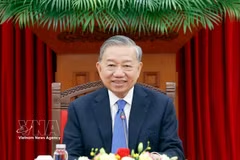
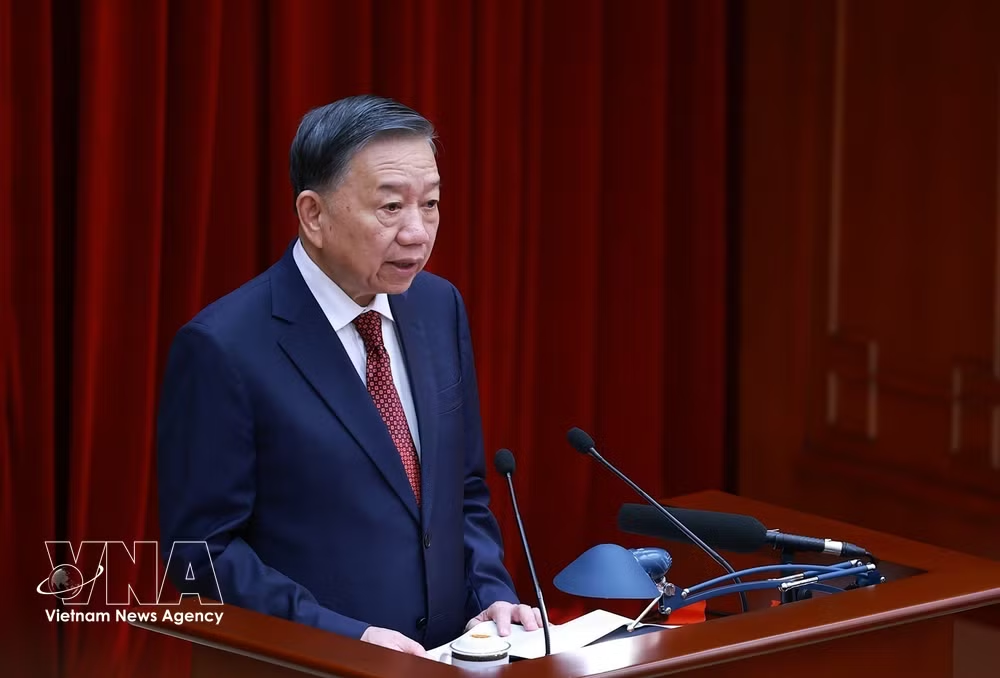
Party General Secretary and State President To Lam speaks at the closing session of the 14th Party Central Committee's third plenum. (Photo: VNA)

Integrated governance also unlocks new growth poles with the power to generate spillover effects for neighbouring localities, replacing the practice of investing solely on administrative jurisdictions.

Governing beyond administrative lines yields concrete gains, including lower logistics costs, larger and more integrated markets, and stronger global competitiveness. Citizens would benefit from more coordinated transport, urban, and industrial development. Faster expansion in key economic zones would create more jobs and higher incomes, while those in rural, remote, and disadvantaged areas would gain better access to public services and economic opportunities through improved infrastructure links.

A pressing imperative is for officials to renew their mindset so they fully grasp the new governance model. They must be able to design regional linkage policies that transcend traditional boundaries, run government bodies effectively, and coordinate shared resources across localities and sectors.

They are expected to demonstrate strategic vision and practical capability, coupled with a readiness to innovate, act, and shoulder responsibility in the national interest, placing country-level development above narrow local concerns./.
VNA

See more

Professor Zhu Chenming, Honourary Director of the Institute of South and Southeast Asian Studies under the Yunnan Academy of Social Sciences (Photo: VNA)

Four strategic priorities signal Vietnam’s next phase of development: Chinese scholar

According to Professor Zhu Chenming, Honourary Director of the Institute of South and Southeast Asian Studies under the Yunnan Academy of Social Sciences, the Vietnamese Party and State leader’s decision to outline new strategic directions immediately after the restructuring process reflects a clear understanding of Vietnam’s evolving development needs. Simply completing institutional reorganisation could create the misconception that the reform mission has been accomplished, while significant governance and development challenges remain.

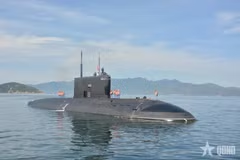
A Russian Navy submarine arrives at Cam Ranh Port. (Photo: qdnd.vn)

Russian naval flotilla begins visit to Vietnam

The visit is part of ongoing efforts to implement bilateral defence cooperation agreements between Vietnam and Russia, while advancing outcomes of the official visit to Russia by General Phan Van Giang, Deputy Prime Minister and Minister of National Defence, in May. It is expected to further strengthen the two countries' longstanding friendship and deepen defence collaboration, particularly between their navies.

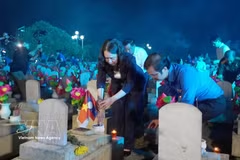
Vice State President Vo Thi Anh Xuan offers incense at the graves of fallen soldiers at the Vietnam–Laos Martyrs' Cemetery. (Photo: VNA)

National candle-lighting ceremony honours fallen heroes

Speaking at the event, First Secretary of the Ho Chi Minh Communist Youth Union Central Committee Bui Quang Huy described Vietnam's history as a testament to patriotism, the pursuit of independence and the aspiration for peace. He paid tribute to the millions of Vietnamese who devoted their youth and sacrificed their lives for the nation's freedom.

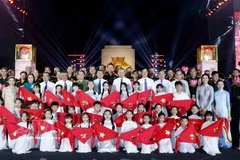
Party General Secretary and State President To Lam; Politburo member and Prime Minister Le Minh Hung; and delegates attend the programme at the Bac Son Monument in Hanoi. (Photo: VNA)

Key Party, State leaders attend live television programme honouring fallen heroes

Jointly organised by Vietnam Television (VTV) and the People's Committees of Hanoi, Ho Chi Minh City, Tuyen Quang and Quang Tri provinces, the programme paid tribute to heroic martyrs who sacrificed their lives for the nation while honouring the forces engaged in the search, recovery and identification of fallen soldiers' remains.

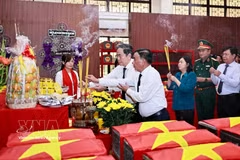
National Assembly Chairman Tran Thanh Man, Permanent member of the Party Central Committee's Secretariat Tran Cam Tu and delegates offer incense in tribute to fallen soldiers at the Martyrs' Remains House. (Photo: VNA)

NA Chairman pays tribute to fallen heroes in Ho Chi Minh City

Chairman of the National Assembly (NA) Tran Thanh Man on July 26 offered flowers and incense in tribute to fallen heroes at memorial sites in Ho Chi Minh City, on the occasion of the 79th anniversary of War Invalids and Martyrs' Day (July 27, 1947–2026).

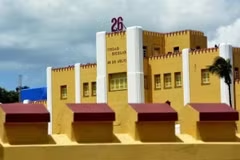
The Moncada Barracks revolutionary historical site in Cuba (Source: granma.cu)

Vietnamese leaders congratulate Cuba on 73rd anniversary of Moncada Barracks attack

General Secretary of the Communist Party of Vietnam (CPV) Central Committee and State President To Lam on July 26 sent a congratulatory message to Miguel Díaz-Canel Bermúdez, First Secretary of the Communist Party of Cuba and President of Cuba on the occasion of the 73rd anniversary of the attack on the Moncada Barracks (July 26, 1953 – 2026).

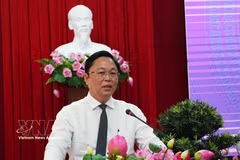
Chairman of the Hue City People’s Committee Le Tri Thanh speaks at the session. (Photo: VNA)

Hue City People’s Committee has new Chairman

Thanh pledged to make every effort and work with dedication, together with the municipal People’s Committee, to lead and implement all areas of work, particularly implementing resolutions of the municipal Party Organisation and People’s Council, action programmes and plans, contributing to promoting the city’s development.

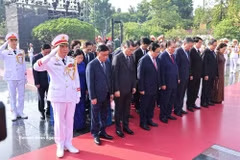
Incumbent and former leaders of the Party and the State pay tribute to fallen soldiers at the Monument to Heroic Martyrs on Bac Son street in Hanoi. (Photo: VNA)

Party and State leaders pay tribute to heroic martyrs, President Ho Chi Minh

Over the past 79 years, the Party, the State, and the people of Vietnam have always paid attention to and cared for those who have contributed to the revolution and the families of martyrs, thereby spreading the traditional values ​​and good morals of the nation, expressing the gratitude of the entire political system with all their hearts and the highest responsibility, contributing to improving the material and spiritual lives of policy beneficiaries, and creating great spiritual motivation for the cause of national construction and protection.

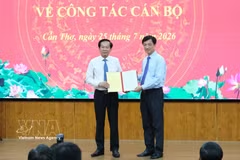
Head of the Party Central Committee's Organisation Commission Nguyen Duy Ngoc presents the Politburo's decision to Do Thanh Binh (left) (Photo: VNA)

Do Thanh Binh named Secretary of Can Tho municipal Party Committee

Under the decision, the Politburo relieved Binh, member of the Party Central Committee, of his roles as deputy head of the Party Central Committee's Organisation Commission, member of the Government Party Committee’s standing board, and relevant positions. He was appointed to the standing board of the Can Tho Party Committee.

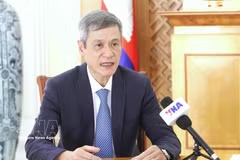
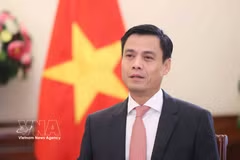
Deputy Minister of Foreign Affairs Dang Hoang Giang (Photo: VNA)

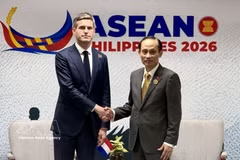
Vietnam leaves lasting imprint at AMM-59: Deputy FM

The Vietnamese delegation led by Foreign Minister Le Hoai Trung embodied the foreign policy line of the 14th National Party Congress by acting proactively, responsibly and with leadership inside ASEAN.

Illustrative photo (Source: baochinhphu.vn)

Guidelines issued for Apostille certification of Vietnamese public documents

Decree No. 293/2026/ND-CP dated July 23, 2026 stipulates the authority, procedures, and processes for issuing Apostille certifications to Vietnamese public documents; the receipt and use in Vietnam of public documents certified by Apostille member states; the verification of such certifications and state management of the implementation of the convention.