📝 OP-ED: Transition to new development stage: Action is decisive factor

The fourth strategic shift outlined at the third meeting of the 14th Party Central Committee is therefore about building national resilience. The objective is not to eliminate every possible risk, but to strengthen the country's ability to adapt and recover when disruptions occur.

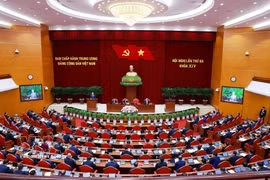
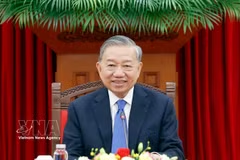
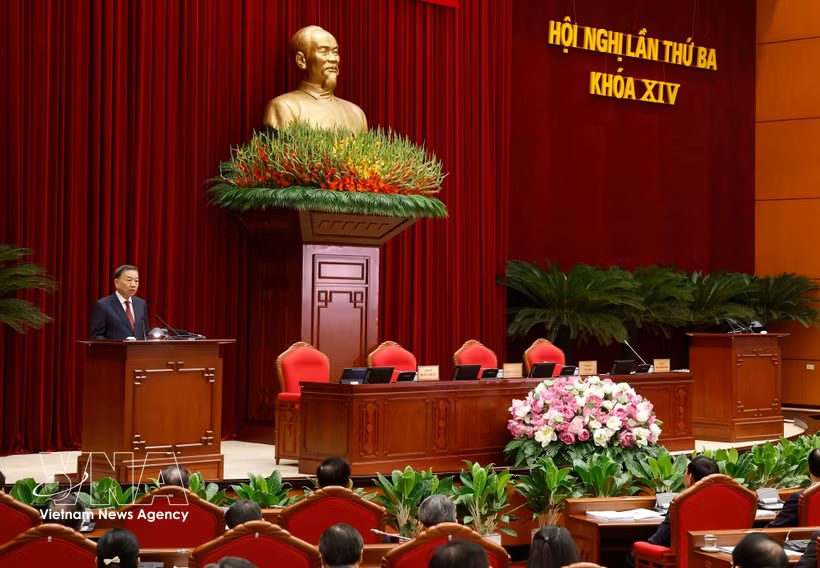
Party General Secretary and State President To Lam speaks at the closing ceremony of the third meeting of the 14th Party Central Committee. (Photo: VNA)

Hanoi (VNA) – No country has achieved lasting development without facing difficulties and challenges. The real question is whether it can identify risks early enough to prepare for them. Against that backdrop, the third meeting of the 14th Party Central Committee set out a fourth strategic shift: moving from responding to individual risks to proactively preventing them, strengthening national resilience, and safeguarding the country. This is not only a matter of national defence and security, but also a development mindset suited to an increasingly uncertain world.

As a Vietnamese saying goes, "Don't wait for the storm before repairing the roof". It is more than advice on preparing for natural disasters; it is also a lesson in national governance. In practice, there have been times when problems were addressed only after they emerged, bottlenecks were tackled only after they had slowed progress, and solutions were sought only after risks had materialised. While such an approach may resolve immediate challenges, it often comes at a far greater cost than preventing problems before they arise.

Recent global events have made this lesson even clearer. The COVID-19 pandemic disrupted economies and societies worldwide and claimed millions of lives. Geopolitical conflicts, strategic competition among major powers, supply chain disruptions, extreme weather events, and cyberattacks have continued to test the resilience of countries across the globe. According to the United Nations, the global economy contracted by 4.3% in 2020, one of the steepest declines in decades. Natural disasters alone caused more than 500 billion USD in losses worldwide during 2024 and 2025. In Vietnam, Typhoon Yagi and other extreme weather events in 2024 inflicted damage exceeding 88.7 trillion VND (3.37 billion USD).

These figures underline an important reality: rapid growth alone is not enough. A country must also be able to withstand unexpected shocks.

With that in mind, the 14th National Party Congress not only set a target of double-digit economic growth but also of maintaining political stability, safeguarding national defence, security and foreign affairs, and building an independent and self-reliant economy while pursuing deep international integration.
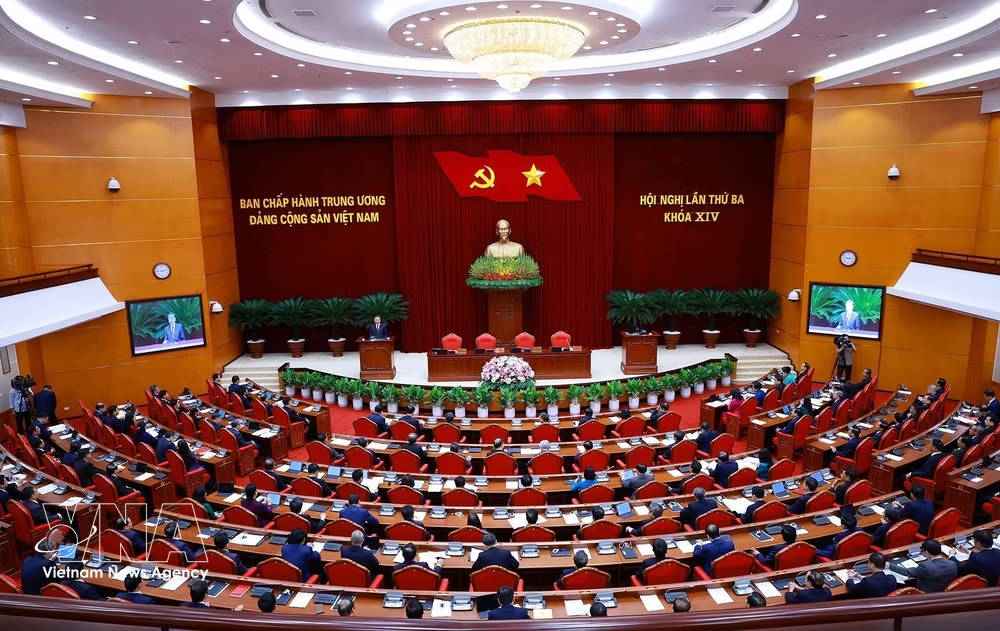
vnanet-potal-be-mac-hoi-nghi-ban-chap-hanh-trung-uong-dang-lan-thu-3-khoa-xiv-8909903.jpg
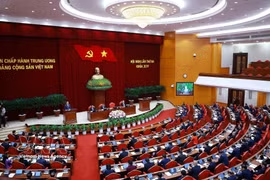
At the closing ceremony of the third meeting of the 14th Party Central Committee. (Photo: VNA)

Protecting the country today therefore means more than defending independence and sovereignty. It also means safeguarding economic security, energy security, food security, water security, data security, cybersecurity, and a peaceful environment needed for development. Protecting these foundations is, in essence, protecting the country's long-term growth prospects.

The fourth strategic shift outlined at the third meeting of the 14th Party Central Committee is therefore about building national resilience. The objective is not to eliminate every possible risk, but to strengthen the country's ability to adapt and recover when disruptions occur. This requires a corresponding shift in governance - from reacting to problems to anticipating and preventing them. It also means ensuring the security, safety and uninterrupted operation of the political system, the economy, society, technology, and critical infrastructure. Security provides the foundation for development, while sustainable development, in turn, reinforces security. Risks must therefore be detected early, warnings issued promptly, and problems addressed before they escalate. Small issues should never be allowed to grow into major crises.

This approach is already being translated into practice. More than a year after Vietnam introduced its two-tier local administration model, many shortcomings have been identified and adjusted during implementation rather than being allowed to accumulate into larger obstacles.

In the coming days, the Politburo will convene a national conference to study, disseminate and implement the resolution adopted at the third meeting of the 14th Party Central Committee. Senior Party and State leaders will personally present its core contents, demonstrating that the resolution is intended not merely as a policy document but as a programme of immediate action.

Experiences over many years has shown that the greatest gap often lies between resolutions and their implementation. Party General Secretary and State President To Lam has acknowledged this directly, saying: "The biggest bottleneck remains implementation." People expect reforms that they can see and feel in their daily lives. Businesses are looking for a more transparent investment environment, lower costs, and simpler administrative procedures.

At this stage, what matters most is action. Words must be matched by deeds, and results must be measurable. That is also the principle set out by the third meeting: clearly defined responsibilities, tasks, authority, timelines and expected outcomes. Only when a policy is translated into concrete actions and tangible results will the resolution truly come to life.

As Party General Secretary and State President To Lam emphasised: "The value and vitality of policy decisions must be measured by practical outcomes: bottlenecks removed, new capacities created, institutions operating smoothly, resources unlocked, productivity and competitiveness improved, the country made safer, and people enjoying more tangible benefits. From that understanding, unity in policy must immediately become unity in action, turning the Party Central Committee's decisions into concrete results."

Only four years remain until 2030, while the vision for 2045 is drawing closer. Every sound policy implemented in a timely manner will generate new momentum for development. Every delay in execution, however, risks missing valuable opportunities.

The four strategic shifts will have meaning only if they are transformed into action. That is the strongest message emerging from the third meeting: creating the conditions needed to turn national aspirations into tangible achievements./.
VNA

See more

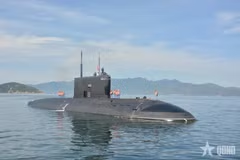
A Russian Navy submarine arrives at Cam Ranh Port. (Photo: qdnd.vn)

Russian naval flotilla begins visit to Vietnam

The visit is part of ongoing efforts to implement bilateral defence cooperation agreements between Vietnam and Russia, while advancing outcomes of the official visit to Russia by General Phan Van Giang, Deputy Prime Minister and Minister of National Defence, in May. It is expected to further strengthen the two countries' longstanding friendship and deepen defence collaboration, particularly between their navies.

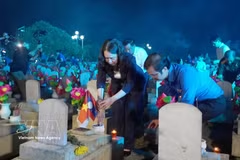
Vice State President Vo Thi Anh Xuan offers incense at the graves of fallen soldiers at the Vietnam–Laos Martyrs' Cemetery. (Photo: VNA)

National candle-lighting ceremony honours fallen heroes

Speaking at the event, First Secretary of the Ho Chi Minh Communist Youth Union Central Committee Bui Quang Huy described Vietnam's history as a testament to patriotism, the pursuit of independence and the aspiration for peace. He paid tribute to the millions of Vietnamese who devoted their youth and sacrificed their lives for the nation's freedom.

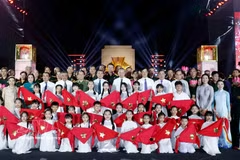
Party General Secretary and State President To Lam; Politburo member and Prime Minister Le Minh Hung; and delegates attend the programme at the Bac Son Monument in Hanoi. (Photo: VNA)

Key Party, State leaders attend live television programme honouring fallen heroes

Jointly organised by Vietnam Television (VTV) and the People's Committees of Hanoi, Ho Chi Minh City, Tuyen Quang and Quang Tri provinces, the programme paid tribute to heroic martyrs who sacrificed their lives for the nation while honouring the forces engaged in the search, recovery and identification of fallen soldiers' remains.

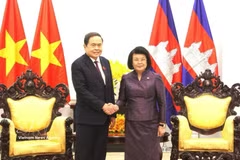
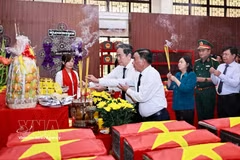
National Assembly Chairman Tran Thanh Man, Permanent member of the Party Central Committee's Secretariat Tran Cam Tu and delegates offer incense in tribute to fallen soldiers at the Martyrs' Remains House. (Photo: VNA)

NA Chairman pays tribute to fallen heroes in Ho Chi Minh City

Chairman of the National Assembly (NA) Tran Thanh Man on July 26 offered flowers and incense in tribute to fallen heroes at memorial sites in Ho Chi Minh City, on the occasion of the 79th anniversary of War Invalids and Martyrs' Day (July 27, 1947–2026).

The Moncada Barracks revolutionary historical site in Cuba (Source: granma.cu)

Vietnamese leaders congratulate Cuba on 73rd anniversary of Moncada Barracks attack

General Secretary of the Communist Party of Vietnam (CPV) Central Committee and State President To Lam on July 26 sent a congratulatory message to Miguel Díaz-Canel Bermúdez, First Secretary of the Communist Party of Cuba and President of Cuba on the occasion of the 73rd anniversary of the attack on the Moncada Barracks (July 26, 1953 – 2026).

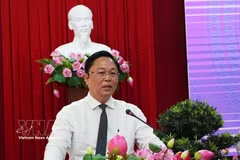
Chairman of the Hue City People’s Committee Le Tri Thanh speaks at the session. (Photo: VNA)

Hue City People’s Committee has new Chairman

Thanh pledged to make every effort and work with dedication, together with the municipal People’s Committee, to lead and implement all areas of work, particularly implementing resolutions of the municipal Party Organisation and People’s Council, action programmes and plans, contributing to promoting the city’s development.

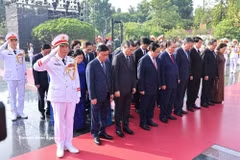
Incumbent and former leaders of the Party and the State pay tribute to fallen soldiers at the Monument to Heroic Martyrs on Bac Son street in Hanoi. (Photo: VNA)

Party and State leaders pay tribute to heroic martyrs, President Ho Chi Minh

Over the past 79 years, the Party, the State, and the people of Vietnam have always paid attention to and cared for those who have contributed to the revolution and the families of martyrs, thereby spreading the traditional values ​​and good morals of the nation, expressing the gratitude of the entire political system with all their hearts and the highest responsibility, contributing to improving the material and spiritual lives of policy beneficiaries, and creating great spiritual motivation for the cause of national construction and protection.

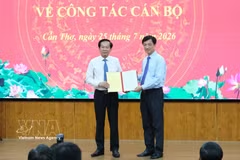
Head of the Party Central Committee's Organisation Commission Nguyen Duy Ngoc presents the Politburo's decision to Do Thanh Binh (left) (Photo: VNA)

Do Thanh Binh named Secretary of Can Tho municipal Party Committee

Under the decision, the Politburo relieved Binh, member of the Party Central Committee, of his roles as deputy head of the Party Central Committee's Organisation Commission, member of the Government Party Committee’s standing board, and relevant positions. He was appointed to the standing board of the Can Tho Party Committee.

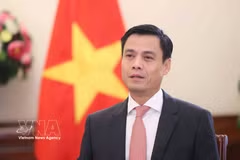
Deputy Minister of Foreign Affairs Dang Hoang Giang (Photo: VNA)

Vietnam leaves lasting imprint at AMM-59: Deputy FM

The Vietnamese delegation led by Foreign Minister Le Hoai Trung embodied the foreign policy line of the 14th National Party Congress by acting proactively, responsibly and with leadership inside ASEAN.

Illustrative photo (Source: baochinhphu.vn)

Guidelines issued for Apostille certification of Vietnamese public documents

Decree No. 293/2026/ND-CP dated July 23, 2026 stipulates the authority, procedures, and processes for issuing Apostille certifications to Vietnamese public documents; the receipt and use in Vietnam of public documents certified by Apostille member states; the verification of such certifications and state management of the implementation of the convention.

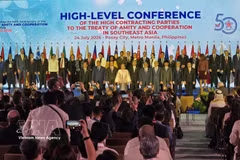
Officials pose for a group photo at the high-level conference of the TAC High Contracting Parties in Manila, the Philippines, on July 24, 2026. (Photo: VNA)

Vietnam attends celebration of TAC’s 50th anniversary in Philippines

In a discussion on enhancing maritime security and cooperation, the Vietnamese delegation underscored that the TAC's principles serve as a "foundational code of conduct" guiding relations among countries amid profound global changes, rising geopolitical tensions, mounting challenges to international law and the erosion of multilateralism.