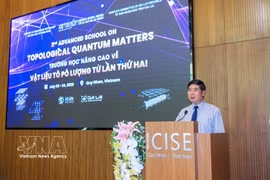
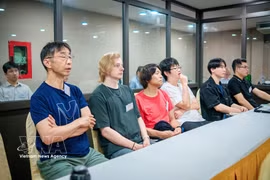
Gia Lai (VNA) – The 10th Vietnam School on Astrophysics (VSOA10) opened on July 27 at the International Centre for Interdisciplinary Science and Education (ICISE) in the central province of Gia Lai, bringing together nearly 30 young scientists, researchers and students from nine countries.
The programme, running through August 1, is jointly organised by the Rencontres du Vietnam Association, ICISE and astronomers from the Vietnam Association for Cosmology and Astronomy. Participants come from Brazil, Croatia, France, Germany, India, Malaysia, the Philippines, Thailand and Vietnam.
According to the organisers, VSOA10 reinforces Vietnam’s growing role as a destination for international academic activities in fundamental science, providing an opportunity for early-career researchers to explore the latest advances in astrophysics and cosmology while expanding collaboration with the global scientific community.
This year’s lecturers include Professor Leander Thiele, Dr Otavio Alves, Dr Anamaria Hell and Dr Nguyen Nhat Minh, all affiliated with the Kavli Institute for the Physics and Mathematics of the Universe (Kavli IPMU) in Japan.
The event also marks the first time that Dr Nguyen Nhat Minh has served as the programme’s lead organiser in his capacity as head of the Astrophysics and Cosmology Group at the Interdisciplinary Institute for Research in Science and Education (IFIRSE) under ICISE, a position he assumed in July 2026. He was previously the first Vietnamese scientist to receive the 2024 Buchalter Cosmology Prize from the American Astronomical Society, one of the field’s most prestigious awards for early-career researchers.
This year's programme focuses on modern cosmology, examining the formation and evolution of the universe from the moments immediately following the Big Bang to the emergence of the large-scale structures observed today. The course also introduces advanced techniques for inferring cosmological parameters from increasingly precise observational datasets.
Organisers noted that cosmology has entered the era of big data, driven by rapid advances in measurements of the cosmic microwave background, galaxy clustering, weak gravitational lensing and other observations of the universe’s large-scale structure. These datasets are testing the standard cosmological model with unprecedented precision.
At the same time, progress in numerical simulations, statistical inference, artificial intelligence and machine learning is opening new ways to connect theoretical models with observational evidence.
Held annually since 2013, the Vietnam School on Astrophysics was established by the Rencontres du Vietnam Association and ICISE to train, mentor and inspire young scientists pursuing astronomy and astrophysics. Over the past decade, it has developed into a respected academic forum, helping strengthen Vietnam’s scientific workforce, promote scholarly exchange and deepen collaboration between Vietnamese researchers and the international scientific community.
As astronomy becomes increasingly interdisciplinary, integrating particle physics, atomic physics, optics, plasma physics, chemistry and biology to explore the origin, structure and evolution of the universe, major questions such as the nature of dark matter, dark energy and the universe’s accelerating expansion continue to attract global scientific attention.
Advances in observational instruments and data-analysis techniques are creating new opportunities for discovery while enhancing Vietnam’s research capacity, international integration and the development of fundamental science./.
See more
Scientists announce preliminary results in decoding 1,000 Vietnamese human genomes
The work has just been published in Nature Communications – one of the world’s leading prestigious scientific journals – opening up an important foundation for genetics research, precision medicine and preventive medicine in Vietnam.
Ho Chi Minh City takes lead in preparing workforce for quantum computing era
As a leading centre for science, technology, and innovation, Ho Chi Minh City is taking proactive steps to build capacity for the quantum computing era, with a strong focus on developing talents to seize arising technological opportunities.
VAST expands global partnerships through science and people-to-people diplomacy
During a working visit to Austria from July 19-23, a VAST delegation led by Vice President Prof. Dr. Tran Tuan Anh held a series of meetings with leading research institutions and international organisations, including the International Institute for Applied Systems Analysis (IIASA), the Austrian Academy of Sciences, the Vienna University of Technology (TU Wien), and the International Atomic Energy Agency.
Int’l quantum computing hackathon kicks off in Gia Lai
As a key activity within the technology component of the Gia Lai Quantum Year 2026, the event brings together nearly 100 contestants across 26 teams, including students, PhD candidates, young researchers, startups, and tech talents, alongside 50 domestic and international experts, mentors, and judges.
Technology forum to spotlight digital transformation in hospitality, tourism
HORECFEX Vietnam 2026 will take place on August 20–21 at the Ariyana International Convention Centre in the central city of Da Nang, showcase digital solutions and innovation aimed at improving efficiency and competitiveness across Vietnam's hospitality and tourism industry.
Global Vietnamese expertise drives competitive homegrown technologies
For Assoc. Prof. Ta Duc Tung, the biggest gift overseas researchers can give isn’t simply handing over technology; it’s linking up knowledge, people and entire research ecosystems.
Data security, innovation ecosystem key to strengthening Vietnam’s competitiveness
For digital government, stronger investment is needed in shared digital infrastructure, particularly critical infrastructure, AI infrastructure and high-performance connectivity.
Digital transformation lays foundation for Hanoi’s new growth model
The capital city of Hanoi aims for the digital economy to contribute around 40% of its Gross Regional Domestic Product (GRDP) by 2030, with the Hoa Lac Hi-Tech Park serving as the core research and development hub.
Vietnam, Japan launch five joint semiconductor research projects
The signing and implementation of the five projects mark a concrete step toward realising the Party and State’s policies on science – technology development, innovation and digital transformation, with the semiconductor industry identified as one of strategic technologies fundamental to national competitiveness and technological autonomy.
Vietnam urged to develop sovereign AI in digital era
Data has become a strategic asset and a key resource for socio-economic development, as well as a foundation of national competitiveness. As a result, effective data governance, utilisation and protection have become increasingly urgent for organisations and businesses.
Talent strategy seen as key to Vietnam's next growth phase
Building a national talent ecosystem is a long-term development strategy that will underpin Vietnam's competitiveness and innovation-driven growth.
Expert calls for secure national digital archives system
Building a national electronic archives system is not merely a matter of investing in technological infrastructure. It must be designed in an integrated manner from the outset, encompassing system architecture, governance procedures, and data protection mechanisms, to ensure long-term security, integrity, and data sovereignty.
Vietnam can deepen role in global semiconductor supply chain: Taiwan-based expert
Vietnam’s biggest takeaway from Taiwan isn’t just cutting-edge technology alone, but how to build an entire semiconductor ecosystem from the ground up, said Dr. Vo Duc Thang, Assistant Professor at the National Taiwan University of Science and Technology (Taiwan Tech) and President of the Vietnam Innovative and Intellectual Network in Taiwan (China) (VIN Taiwan) told the Vietnam News Agency.
Vietnam needs tens of thousands of nuclear power workers by 2035
According to the Agency for Radiation and Nuclear Safety under the Ministry of Science and Technology, human resources will be among the decisive factors determining whether the country can successfully implement its nuclear power programme on schedule.
Ho Chi Minh City to complete 1st recruitment drive for top science, technology experts in Q3
To strengthen its competitiveness in attracting global talent, the city has introduced a comprehensive package of incentives, including housing assistance, transportation support, streamlined immigration and work permit procedures, improved research facilities, and favourable working conditions.
Vietnam approves national digital transformation strategy for 2026 - 2030
Vietnam aims to become a developed digital nation where digital transformation is implemented comprehensively across all sectors and serves as the country's principal development model. The strategy envisions a modern system of national governance powered by data and AI, strong domestic capabilities in strategic digital technologies, platforms and products, and firm protection of national digital sovereignty.
Vietnam needs “open technological sovereignty” to strengthen position in AI era: expert
Vietnam possesses significant advantages for deeper participation in the global technology value chain. Its young engineering workforce, strong capacity to absorb new technologies and strategic location have made the country an increasingly attractive destination for technology-related foreign direct investment.
Vietnam AI Innovation Challenge 2026 spotlights real-world AI solutions
The Vietnam AI Innovation Challenge 2026 showcased a new generation of AI solutions with the potential to move beyond the lab and into real-world use.
More than 80% of Vietnam's population uses smartphones
The 2025 household living standards survey showed that 87.3% of the population used mobile phones, up 2.5 percentage points from 84.8% in 2024. Of those, 80.3% used smartphones, while the proportion of people using feature phones fell to 8.5%.
Vietnam RWA Summit 2026 highlights need to balance innovation with risk management
A healthy tokenised asset market must be built on reliable data, verifiable identities, transparent information on assets and cash flows, and effective disclosure and supervision mechanisms, an expert has said.