Scientists announce preliminary results in decoding 1,000 Vietnamese human genomes

The work has just been published in Nature Communications – one of the world’s leading prestigious scientific journals – opening up an important foundation for genetics research, precision medicine and preventive medicine in Vietnam.

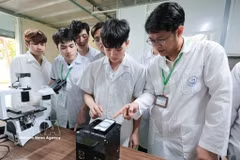
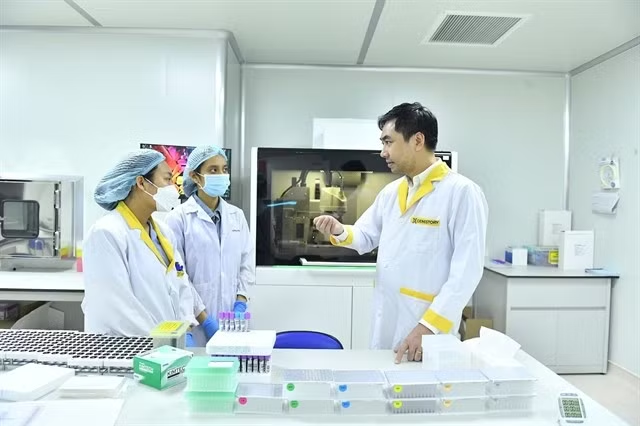
Dr. Vo Sy Nam (right) discusses genome sequencing technology with his colleagues. (Photo: VGP)

Hanoi (VNS/VNA) - For the first time, Vietnamese scientists have successfully built a large-scale human genome dataset together with a population-specific reference genome for people.

The work has just been published in Nature Communications – one of the world’s leading prestigious scientific journals – opening up an important foundation for genetics research, precision medicine and preventive medicine in Vietnam.

A group of Vietnamese scientists led by Dr Vo Sy Nam, Executive Director of the Big Data Research Institute under VinUni University, and Prof Vu Ha Van, the institute’s scientific director, has just published the study 'VN1K is a pangenome-informed multi-omics and phenomics resource for the Vietnamese population' in Nature Communications.

The work introduces the first large-scale, comprehensive source of genome, multi-omics and phenotypic data of Vietnamese people, and at the same time successfully builds the Vietnamese PanGenome Reference (VPR) – the first population reference genome specifically for Vietnamese people.

This is considered an important scientific foundation for genetics research and many applications in precision medicine, preventive medicine, as well as genome decoding services for citizens.

The project was initiated in 2018, with the participation of more than 40 Vietnamese scientists. The research team analysed data from 1,011 people from 53 out of 63 provinces and cities, recording more than 42 million genetic variants, of which about 8.5 million variants had never appeared in commonly used international databases.

From this source of data, the scientists developed the Vietnamese PanGenome Reference (VPR) – Vietnam’s first large-scale population reference genome, helping to improve the accuracy in analysing and interpreting genetic variants of Vietnamese people compared with current reference genomes, which are mainly built from European data.

Previously, genetic data of Vietnamese people in international studies remained very limited. This gap meant that many studies on disease pathology, drug response and precision medicine applications did not fully reflect the genetic characteristics of Vietnamese people.

According to the research team, the successful building of VN1K not only supplements the missing data of Vietnam on the world genome map but also contributes an important source of data for Southeast Asia, where large-scale genetic data remains lacking.

From VN1K data, the scientists identified many gene variants related to adverse reactions to some common drugs, while also developing drug-response prediction models for about 150 groups of drug substances, contributing to supporting personalised treatment.

One application already implemented is the project “The right medicine for me”, helping thousands of disadvantaged children with epilepsy undergo genetic testing before treatment, thereby reducing the risk of serious drug reactions and improving treatment effectiveness.

One outstanding application of the project is VinGenChip – the first biochip designed based on Vietnamese human genome data. This technology is capable of simultaneously analysing tens of thousands of genetic variants, serving individual identification, drug-response prediction, disease-risk screening and population genetics research.

Currently, VinGenChip is one of the technologies being used in the Martyrs’ Gene Bank Project and related projects, as well as the 500-day-and-night campaign to search for, collect and identify the identities of martyrs’ remains, which is being implemented on a scale of up to millions of DNA samples.

With the ability to simultaneously read a large number of identification-value genetic variants, this technology contributes to improving the accuracy of matching data between relatives’ DNA samples and remains, while significantly reducing costs compared with many imported solutions.

The application of VinGenChip on the platform of Vietnamese genome data is expected to contribute to improving the effectiveness of identifying the remains of martyrs whose information is still missing, serving a task of special historical, political and humanitarian significance. This is also proof of the ability to transform scientific research results into technologies serving the country’s practical needs.

Sharing the significance of the work, Van said this was a study entirely carried out by Vietnamese scientists in Vietnam, for Vietnamese people, pioneering in nature and laying the foundation for comprehensive studies on the Vietnamese genome in the future.

Meanwhile, Nam affirmed that the group’s goal was not only to build databases and AI tools for genetic data, but also to transform research results into applications serving the community, contributing to promoting preventive medicine and precision medicine in Vietnam./.

VNA

See more

VAST Vice President Prof. Dr. Tran Tuan Anh speaks at an event in Vienna. (Photo published by VNA)

VAST expands global partnerships through science and people-to-people diplomacy

During a working visit to Austria from July 19-23, a VAST delegation led by Vice President Prof. Dr. Tran Tuan Anh held a series of meetings with leading research institutions and international organisations, including the International Institute for Applied Systems Analysis (IIASA), the Austrian Academy of Sciences, the Vienna University of Technology (TU Wien), and the International Atomic Energy Agency.

The Quantum Hackathon for Social Good 2026 (QC4SG 2026) kicks off in Quy Nhon, Gia Lai province, on July 24. (Photo: VNA)

Int’l quantum computing hackathon kicks off in Gia Lai

As a key activity within the technology component of the Gia Lai Quantum Year 2026, the event brings together nearly 100 contestants across 26 teams, including students, PhD candidates, young researchers, startups, and tech talents, alongside 50 domestic and international experts, mentors, and judges.

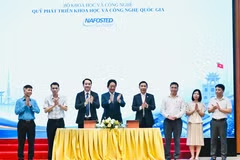
The National Foundation for Science and Technology Development under the Ministry of Science and Technology signs funding agreements for five Vietnam-Japan joint research projects in semiconductors for 2026 at a ceremony on July 22 (Photo: https://baochinhphu.vn/)

Vietnam, Japan launch five joint semiconductor research projects

The signing and implementation of the five projects mark a concrete step toward realising the Party and State’s policies on science – technology development, innovation and digital transformation, with the semiconductor industry identified as one of strategic technologies fundamental to national competitiveness and technological autonomy.

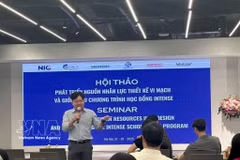
Speakers at the workshop held in Ho Chi Minh City on July 22 (Photo: VNA)

Vietnam urged to develop sovereign AI in digital era

Data has become a strategic asset and a key resource for socio-economic development, as well as a foundation of national competitiveness. As a result, effective data governance, utilisation and protection have become increasingly urgent for organisations and businesses.

(Illustrative photo; VietnamPlus)

Expert calls for secure national digital archives system

Building a national electronic archives system is not merely a matter of investing in technological infrastructure. It must be designed in an integrated manner from the outset, encompassing system architecture, governance procedures, and data protection mechanisms, to ensure long-term security, integrity, and data sovereignty.

Dr. Vo Duc Thang, Assistant Professor at the National Taiwan University of Science and Technology and President of the Vietnam Innovative and Intellectual Network in Taiwan (China), speaks at a seminar on the semiconductor industry. (Photo: VNA)

Vietnam can deepen role in global semiconductor supply chain: Taiwan-based expert

Vietnam’s biggest takeaway from Taiwan isn’t just cutting-edge technology alone, but how to build an entire semiconductor ecosystem from the ground up, said Dr. Vo Duc Thang, Assistant Professor at the National Taiwan University of Science and Technology (Taiwan Tech) and President of the Vietnam Innovative and Intellectual Network in Taiwan (China) (VIN Taiwan) told the Vietnam News Agency.

The need to develop human resources for the atomic energy and nuclear power sectors is becoming increasingly urgent. (Illustrative photo from the Vietnam Government Portal)

Vietnam needs tens of thousands of nuclear power workers by 2035

According to the Agency for Radiation and Nuclear Safety under the Ministry of Science and Technology, human resources will be among the decisive factors determining whether the country can successfully implement its nuclear power programme on schedule.

Technologies for developing digital government infrastructure and cashless payment solutions are showcased at an exhibition. (Photo: VNA)

Vietnam approves national digital transformation strategy for 2026 - 2030

Vietnam aims to become a developed digital nation where digital transformation is implemented comprehensively across all sectors and serves as the country's principal development model. The strategy envisions a modern system of national governance powered by data and AI, strong domestic capabilities in strategic digital technologies, platforms and products, and firm protection of national digital sovereignty.

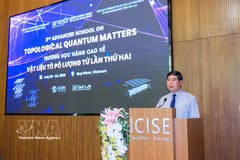
Vice Chairman of the Gia Lai provincial People’s Committee Lam Hai Giang speaks at the event. (Photo: VNA)

Int’l scientists gather at 2nd advanced school on topological quantum matters in Gia Lai

Jointly organised by the Rencontres du Vietnam (Meeting Vietnam) association and the International Centre for Interdisciplinary Science and Education (ICISE), the five-day event features lectures by leading professors and scientists in quantum physics and materials science, providing participants with a solid theoretical foundation. They are also updated on the latest research advances in quantum topological materials.

The survey found that mobile phones, particularly smartphones, have become an essential part of daily life in Vietnam. (Photo: VietnamPlus)

More than 80% of Vietnam's population uses smartphones

The 2025 household living standards survey showed that 87.3% of the population used mobile phones, up 2.5 percentage points from 84.8% in 2024. Of those, 80.3% used smartphones, while the proportion of people using feature phones fell to 8.5%.