Top leader calls for stronger Party leadership over inspection work to combat corruption

The achievements gained so far mark a significant shift from viewing inspections solely as a tool to detect violations to recognising them as an important mechanism for improving institutions and strengthening national governance, said Party General Secretary and State President To Lam.

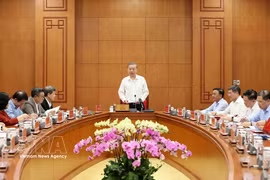
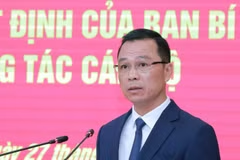
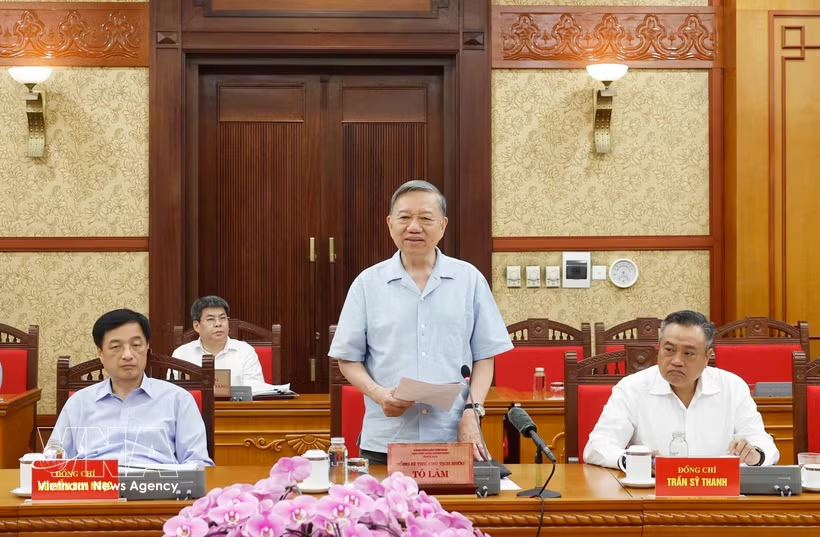
Party General Secretary and State President To Lam (centre) speaks at the working session with the Standing Board of the Government Inspectorate's Party Committee and its leaders on July 27, 2026. (Photo: VNA)

Hanoi (VNA) – Party General Secretary and State President To Lam chaired a working session with the Standing Board of the Government Inspectorate's Party Committee and its leaders in Hanoi on July 27 to review the sector's performance after more than a year of restructuring, identify institutional bottlenecks, and discuss a plan on strengthening the Party's leadership over the work to meet anti-corruption requirements in the current period.

After listening to reports and opinions, the top leader commended the Government Inspectorate's Party Committee, leadership and the entire sector for overcoming difficulties, actively implementing the new organisational model and successfully handling a heavy workload to achieve positive results.

He noted that inspection activities have uncovered numerous shortcomings in mechanisms, policies, management and implementation while recommending revisions to Party regulations, as well as policies and laws. These efforts have helped improve the institutional framework, enhance the effectiveness of Party leadership and State management, and unlock resources for national development.

The achievements, he said, mark a significant shift from viewing inspections solely as a tool to detect violations to recognising them as an important mechanism for improving institutions and strengthening national governance.

The General Secretary and President stressed that reforms of inspection work must be aligned with broader efforts to renew the Party's leadership methodology, perfect the socialist rule-of-law State, streamline the State apparatus, ensure the smooth operation of the two-tier local administration model, promote the decentralisation and delegation of authority, and improve national governance.

He said the inspection sector must operate in a centralised, unified and efficient manner while remaining closely connected with grassroots realities, strengthening control over the exercise of power, maintaining discipline, protecting the people, and serving development.
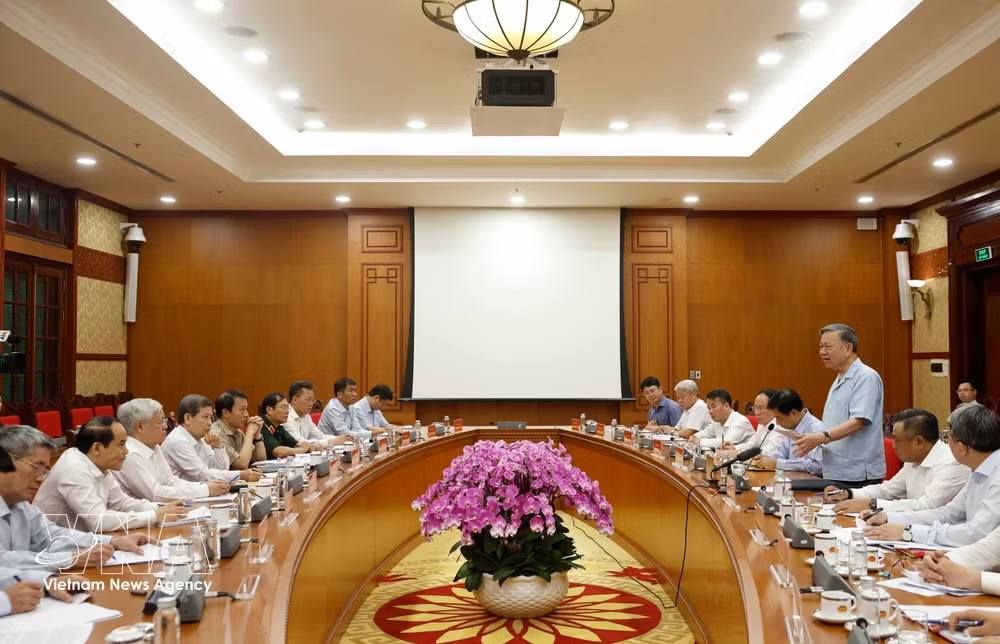
vnanet-tbt-2.jpg
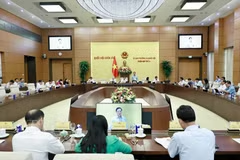
Party General Secretary and State President To Lam chairs the working session with the Standing Board of the Government Inspectorate's Party Committee and its leaders in Hanoi on July 27, 2026. (Photo: VNA)

Highlighting six guiding viewpoints for the sector, General Secretary and President Lam noted that first, the Party's direct and comprehensive leadership, respect for the Constitution and law, and strict control of power must be ensured. Inspection activities must be conducted within their functions, authority and in line with legal procedures, and remain objective, impartial and accountable. Power decentralisation must be accompanied by accountability, inspection and supervision.

Second, inspection work must place national interests, the people's interests, discipline and development at the forefront. It should contribute to building a clean State apparatus, improving governance, ensuring the efficient use of resources and creating a transparent environment for development. Besides, it must handle corruption, wastefulness and misconduct, and protecting officials who act properly and dare to innovate for the common good.

Third, the work should shift towards prevention, early warning and risk control from an early stage and from the grassroots level, focusing on high-risk sectors, localities and management areas, along with issues of public concern.

Fourth, post-inspection implementation results and governance improvement should become the key yardstick of effectiveness. All inspection recommendations must clearly define tasks, responsible individuals, authority, deadlines and expected outcomes.

Fifth, the apparatus and authority of the inspection sector must be aligned with the political system and the two-tier local administration model, ensuring a lean, concentrated, professional, unified and efficient structure that remains close to the grassroots.

Sixth, the sector must build a contingent of inspectors who are honest, courageous, professional and modern while strengthening internal power control so that the inspection system serves as a model of integrity, discipline and public service responsibility.

​The Party and State leader also requested the inspection sector to focus on seven priority tasks. These include improving inspection planning to avoid overlap while covering high-risk areas, shortening inspection processes and improving the quality of inspection conclusions, and accelerating the handling of pending inspection conclusions and recommendations.

He also urged stronger coordination with law enforcement agencies with improved accountability, more effective settlement of citizens' complaints, and accelerated implementation of the Government's Decree No. 164/2026/ND-CP together with faster development of a national digital data platform that gathers six databases.

In addition, he stressed the need to tighten internal discipline, strengthen oversight, and prevent the abuse of power, conflict of interest, information leaks and unlawful interference in inspection activities./.​

VNA

See more

Standing Vice Chairman of the Ho Chi Minh City People’s Committee Nguyen Loc Ha (R) and Vice Chairman of the Champasak provincial Administrative Committee Phimpone Phandanuvong sign an MoU on cooperation between the two localities for the 2026-2030 period. (Photo: VNA)

Ho Chi Minh City-Champasak cooperation: A bright spot in Vietnam-Laos local ties

Cooperation priorities for the 2026-2030 period will cover trade, investment, agriculture, tourism, finance, education and human resources training, and socio-cultural affairs, with a focus on business connectivity, trade and investment promotion, tourism development, and support for education and human resources training.

General Secretary of the Communist Party of Vietnam (CPV) Central Committee and President To Lam (right) meets with Craig Bradshaw, CEO of EQ Resources Limited of Australia. (Photo: VNA)

Top Vietnamese leader highlights strategic mineral, high-tech cooperation with Australian firms

General Secretary of the Communist Party of Vietnam (CPV) Central Committee and President To Lam received leaders of Australian businesses in Canberra on August 12 morning (local time), highlighting opportunities to expand cooperation in strategic mineral supply chains, high technology and innovation as the Comprehensive Strategic Partnership between the two nations enters a new phase.

Dr Nguyen Thi Lan, Chairwoman of the Vietnamese Association in Chongqing and Sichuan (Photo published by VNA)

New impetus for overseas Vietnamese communities

On August 2, 2026, General Secretary of the Central Committee of the Communist Party of Vietnam and President To Lam signed the resolution, marking an important shift after more than two decades of implementing Politburo Resolution No. 36-NQ/TW. It affirms that the overseas group is an inseparable part of the nation and one of the country’s important strategic resources, contributing to strengthening national collective power.

Prime Minister Le Minh Hung (centre) holds high-level phone talks with his Dutch counterpart Rob Jetten on August 11. (Photo: VNA)

Vietnam, Netherlands to deepen cooperation, elevate Comprehensive Partnership

Congratulating the Netherlands on its achievements in socio-economic development and foreign affairs, PM Hung thanked the country for considering Vietnam as one of its leading strategic partners in the region under its new foreign policy. He affirmed that Vietnam attaches importance to and wants to further deepen its multifaceted cooperation with the Netherlands.

Deputy Minister of National Defence Sen. Lt. Gen. Nguyen Van Gau (right) and US Assistant Secretary of State for East Asian and Pacific Affairs Michael George DeSombre at their meeting on August 10 (Photo published by VNA)

Vietnam, US step up cooperation in search for missing Vietnamese soldiers

A Vietnamese official proposed that the US continue increasing resources for dioxin remediation at Bien Hoa and Phu Cat airbases, expand projects supporting people with disabilities, enhance the sharing of historical data, provide DNA technology assistance and continue close coordination in the search for missing US service members and Vietnamese soldiers.

Trinh Van Quyet (left), member of the Political Bureau of the Communist Party of Vietnam (CPV) Central Committee, Secretary of the CPV Central Committee and Chairman of its Commission for Publicity, and Australian Assistant Minister for Foreign Affairs and Trade Matt Thistlethwaite at their meeting in Canberra on August 11, 2026 (Photo: VNA)

Vietnam, Australia seek to forge stronger bonds

The two sides highlighted the progress in the Vietnam–Australia Comprehensive Strategic Partnership and discussed measures to boost cooperation in areas with considerable potential, including communications, digital trade, cybersecurity, education and people-to-people exchanges.

The executive board of the Vietnam–Spain Friendship Association for the 2026–2031 term makes debut at the congress. (Photo: VNA)

Vietnam–Spain Friendship Association looks to strengthen people-to-people ties

Nguyen Duc Loi, President of the Vietnam–Spain Friendship Association for the 2021–2026 term, said Vietnam–Spain relations have continued to develop positively across various fields, with political ties increasingly strengthened and cooperation in trade, education, culture, tourism, and people-to-people exchanges.