New US tariff policy should be based on objective, comprehensive assessment

This progress has been built on mutual respect, transparency and Vietnam's sustained efforts to improve its legal framework and comply with international standards. However, the US' recent tariff decision appears to overlook realities regarding Vietnam's labour environment and manufacturing practices.

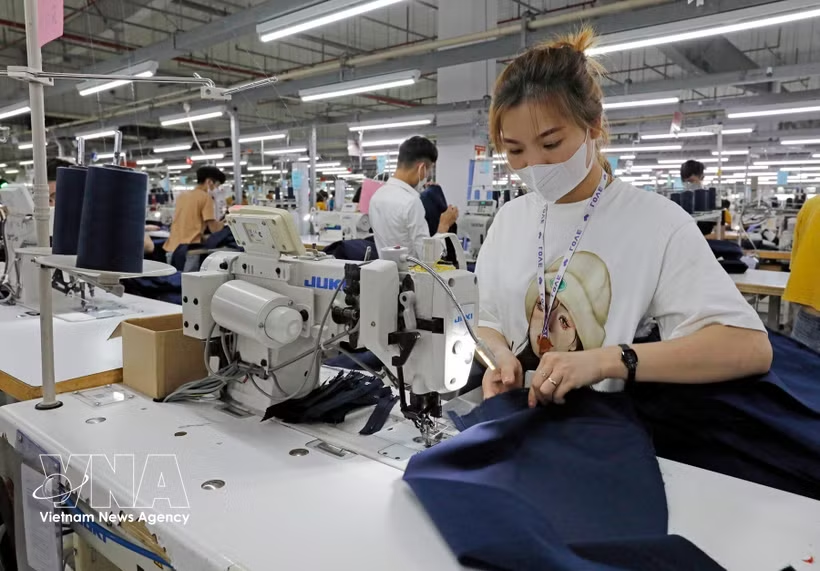
Garment production for export to the US market at TAL Vinh Phuc Garment Company. (Photo: VNA)

Hanoi (VNA) – Economic and trade ties between Vietnam and the US have grown remarkably over the years, becoming a key pillar underpinning the elevation of bilateral relations to a Comprehensive Strategic Partnership.

This progress has been built on mutual respect, transparency and Vietnam's sustained efforts to improve its legal framework and comply with international standards. However, the US's recent tariff decision appears to overlook realities regarding Vietnam's labour environment and manufacturing practices.

On July 24, the Office of the US Trade Representative (USTR) announced a new 12.5% tariff under Section 301 on imports from all economies included in its investigation list.

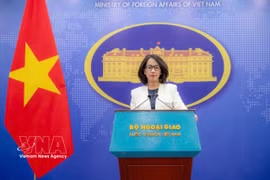
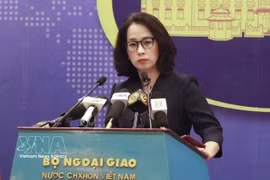
Responding to a reporter's question regarding Vietnam’s response to this move, Spokesperson of the Ministry of Foreign Affairs Pham Thu Hang on July 25 stated that the decision does not fully reflect the realities in Vietnam and its efforts to prevent, reduce and eliminate forced labour, including its ban on imports of goods produced with forced labour. She reaffirmed that Vietnam strictly prohibits all forms of forced labour and fully complies with the regulations of the International Labour Organisation (ILO), international treaties and free trade agreements to which it is a party.

Vietnam's legal framework, from the Constitution and laws to guiding documents, and practical implementation demonstrate that the rights to work and employment are fundamental rights safeguarded by the Party and State. Vietnam remains committed to international economic principles by improving working conditions, strengthening a transparent legal framework, and resolutely eliminating all forms of forced labour.

The 2013 Constitution guarantees citizens the right to work, freely choose their occupation and workplace, and enjoy fair and safe working conditions. It also explicitly prohibits discrimination, forced labour and the employment of workers below the minimum legal working age.

These principles are further reinforced in the 2019 Labour Code, which safeguards the legitimate rights and interests of workers while encouraging employment conditions that exceed statutory requirements. The Labour Code also affirms workers' rights to freely choose their jobs and prohibits forced labour in all forms.

Most recently, the Government issued Decree No. 292/2026/ND-CP on July 22, banning the import of goods wholly or partly extracted, produced or manufactured through forced labour.

According to the Ministry of Industry and Trade, the decree demonstrates Vietnam's determination to strengthen its legal framework, fully implement ILO conventions and other international commitments, and enhance transparency and sustainability across supply chains.

Beyond legislation, standardising working conditions remains a top priority for Vietnam. As an active participant in new-generation free trade agreements (FTAs), which place strong emphasis on non-trade issues such as labour and environmental standards, the country has consistently fulfilled its commitments in these areas.

This commitment is reflected in the steady improvement of occupational safety and hygiene in recent years. At the launch of the 2026 National Month on Occupational Safety and Hygiene and Workers' Month, Minister of Home Affairs Do Thanh Binh reaffirmed that improving people's living standards and ensuring effective implementation of occupational safety and hygiene policies and laws remain priorities across the political system.

These sustained efforts have helped build a workforce that is growing in both size and quality. Vietnam now has a labour force of more than 53 million people, including an increasing number of highly skilled professionals and workers whose qualifications and expertise meet regional and international standards.

In addition, the country’s export industries, including textiles, footwear, agricultural products, electronics and furniture, are also subject to rigorous international social responsibility and ESG (environmental, social and governance) standards, with performance in ensuring workers’ rights closely monitored by global buyers.

These efforts have helped Vietnam become one of the world's 20 largest trading economies and a key link in global supply chains serving demanding markets such as the US and the European Union.

Against this backdrop, imposing the new 12.5% tariff without a comprehensive assessment could produce unintended consequences for both countries. Vietnamese exports have played an important role in ensuring stable supplies and moderating prices in the US market. The tariffs would inevitably increase costs for US importers and consumers while adversely affecting Vietnamese businesses that comply with international labour standards.

Within the framework of the Vietnam–US Comprehensive Strategic Partnership, economic and trade relations should continue to be guided by mutual trust and constructive dialogue. A more objective and comprehensive assessment of Vietnam's substantive efforts would provide a sound basis for policy decisions that support fair trade and deliver long-term benefits for both sides./.
VNA

See more

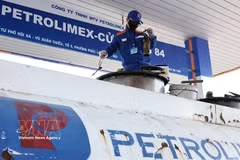
At a Petrolimex station. Petrolimex said it was increasing fuel procurement, adjusting distribution and moving supplies between regions to ensure fuel supply across its system. (Photo: VNA)

Ministry orders fuel supply inspections amid localised shortages

The ministry has taken steps to immediately inspect locations reporting shortages and identify the cause. Localities where shortages are taking place must examine the entire supply chain, including contracts between retailers and wholesalers, actual supply volumes, delivery schedules and the reasons for any failure to provide fuel.

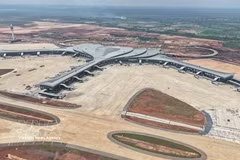
The construction site of Long Thanh International Airport in July 2026. (Photo: VNA)

Long Thanh Airport's second runway to be completed in September

According to the Airports Corporation of Vietnam (ACV), after 14 months of construction, the cement concrete pavement for the runway and taxiways has been substantially completed. Contractors are mobilising hundreds of workers and construction equipment to finish the remaining works on schedule.

Illustrative image (Photo: VNA)

Vietnam introduces special policies to strengthen anti-money laundering framework

Issued on July 24, Resolution No. 66.23/2026/NQ-CP amends and supplements a number of provisions in the 2022 Law on Anti-Money Laundering and related guiding documents. The revisions focus on key areas, including the definition of beneficial ownership, verification of customer information, transparency of legal arrangements, risk-based customer classification and the frequency of updating customer information.

International buyers explore products at the Vietnam International Sourcing Expo 2025. (Photo: VNA)

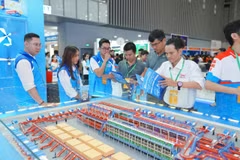
Nordic businesses look to Vietnam for deeper trade, supply-chain cooperation

VIS 2025 enabled Nordic businesses to directly explore Vietnamese suppliers while facilitating deeper engagements with management agencies, localities, industry associations, seaports, factories and logistics partners. The programme showed that Vietnam-Nordic cooperation is expanding beyond trade to supply-chain development, investment, logistics and digital transformation.

Phu Quoc airport’s 3,300m runway lights up ahead of landmark flight inspections

Phu Quoc airport’s 3,300m runway lights up ahead of landmark flight inspections

Viewed from above, Runway No. 2 has taken clear shape within the overall layout of Phu Quoc International Airport. Measuring 3,300 metres long and 45 metres wide, the new runway has been built parallel to the existing one. Its pavement and markings have been completed, and the project is now undergoing final technical inspections. At night, the lighting system has been switched on at full intensity for testing.

Villas left unoccupied for years. (Photo: diendandoanhnghiep.vn)

Taxes proposed on vacant land, speculative deals

A key proposal is to introduce a mechanism to regulate windfall gains from differences in land values, while imposing high taxes on vacant land and property transactions conducted within a short period.

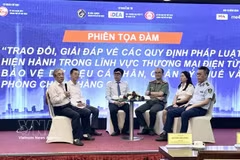
Panellists at the conference (Photo: VNA)

Ho Chi Minh City promotes safe, transparent e-commerce ecosystem

Ho Chi Minh City is stepping up efforts to build a safer and more transparent e-commerce ecosystem as authorities accelerate implementation of the new E-commerce Law, which aims to strengthen consumer protection, enhance platform accountability and support the sustainable growth of Vietnam's digital economy.

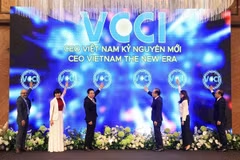
Minister of Foreign Affairs Le Hoai Trung (third, right), VCCI Chairman Ho Sy Hung (third, left), and representatives of government agencies and educational institutions attend the launch ceremony of the programme. (Photo courtesy of VCCI)

Vietnam launches programme to develop globally competitive CEOs

The Vietnam Chamber of Commerce and Industry (VCCI) on July 25 launched a Vietnam business leadership development programme 2026-2030 (CEO Vietnam The New Era), to build a new generation of internationally competitive chief executive officers (CEOs) in Vietnam.

The fourth Vietnam International Logistics Exhibition (VILOG 2026) will take place in Ho Chi Minh City from July 30 to August 1, 2026. (Illustrative photo: vilog.vn)

Vietnam's flagship logistics exhibition returns with smart, sustainable focus

The exhibition comes as Vietnam cements its position as one of Asia's fastest-growing manufacturing and logistics hubs, with demand increasing for more integrated, technology-driven supply chain solutions. It also reflects the sector's ongoing push towards greater competitiveness and deeper participation in global value chains.

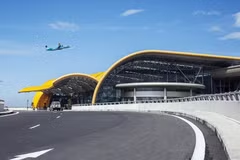
Lien Khuong International Airport is expected to provide a major boost to Lam Dong's tourism after August 19. (Photo published by VNA)

Lien Khuong International Airport set to reopen on August 19

Once operations stabilise, Lien Khuong International Airport in the Central Highlands province of Lam Dong is projected to serve approximately 6,800 passengers a day, nearly 1,000 more than before its temporary closure. Passenger throughput during the final four months of 2026 is forecast to reach around 816,000.

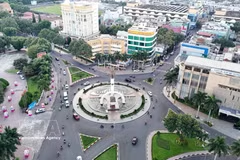
A corner of Buon Ma Thuot ward of Dak Lak province. (Photo: VNA)

Dak Lak focuses on promoting marine-based economy, logistics

With a coastline stretching nearly 189 kilometers, featuring a network of straits, bays, lagoons, and seaports with significant development potential, Dak Lak is well positioned to advance its marine economy, particularly through the harvesting, aquaculture, and processing of high-value seafood products.