Top leader urges shift from emergency relief to community resilience

The Vietnam Red Cross Society must anchor operations in transparency, integrity, accountability, and openness. All donations must be managed and allocated as intended, with donors entitled to track use, beneficiaries, and outcomes, and recipients able to give feedback on relevance, fairness, and timeliness.

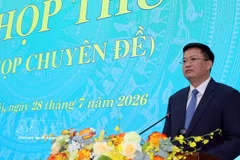
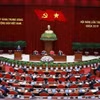
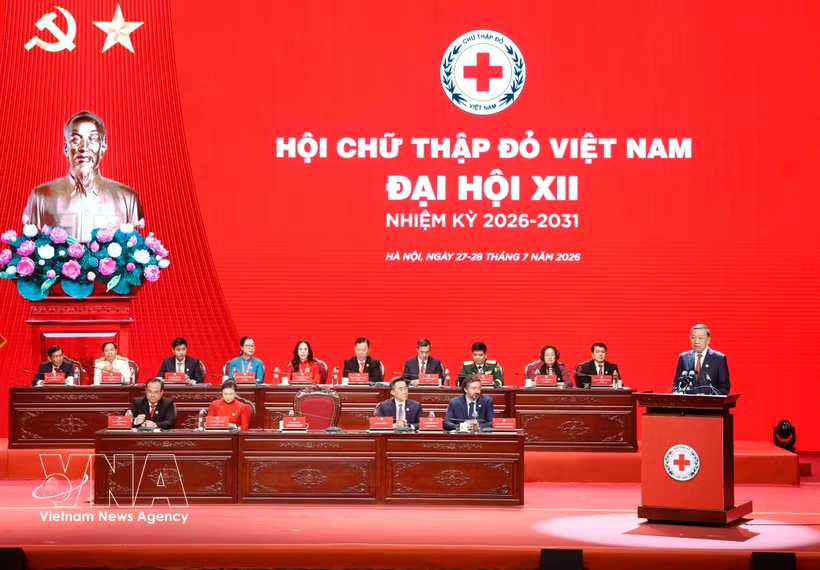
Party General Secretary and State President To Lam addresses the 12th National Congress of the Vietnam Red Cross Society for the 2026-2031 tenure on July 28. (Photo: VNA)

Hanoi (VNA) – Party General Secretary and State President To Lam, recently becoming Honorary President of the Vietnam Red Cross Society (VRCS) for the 2026-2031 tenure, has vowed to partner with the Party Central Committee’s Politburo and Secretariat, to improve the VRCS’s operating efficiency and fulfill its noble humanitarian mission with all possible support.

From relief to resilience

Addressing the VRCS’s 12th National Congress for the 2026-2031 tenure in Hanoi on July 28, which drew 500 delegates representing more than 5.6 million officials, members, volunteers, and youth nationwide, General Secretary and President Lam said the Vietnamese Party, State, and people look forward to continued cooperation from the International Red Cross and Red Crescent Movement, international organisations, and development partners to strengthen humanitarian capacity, friendship, solidarity, peace, and sustainable development.

Humanitarian work should not be confined to emergency relief when natural disasters, disease outbreaks, or other crises occur. Instead, it should become an integral part of the country's human development strategy, social welfare, risk governance, and community resilience, he said.

The leader called for a pivot from reactive response to proactive prevention, from post-disaster relief to early warning and action, from one-off aid to livelihood support and capacity building, and from isolated initiatives to an integrated humanitarian ecosystem linking the State, society, business, and citizens. The most effective assistance, he said, enables citizens to rebuild their lives and achieve lasting stability.

Endorsing the broad orientations, targets, and six action plans in the Congress’s political report, he said the newly elected 12th VRCS Central Committee and local chapters should refine the legal and institutional frameworks and tighten enforcement of legislation protecting vulnerable groups.

He also urged expanded education, vocational training, livelihood support, and sustainable job creation to integrate disadvantaged groups more firmly into the community.

The VRCS should take a more active role in community-based disaster risk management by building early warning systems, local emergency response forces, first-aid networks, and safe community models, he said. Each commune, ward, and special zone should gradually create trained volunteer teams with action plans and the capacity to deliver timely aid to vulnerable groups, particularly children, the elderly, the disabled, the seriously ill, and those in remote, border, and island areas.

It was urged to continue serving as the leading coordinator and bridge in humanitarian activities, with all efforts centred on the people, driven by actual needs and measured by tangible improvements in lives. Priority must go to the most in need, ensuring no one is left behind because of geographical distance, bureaucracy, or limited technology skills.

Transparency, tech, and resource mobilisation

He stressed that the VRCS must anchor operations in transparency, integrity, accountability, and openness. All donations must be managed and allocated as intended, with donors entitled to track use, beneficiaries, and outcomes, and recipients able to give feedback on relevance, fairness, and timeliness.

The organisation was directed to build a unified humanitarian database linked, where possible, with national databases and the social security system. He pushed for greater use of big data, artificial intelligence, geospatial mapping, and digital platforms to pinpoint needs, prevent duplication, coordinate resources, issue early warnings, manage volunteers, and assess impact.

He also underscored the need to build a strong, professional, modern VRCS by leveraging the contributions of its officials, members, and volunteers and expanding international cooperation.
vnanet-o.jpg
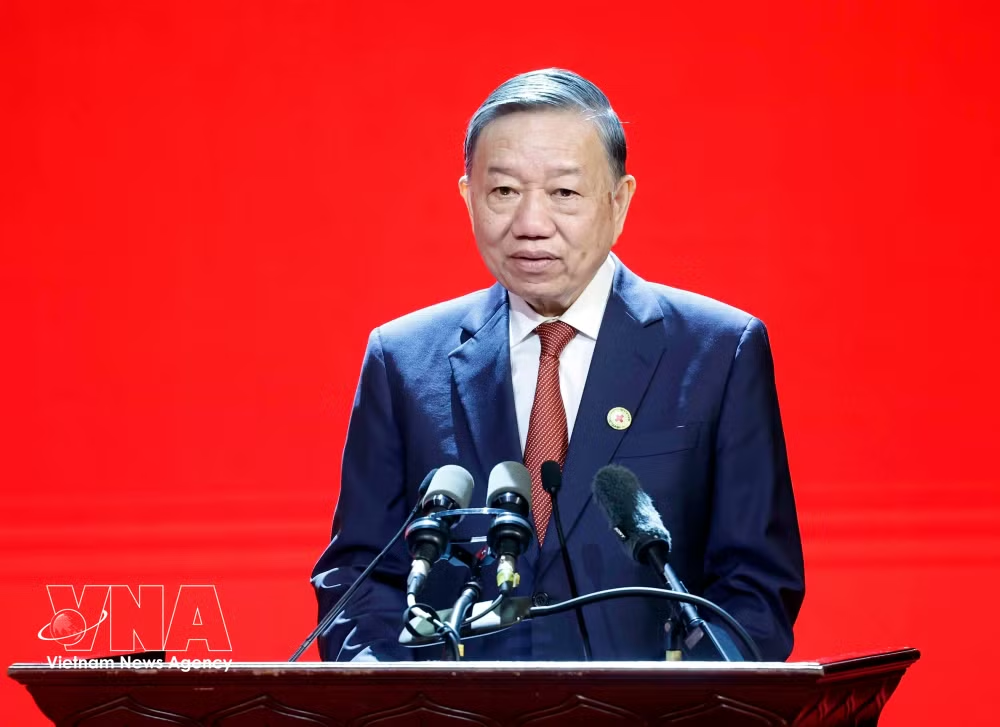
Party General Secretary and State President To Lam speaks at the congress. (Photo: VNA)

The Ministry of Health, healthcare facilities, and medical staff should continue working closely with the VRCS to spread the “Florence Nightingale Spirit” featuring compassion, dedication, courage, and tireless service, he said. He called for identifying, nurturing, and honouring outstanding contributors to patient care, disease control, disaster response, and community health.

The VRCS’s international humanitarian work should become a key channel of people-to-people diplomacy, projecting Vietnam as a peaceful, compassionate, and responsible nation, he said.

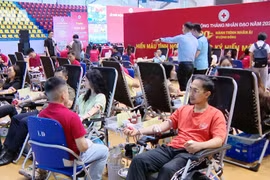
To deliver on these responsibilities, the entire political system, from central to local levels, must keep improving institutional mechanisms and policies, tighten coordination and information sharing, pool resources, and provide full support so the VRCS can play a bigger role in disaster prevention and response, community healthcare, first aid, blood donation, social assistance, and international humanitarian work.

He also pushed closer health sector coordination with the VRCS on blood and tissue donation campaigns, first-aid training, disease prevention and control, and aid for disadvantaged patients.

The education sector, the Ho Chi Minh Communist Youth Union, media, and social organisations should collaborate to cultivate compassion, volunteerism, life skills, and social responsibility among young people, he said.

He closed by calling on businesses, organisations, individuals, philanthropists, overseas Vietnamese, and international friends to keep backing the VRCS with resources, knowledge, technology, and shared responsibility./.
VNA

See more

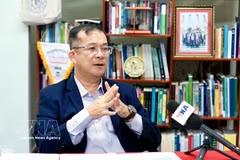
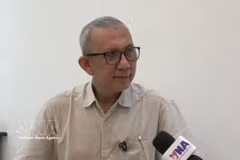
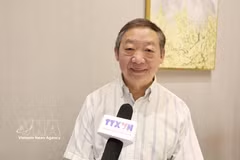
Assoc. Prof. Dr. Neak Chandarith, Director of the Institute for International Studies and Public Policy at the Royal University of Phnom Penh (Photo: VNA)

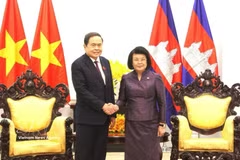
Top Cambodian lawmaker’s Vietnam visit further institutionalises legislative ties: Scholar

Talking with Vietnam News Agency correspondents in Phnom Penh, Assoc. Prof. Dr. Neak Chandarith, Director of the Institute for International Studies and Public Policy (IISPP) at the Royal University of Phnom Penh (RUPP), underscored the visit’s profound political and strategic significance for the two Southeast Asian neighbours’ traditional friendship, particularly in further institutionalising ties between their legislative bodies.

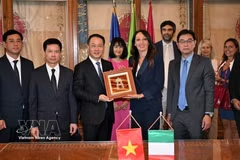
A Hanoi leader presents a gift to President of the Rome City Council Svetlana Celli at the meeting on July 27. (Photo: VNA)

Hanoi, Rome sign statement on advancing all-round ties

The two-year statement focuses on six priority areas, namely urban management and regeneration; environmental protection and sustainable development; education and culture; social development; integration and innovation; and the economy, trade and investment.

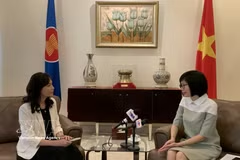
Beni Sukadis, Senior Coordinator at the Indonesian Institute for Defence and Strategic Studies, grants an interview to the Vietnam News Agency. (Photo: VNA)

Indonesian expert lauds Vietnam’s contributions to ASEAN community-building

As a proactive and responsible member, Vietnam has demonstrated its ability to build consensus, foster cooperation, and maintain balance amid an increasingly complex geopolitical environment in the region, said Beni Sukadis, Senior Coordinator at the Indonesian Institute for Defence and Strategic Studies (LESPERSSI)

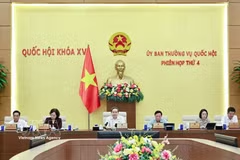
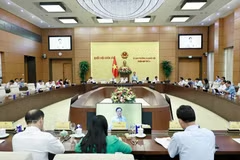
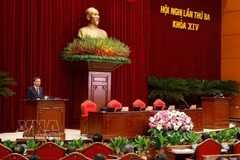
National Assembly Chairman Tran Thanh Man addresses the fourth session of the NA Standing Committee. (Photo: VNA)

NA seeks consistency in military, defence legislation

The National Assembly (NA) Standing Committee continued its fourth session on July 27, reviewing a draft law amending and supplementing provisions to nine military and defence laws to ensure consistency across Vietnam’s legal framework.

A session of the NA Standing Committee (Illustrative image: VNA)

NA adjusts legislative programme for 2026

Under Resolution No. 11/2026/UBTVQH16, the NA Standing Committee added several draft laws to the 2026 agenda for both discussion and approval at the second session of the 16th NA, scheduled for October.

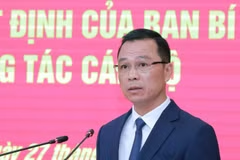
Deputy Secretary of the Party Committee and Chairman of the People’s Committee of Thanh Hoa province To Anh Dung speaks at the conference on July 27. (Photo published by VNA)

Thanh Hoa provincial People’s Committee has new Chairman

Dung pledged to continue improving his political mettle, ethics and leadership capacity, while working with the provincial leadership to strengthen solidarity, promote collective intelligence and reform leadership mindset and governance methods, proactively seize opportunities and overcome difficulties and challenges to realise the set targets.

Professor Zhu Chenming, Honourary Director of the Institute of South and Southeast Asian Studies under the Yunnan Academy of Social Sciences (Photo: VNA)

Four strategic priorities signal Vietnam’s next phase of development: Chinese scholar

According to Professor Zhu Chenming, Honourary Director of the Institute of South and Southeast Asian Studies under the Yunnan Academy of Social Sciences, the Vietnamese Party and State leader’s decision to outline new strategic directions immediately after the restructuring process reflects a clear understanding of Vietnam’s evolving development needs. Simply completing institutional reorganisation could create the misconception that the reform mission has been accomplished, while significant governance and development challenges remain.

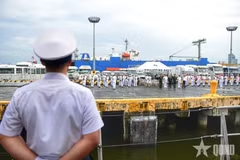
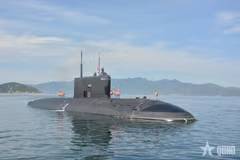
A Russian Navy submarine arrives at Cam Ranh Port. (Photo: qdnd.vn)

Russian naval flotilla begins visit to Vietnam

The visit is part of ongoing efforts to implement bilateral defence cooperation agreements between Vietnam and Russia, while advancing outcomes of the official visit to Russia by General Phan Van Giang, Deputy Prime Minister and Minister of National Defence, in May. It is expected to further strengthen the two countries' longstanding friendship and deepen defence collaboration, particularly between their navies.

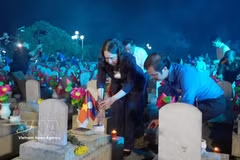
Vice State President Vo Thi Anh Xuan offers incense at the graves of fallen soldiers at the Vietnam–Laos Martyrs' Cemetery. (Photo: VNA)

National candle-lighting ceremony honours fallen heroes

Speaking at the event, First Secretary of the Ho Chi Minh Communist Youth Union Central Committee Bui Quang Huy described Vietnam's history as a testament to patriotism, the pursuit of independence and the aspiration for peace. He paid tribute to the millions of Vietnamese who devoted their youth and sacrificed their lives for the nation's freedom.