Hanoi (VNA) – Expanding access to green finance is becoming essential for Vietnam's low-carbon transition, as businesses seek capital to invest in cleaner technologies, modernise production and meet increasingly stringent international environmental standards, according to insiders.
Businesses say the biggest obstacle to reducing emissions and transforming production models remains the lack of financial resources needed to upgrade technologies, modernise production lines and build governance systems that comply with global sustainability standards.
According to Giandomenico Zappia, Chair of the EuroCham Sustainable Finance Sector Committee, sustainable finance is not simply about issuing green bonds or offering preferential loans, but about changing how financial institutions assess the value and risks of investment projects.
He noted that projects with low upfront costs but high energy consumption, significant emissions or poor environmental performance may ultimately prove less attractive investments. By contrast, green buildings can lower operating costs, improve occupancy rates, increase asset values and attract international capital inflows. In many developed markets, certified green buildings typically command rental premiums of 5–7% and are more attractive to investors than conventional properties.
Zappia said Vietnam is gradually laying the groundwork for a green finance market by introducing the national green taxonomy, expanding green credit, developing the green bond market. However, with outstanding real estate credit reaching around 2 quadrillion VND by the end of 2025, the priority is not only to increase lending but also to ensure capital flows into projects capable of generating long-term sustainable value.
Nguyen Thi Thu Ha, member of the Members' Council of Agribank, said green transformation has become a strategic direction for banks in supporting businesses to achieve green growth targets and Vietnam's net-zero emissions commitment by 2050.
In 2025, Agribank allocated about 400 trillion VND to preferential lending programmes focused on high-tech and clean agriculture, agro-forestry-fisheries processing and environmentally friendly production projects. It also issued 5 trillion VND worth of private green bonds, marking a shift towards purpose-driven fundraising for sustainable development.
International financial institutions are also expanding support channels to help Vietnamese businesses access green financing.
According to Vu Hong Phong, EDGE Green Building Specialist at IFC – a member of the World Bank Group, green building certification is no longer merely a technical standard but has become a "passport" enabling businesses to access green loans, green bonds, and international investment. When energy efficiency, water savings, and emissions reductions are measured against internationally recognised standards, financial institutions have a stronger basis for assessing asset quality and project risk.
Several Vietnamese projects have already secured international financing by meeting green standards, including a 150-million-USD syndicated loan for the Vinschool system and a green bond issued by Binh Thuan Plastics Group with a guarantee from GuarantCo.
According to Chu Thi Lan Huong, ESG Advisor at Techcombank and Vice Chair of the EuroCham Sustainable Finance Sector Committee, Vietnam will require an estimated 368 billion USD by 2040 to achieve its net-zero target. The construction sector alone accounts for 36-40% of the country's total energy consumption and about one-quarter of greenhouse gas emissions, underscoring the need for effective financing solutions.
She said businesses can now access funding mobilisation instruments, including green credit, green bonds, sustainability-linked bonds and concessional financing from international institutions. However, investors increasingly prioritise "bankable green projects" that not only meet environmental criteria but also demonstrate commercial viability, transparent risk management, and clear repayment prospects.
To access green financing, businesses need to clearly quantify their energy savings, emissions reductions, and operational efficiency, while establishing a transparent ESG data system from the project preparation stage onward.
Experts said that as carbon and ESG standards become increasingly important in global trade, green finance is evolving beyond a funding tool into a catalyst for restructuring production models. By directing capital towards energy-efficient, low-emission and technology-driven projects, businesses can strengthen competitiveness, meet emerging trade requirements and build a foundation for sustainable growth and strengthen their competitiveness in global value chains./.
See more
Vietnam advances integrated marine governance to unlock blue economy potential
A transparent and stable legal environment with outstanding incentives is expected to create a new wave of investment and help turn the marine economy into a key driver of Vietnam's ambition for double-digit economic growth.
Deputy PM seeks WTO, WEF’s more support to Vietnam
As an active WTO member, Vietnam has been making active contributions to the organisation's agenda, including ratifying the first phase of the Agreement on Fisheries Subsidies, negotiating entry into the expanded Information Technology Agreement (ITA2), and preparing for its next Trade Policy Review scheduled for late 2026, Deputy Prime Minister Nguyen Van Thang said.
Shipbuilding helps shape Vietnam's maritime ecosystem, capabilities
Shipbuilding is increasingly viewed as an important component of Vietnam's marine economy. More than simply a manufacturing sector, it forms part of an integrated industrial ecosystem closely linked with metallurgy, mechanical engineering, electrical and electronic industries, automation, information technology and maritime logistics.
Reference exchange rate up 13 VND on July 28
The State Bank of Vietnam set the daily reference exchange rate at 25,306 VND/USD on July 28, up 13 VND from the previous working day.
Resolution No. 10 helps upgrade FDI quality to strengthen national self-reliance
Resolution No. 10-NQ/TW, issued by the Politburo in 2026 on the development of the foreign-invested sector, identifies foreign direct investment (FDI) as “an important component of the national economy” and “a key driver of economic development and international integration.”
Vietnam becomes top Asian magnet for long-term manufacturing: Malaysian economist
The story of Vietnam’s economy in 2026 is not just one of faster GDP growth. It is about higher productivity, industrial upgrading, stronger capital formation, and a more prominent role in Asia’s strategic economic landscape.
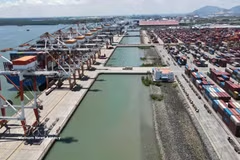
Ho Chi Minh City prioritises logistics infrastructure to raise direct import-export throughput above 80%
With measures revolving around investment in integrated logistics infrastructure, multimodal transport expansion and digital transformation acceleration, the strategy is intended to reduce logistics costs, enhance competitiveness and support sustainable growth in external trade.
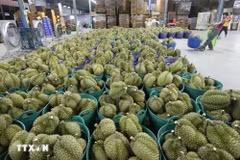
Durian exports recover despite mounting price pressure
If the Central Highlands harvest proceeds smoothly and pending issues related to growing-area and packing-house codes are resolved promptly, exports could generate an additional 2 billion USD in the remaining months of the year, pushing the whole-year figure beyond 4 billion USD, up from 3.8 billion USD last year.
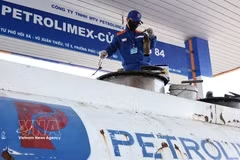
Ministry orders fuel supply inspections amid localised shortages
The ministry has taken steps to immediately inspect locations reporting shortages and identify the cause. Localities where shortages are taking place must examine the entire supply chain, including contracts between retailers and wholesalers, actual supply volumes, delivery schedules and the reasons for any failure to provide fuel.
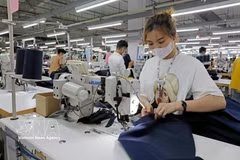
New US tariff policy should be based on objective, comprehensive assessment
This progress has been built on mutual respect, transparency and Vietnam's sustained efforts to improve its legal framework and comply with international standards. However, the US' recent tariff decision appears to overlook realities regarding Vietnam's labour environment and manufacturing practices.
Long Thanh Airport's second runway to be completed in September
According to the Airports Corporation of Vietnam (ACV), after 14 months of construction, the cement concrete pavement for the runway and taxiways has been substantially completed. Contractors are mobilising hundreds of workers and construction equipment to finish the remaining works on schedule.
Vietnam introduces special policies to strengthen anti-money laundering framework
Issued on July 24, Resolution No. 66.23/2026/NQ-CP amends and supplements a number of provisions in the 2022 Law on Anti-Money Laundering and related guiding documents. The revisions focus on key areas, including the definition of beneficial ownership, verification of customer information, transparency of legal arrangements, risk-based customer classification and the frequency of updating customer information.
Hanoi accelerates digital economy development, targets 22% of GRDP by end-2026
With Hanoi's overall GRDP growing by 8.2% during the period, the digital economy contributed approximately 1.1 percentage points to the city's economic expansion, underscoring its increasingly substantive role in driving growth rather than remaining merely a policy objective.
Sun PhuQuoc Airways opens fourth international route, bringing Phu Quoc closer to the world
Sun PhuQuoc Airways (SPA) on July 25 operated its inaugural Singapore - Phu Quoc flight, marking the airline's fourth international route and making it the first full-service carrier to fly directly between two of Asia's most celebrated island destinations.
Nordic businesses look to Vietnam for deeper trade, supply-chain cooperation
VIS 2025 enabled Nordic businesses to directly explore Vietnamese suppliers while facilitating deeper engagements with management agencies, localities, industry associations, seaports, factories and logistics partners. The programme showed that Vietnam-Nordic cooperation is expanding beyond trade to supply-chain development, investment, logistics and digital transformation.
Phu Quoc airport’s 3,300m runway lights up ahead of landmark flight inspections
Viewed from above, Runway No. 2 has taken clear shape within the overall layout of Phu Quoc International Airport. Measuring 3,300 metres long and 45 metres wide, the new runway has been built parallel to the existing one. Its pavement and markings have been completed, and the project is now undergoing final technical inspections. At night, the lighting system has been switched on at full intensity for testing.
Reference exchange rate up 10 VND at week’s beginning
With the current trading band of +/- 5%, the ceiling rate applicable for commercial banks during the day is 26,558 VND/USD, and the floor rate 24,028 VND/USD.
Brazil spends nearly 35 million USD on Vietnamese tilapia, imports surge 289-fold
VASEP said Brazil had become the fastest-growing market for Vietnamese tilapia, helping drive export growth as global demand for whitefish continues to increase.
Taxes proposed on vacant land, speculative deals
A key proposal is to introduce a mechanism to regulate windfall gains from differences in land values, while imposing high taxes on vacant land and property transactions conducted within a short period.
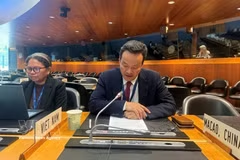
Vietnam attends India’s 8th WTO Trade Policy Review
India is one of Vietnam’s leading economic partners in South Asia and its eighth-largest trading partner of the Southeast Asian nation. Bilateral trade accounts for about 80% of Vietnam’s total trade with other South Asian countries. Meanwhile, Vietnam is currently India’s 22nd-largest trading partner globally and the fourth-largest in ASEAN.