Bac Ninh targets full digital governance at all SOEs by 2030

Bac Ninh province has set a 2030 goal for all State-owned enterprises to adopt modern, digital corporate governance as part of a sweeping restructuring to boost efficiency and transparency.

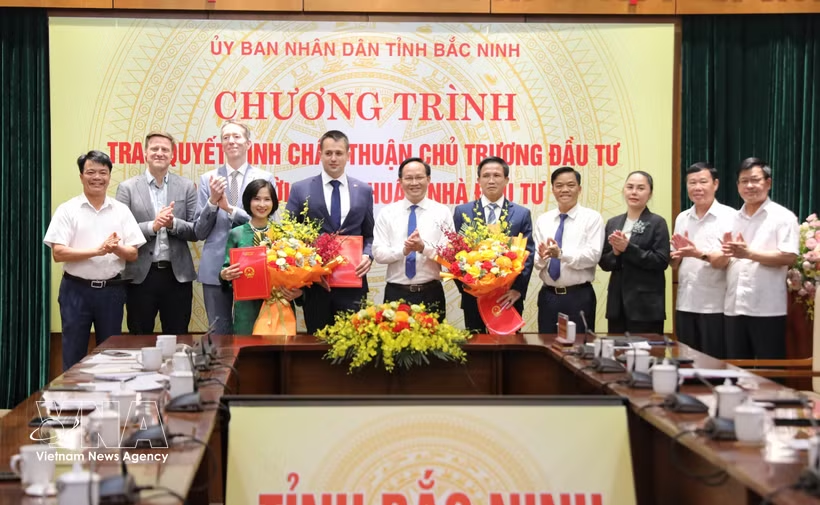
The People's Committee of Bac Ninh province hands over investment policy approval decisions, along with investor approvals, for SD Son Dong Wind Power Plant and the Bac Giang 2 Wind Power Plant projects. (Photo: VNA)

Bac Ninh (VNS/VNA) – The northern province of Bac Ninh has set a 2030 target for all State-owned enterprises (SOEs) to adopt modern corporate governance on digital platforms, alongside a comprehensive restructuring drive and tighter performance oversight to boost the efficiency of the State sector.

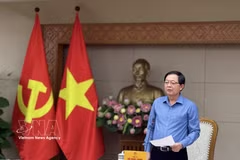
Nguyen Thi Huong, Standing Deputy Secretary of the Bac Ninh provincial Party Committee, said the province will restructure SOEs by sector and mandate, streamline organisational structures and concentrate State ownership in public utilities, infrastructure and other essential services where private investment remains limited or ineffective.

The province will also manage and use land and natural resources economically and transparently, and develop synchronised, modern strategic infrastructure – transport, irrigation, digital, and urban – in line with first-tier city standards as it pursues the goal of becoming a centrally governed city.

Bac Ninh plans to strengthen State-owned credit institutions so they lead in technology and governance, continue the socialisation of public services, and streamline public service units.

It will study capital contributions to establish enterprises in science, technology and digital transformation, and roll out company-specific restructuring roadmaps with clear timelines and outcomes.

Long-standing weaknesses at SOEs will be addressed, with loss-making firms reviewed urgently. The province will clarify organisational and individual accountability and create conditions for enterprises to either proceed with bankruptcy or continue restructuring to restore efficiency, avoiding prolonged losses and waste of State assets and capital.

Human resource quality will be improved, particularly among leaders, managers and specialists in State economic bodies, with market-competitive pay. Public–private partnerships will be promoted in artificial intelligence and advanced digital technologies.

For enterprises where the State does not need to retain controlling stakes, Bac Ninh will transfer ownership, under a defined roadmap, to central or local State capital investment entities for comprehensive review, classification and appropriate capital restructuring.

Financial supervision of SOEs will be tightened, with enhanced inspections, audits and risk warnings and stronger measures against corruption, waste and other violations in the management and use of State capital and assets.

The province is also studying the conversion of suitable public service units into single-member limited liability companies wholly owned by the State, and selective investment in capable public units in basic research and strategic technologies.

Vice Chairman of the provincial People’s Committee Ngo Tan Phuong said Bac Ninh will continue to improve the business climate through 2030 and aims to maintain its PCI ranking among the country’s leaders.

Authorities will walk alongside businesses by raising agency heads’ accountability to promptly and effectively resolve investors’ petitions and bottlenecks, ensure fair treatment across all economic sectors, and support local firms to expand in domestic and overseas markets.

From 2021 to 2025, the province recorded 28,590 newly established enterprises with registered capital of more than 367 trillion VND (13.9 billion USD) with an average of 23.7 billion VND per firm.

In the first half of 2026, there were 4,478 new enterprises with total registered capital of about 80.2 trillion VND, along with 177 new branches or representative offices and 1,717 new business locations./.

VNA
See more

A corner of Phu Quoc special zone in An Giang province (Photo: VNA)

An Giang aims to become leading maritime economic hub

Under the province's master plan for 2021–2030 with a vision to 2050, An Giang will prioritise investment in five strategic sectors: strategic infrastructure; processing industries and clean energy; trade, services, logistics and border-gate economy; high-quality tourism; and high-tech agriculture, ecological development and the circular economy.

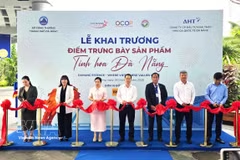
Chairman of Da Nang city People's Committee Nguyen Manh Hung and delegates at the opening ceremony of the product showcase space at the International Passenger Terminal of Da Nang International Airport. (Photo: VNA)

Da Nang opens showcase for signature local products at airport

Speaking at the opening ceremony, Deputy Director of the municipal Department of Industry and Trade Do Thi Quynh Tram said Da Nang is home to a wide range of distinctive OCOP products, rural industrial goods and local specialities. The new exhibition spaces will help connect high-quality local products with consumers, particularly tourists, while enhancing brand recognition and promoting the city’s image.

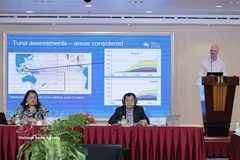
Deputy Prime Minister Ho Quoc Dung speaks at the meeting (Photo: VNA)

Deputy PM calls for long-term strategy for sustainable fisheries development

Localities that have acted decisively have made clear progress while those taking a passive approach continue to see violations, Deputy PM Ho Quoc Dung said, adding that closer coordination among ministries, sectors and local authorities is needed to establish a unified nationwide fisheries management system.

Participants in the business forum held in Veracruz state of Mexico on July 27 (Photo: VNA)

Vietnam, Mexico step up business connectivity

The Trade Office invited Veracruz businesses to attend the Vietnam International Sourcing Expo 2026, a major trade promotion event hosted by Vietnam’s Ministry of Industry and Trade, to explore partnership and sourcing opportunities with Vietnamese manufacturers and exporters.

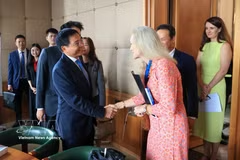
Deputy PM Nguyen Van Thang (L) meets with WTO Deputy Director-General Jennifer DJ Nordquist (Photo: VNA)

Deputy PM seeks WTO, WEF’s more support to Vietnam

As an active WTO member, Vietnam has been making active contributions to the organisation's agenda, including ratifying the first phase of the Agreement on Fisheries Subsidies, negotiating entry into the expanded Information Technology Agreement (ITA2), and preparing for its next Trade Policy Review scheduled for late 2026, Deputy Prime Minister Nguyen Van Thang said.

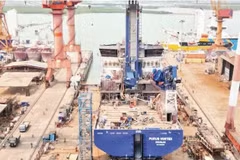
A modern commissioning service operation vessel for the offshore wind industry under construction at Ha Long shipyard. (Photo: nhandan.vn)

Shipbuilding helps shape Vietnam's maritime ecosystem, capabilities

Shipbuilding is increasingly viewed as an important component of Vietnam's marine economy. More than simply a manufacturing sector, it forms part of an integrated industrial ecosystem closely linked with metallurgy, mechanical engineering, electrical and electronic industries, automation, information technology and maritime logistics.

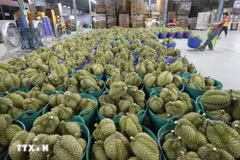
Vietnam's durian exports are expected to exceed 2 billion USD by the end of July. (Photo: VNA)

Durian exports recover despite mounting price pressure

If the Central Highlands harvest proceeds smoothly and pending issues related to growing-area and packing-house codes are resolved promptly, exports could generate an additional 2 billion USD in the remaining months of the year, pushing the whole-year figure beyond 4 billion USD, up from 3.8 billion USD last year.

At a Petrolimex station. Petrolimex said it was increasing fuel procurement, adjusting distribution and moving supplies between regions to ensure fuel supply across its system. (Photo: VNA)

Ministry orders fuel supply inspections amid localised shortages

The ministry has taken steps to immediately inspect locations reporting shortages and identify the cause. Localities where shortages are taking place must examine the entire supply chain, including contracts between retailers and wholesalers, actual supply volumes, delivery schedules and the reasons for any failure to provide fuel.

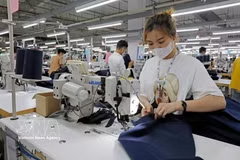
Garment production for export to the US market at TAL Vinh Phuc Garment Company. (Photo: VNA)

New US tariff policy should be based on objective, comprehensive assessment

This progress has been built on mutual respect, transparency and Vietnam's sustained efforts to improve its legal framework and comply with international standards. However, the US' recent tariff decision appears to overlook realities regarding Vietnam's labour environment and manufacturing practices.

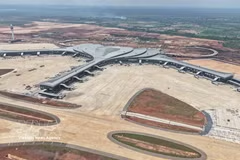
The construction site of Long Thanh International Airport in July 2026. (Photo: VNA)

Long Thanh Airport's second runway to be completed in September

According to the Airports Corporation of Vietnam (ACV), after 14 months of construction, the cement concrete pavement for the runway and taxiways has been substantially completed. Contractors are mobilising hundreds of workers and construction equipment to finish the remaining works on schedule.

Illustrative image (Photo: VNA)

Vietnam introduces special policies to strengthen anti-money laundering framework

Issued on July 24, Resolution No. 66.23/2026/NQ-CP amends and supplements a number of provisions in the 2022 Law on Anti-Money Laundering and related guiding documents. The revisions focus on key areas, including the definition of beneficial ownership, verification of customer information, transparency of legal arrangements, risk-based customer classification and the frequency of updating customer information.