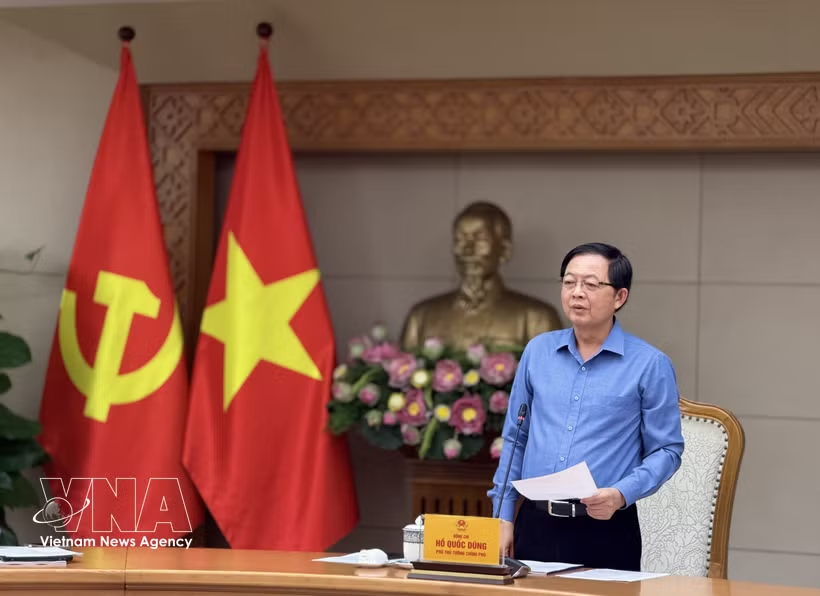
Deputy PM calls for long-term strategy for sustainable fisheries development

Localities that have acted decisively have made clear progress while those taking a passive approach continue to see violations, Deputy PM Ho Quoc Dung said, adding that closer coordination among ministries, sectors and local authorities is needed to establish a unified nationwide fisheries management system.

Deputy Prime Minister Ho Quoc Dung speaks at the meeting (Photo: VNA)

Hanoi (VNA) – Deputy Prime Minister Ho Quoc Dung has called for a long-term strategy to build a sustainable fisheries sector, stressing that stronger governance and digital transformation are essential for Vietnam to secure the removal of the European Commission's (EC) "yellow card" warning on illegal, unreported and unregulated (IUU) fishing.

Chairing the 35th meeting of the National Steering Committee for IUU Fishing Prevention and Sustainable Fisheries Development, held in a hybrid format on July 28, the Deputy PM stressed that developing the marine economy in general, and fisheries in particular, remains an issue of critical importance.

He noted that over the past five years, the fisheries sector has generated tens of billions of US dollars in revenue and made a significant contribution to national development. However, shortcomings in fishing management persist, with the EC's "yellow card" now entering its eighth year despite extensive efforts.

Dung acknowledged progress in addressing EC recommendations, including inspections in three localities that identified six major groups of shortcomings. Police have intensified investigations into vessel monitoring system (VMS)-related violations, authorities have strengthened vessel monitoring and port controls, and seafood traceability has improved. While customs authorities have also reviewed weaknesses in seafood import management, the Coast Guard and Border Guard have stepped up patrols and enforcement.

However, he said digital transformation still falls short of requirements. Although national databases have been established, data sharing among ministries and local authorities remains weak. Following its June inspection, the EC issued 37 recommendations covering five key areas requiring further action.

The Deputy PM blamed the remaining shortcomings mainly on inconsistent leadership and enforcement at the local level.
vnanet-potal-pho-thu-tuong-ho-quoc-dung-can-xay-dung-chien-luoc-phat-trien-thuy-san-ben-vung-8917685.jpg
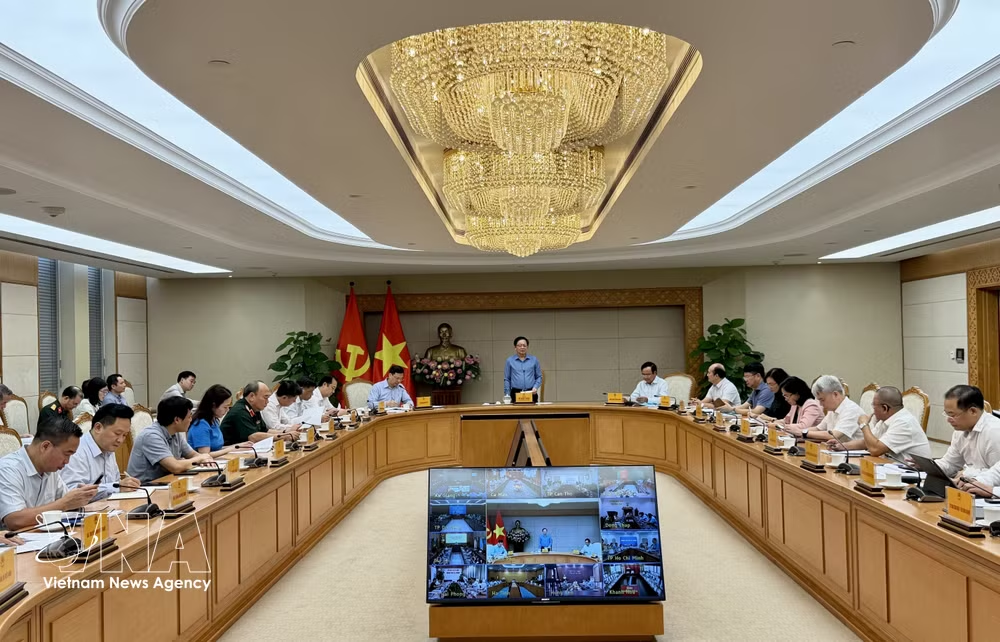
An overview of the meeting (Photo: VNA)

Localities that have acted decisively have made clear progress while those taking a passive approach continue to see violations, he said, adding that closer coordination among ministries, sectors and local authorities is needed to establish a unified nationwide fisheries management system.

Looking beyond the immediate goal of lifting the "yellow card", the official asked for a strategy for sustainable fisheries development aligned with the country's new marine economy policy, covering the entire value chain, from breeding and harvesting to processing, exports and the application of science and technology.

He urged ministries and local governments to immediately implement the measures agreed upon at the meeting, stressing that each locality will be held fully accountable for results and must be thoroughly prepared for the EC's next inspection.

Deputy Minister of Agriculture and Environment Vo Thanh Hung reported that Vietnam has continued to make progress in combating IUU fishing, with improvements in institutional arrangements, fisheries management, vessel monitoring, catch traceability and enforcement.

However, the EC's fifth inspection found that key shortcomings remained in on-the-ground enforcement, particularly in handling violations, integrating the VMS, preventing fishing vessels from encroaching into foreign waters and strengthening catch traceability. These issues will be decisive in Vietnam's efforts to have the "yellow card" lifted in 2026.

Following the inspection, the Government issued Official Dispatch No. 34, restructured the national steering committee, established an inter-agency task force, developed a nationwide electronic reporting system and dispatched inspection teams to key coastal localities.

Of the 267 tasks assigned before the latest EC inspection, 254 have been completed. After the inspection, the Government assigned another 35 tasks, of which 21 have been fulfilled while 14 remain under implementation.

Hung said Vietnam's legal framework for combating IUU fishing now largely meets requirements. The Government has issued Decree No. 246/2026/ND-CP on administrative sanctions in the fisheries sector while continuing to refine fisheries policies and review the Fisheries Law and related regulations.

The national VN-Fishbase database currently manages 80,332 fishing vessels. Among registered vessels, 91.9% hold valid inspection certificates, 95.7% have valid fishing licences and 98.5% possess food safety certificates. Meanwhile, 99.6% of vessels measuring at least 15 metres have installed VMS equipment, and cases of vessels crossing fishing boundaries or losing VMS signals have both declined from a year earlier.

During the first six months of 2026, Vietnam had 94 designated fishing ports, including 79 serving offshore fishing vessels. Authorities conducted 138 patrols and inspections, checked 2,502 vessels and fined 261 vessels, collecting about 4.6 billion VND (about 175,000 USD). The EC also acknowledged progress in Vietnam's deployment of the electronic catch documentation and traceability system (eCDT), while seafood landings through ports reached 421,000 tonnes.

Despite these improvements, enforcement remains a challenge. Authorities detected 4,713 violations during the period but imposed penalties in only 1,341 cases, with total fines exceeding 42 billion VND.

To meet the goal of lifting the "yellow card" in 2026, the Ministry of Agriculture and Environment proposed designating the time from now through August 31 as a nationwide peak enforcement period./.
VNA

See more

Phu Quoc pepper products, granted three stars under the OCOP programme in An Giang province, are displayed at an exhibition of outstanding OCOP products from the Mekong Delta. (Photo: VNA)

Phu Quoc leverages OCOP programme to take local specialities global

Better known as one of Vietnam’s premier island destinations, Phu Quoc is leveraging its “One Commune, One Product” (OCOP) programme to transform traditional specialities into internationally recognised products, integrating local agriculture, food processing and tourism to promote sustainable economic growth.

Production at an FDI enterprise in Tay Ninh province. (Photo: VNA)

FTA Index 2025 to be unveiled later this month

The index is designed to provide valuable information not only for State management agencies but also as an important reference for businesses, foreign investors, and industry associations in planning investment and business activities in Vietnam.

Air Premia, a carrier of the Republic of Korea, will resume flights between Incheon and Ho Chi Minh City from November 5. (Photo: The Courtesy of Air Premia)

Air Premia to resume Incheon–Ho Chi Minh City route from November

Flights will depart Incheon International Airport at 6:40 pm (RoK time) and arrive at Tan Son Nhat International Airport in Ho Chi Minh City at 11 pm (Vietnam time). Return flights will leave Ho Chi Minh City at 12:30 am on Mondays, Tuesdays, Thursdays, Fridays and Sundays, landing in Incheon at 7:40 am.

Production at Viet Hai High-Tech Structure Production Company Limited in Vung Ang Economic Zone. Ha Tinh province aims to develop Vung Ang Economic Zone into a regional centre for industry, energy, seaports and logistics (Photo: VNA)

Revised master plan of Vung Ang EZ approved

The adjustment aims to create a more rational development framework to maximise the zone’s potential and advantages while providing a legal foundation for construction management and ensuring sustainable development.

Illustrative image (Photo: VNA)

Vietnam looks to domestic market to sustain wood industry growth

Vietnam’s wood sector has long been a top foreign-currency earner. Exports of wood and wooden products neared 17.3 billion USD in 2025, reaching more than 160 countries and territories and clearing the high bars set by the US, the European Union and Japan.

Delegates at the event (Photo: VNA)

Vietnam remains key market for Polish food producers

The campaign promotes selected European Union agricultural and food products, including fresh, chilled and frozen beef and pork, fresh apples, apple juice and dried apples, targeting consumers, importers, distributors, retailers and the hospitality sector.

Wei Xiaoli, a representative of Shandong Jindafeng Machinery Co., Ltd., in an interview granted to the Vietnam News Agency. (Photo: VNA)

Chinese firms see strong potential for agricultural mechanisation cooperation with Vietnam

Business representatives said mechanisation not only helps reduce reliance on manual labour but also improves production efficiency, shortens planting and harvesting times, reduces post-harvest losses and enhances the quality of agricultural products. For rice-producing countries like Vietnam, they noted, accelerating mechanisation is an inevitable trend to strengthen the competitiveness of the agricultural sector.

Community-led fisheries groups have become frontline defenders of coastal fisheries. (Photo: VNA)

Community-led fisheries groups strengthen IUU fight in Ha Tinh

With a long coastline and abundant inshore fishing grounds, Ha Tinh has long identified the marine economy as a key growth driver. However, growing fishing pressure and destructive practices have posed major management challenges. Community-led self-management initiatives are now providing an effective solution.

At the VIFC-HCMC (Photo: VNA)

700 bln USD for net zero: Vietnam bets on VIFC

Assoc. Prof. Dr. Nguyen Huu Huan, Vice Chairman of the Executive Board of VIFC-HCMC, said the VIFC will focus on building market infrastructure needed to bridge the gap between big investment pledges and bankable projects.

A view of the launch ceremony for the expanded Vietnam–China cross-border QR payment service. (Photo: NAPAS)

Over 1 billion Weixin Pay users can make QR code payments in Vietnam

NAPAS, Weixin Pay, and BIDV will study the rollout of the reverse payment service, enabling users of Vietnamese banking applications and e-wallets to make QR code payments in China, with the aim of completing a comprehensive cross-border payment ecosystem between the two countries.

Vietnam cuts retail fuel prices on August 6. (Photo: VNA)

Vietnam cuts retail fuel prices on August 6

The maximum retail price of E5RON92 biofuel was reduced by 1,160 VND to 21,728 VND (0.83 USD) per litre, while that of E10RON95-III fell by 1,035 VND to 22,324 VND per litre.