Vietnam unveils financial market overhaul, targets deeper bond market to boost long-term growth

The reform strategy, approved under Decision 1413/QD-TTg, envisions a more balanced financial market structure with stronger links between its banking, capital and insurance sectors, in line with the country’s target of high growth by 2045.

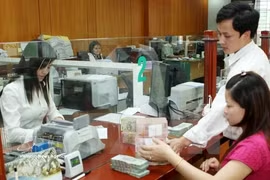
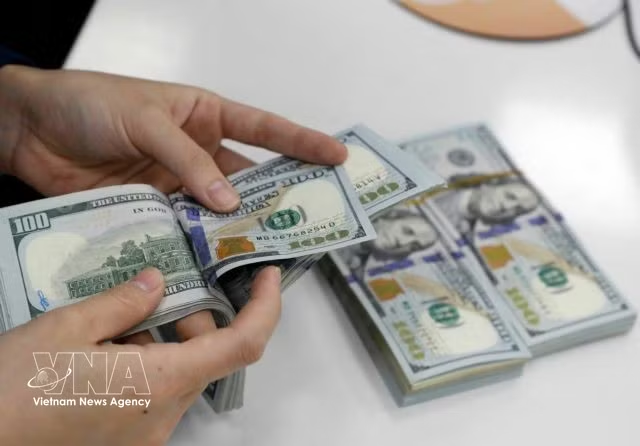
By 2045, outstanding bonds are projected to reach around 60% of GDP. (Photo: VNA)

Hanoi (VNS/VNA) – Vietnam aims to expand its bond market to the equivalent of around 60% of GDP by 2045 and position the capital market as a key source of medium- and long-term financing for the economy, under a recently approved sweeping financial market reform plan.

The reform strategy, approved under Decision 1413/QD-TTg, envisions a more balanced financial market structure with stronger links between its banking, capital and insurance sectors, in line with the country’s target of high growth by 2045.

It sets out measures to strengthen the bond market through improved credit rating mechanisms, a broader range of products and upgraded market infrastructure.

Over the next five years, Government bond issuance is expected to meet 60–65% of the State's borrowing needs, while local government bond issuance is targeted to cover about 20% of local budget borrowing requirements during the same period.

For the corporate bond market, the Government will implement credit rating requirements for public bond offerings and introduce mandatory credit ratings for privately placed bonds sold to individual investors.

New fundraising instruments will also be studied, including infrastructure bonds, environmental, social and governance bonds and public-private partnership project bonds.

The plan also includes the establishment of bond valuation service providers to improve price transparency and support investor decision-making, while strengthening certification mechanisms for green projects and green bonds in line with environmental regulations.

By 2045, outstanding bonds are projected to reach around 60% of GDP.

The new target comes after Vietnam fell short of its previous bond market development goal. Outstanding bonds were estimated at about 34% of GDP in 2025, compared with the Government's target of at least 47% for the 2021–2025 period.

Beyond the bond market, the reform plan aims to build a modern, integrated financial market that meets international standards by 2045, with the stock market playing a central role in mobilising capital and the International Financial Centre gradually becoming an important regional hub for capital flows and financial services.

By 2030, foreign investors' holdings in the capital and stock markets are targeted to reach around 15% of GDP, while the net asset value of securities investment funds is expected to increase to about 5% of GDP.

For the insurance market, the plan aims to develop the insurance sector into a more important pillar of the financial system by mobilising long-term capital, strengthening social protection and supporting financial stability.

It targets average annual premium growth of 6–8% from 2026 through 2045, with 20% of the population covered by life insurance by 2045 and average insurance premiums reaching 7 million VND per person annually.

Authorities will explore a regulatory sandbox for Insurtech business models while building a National Insurance Data Centre to enhance market oversight and data integration. In the longer term, blockchain technology will be studied to record insurance claims and support an industry-wide early warning network against insurance fraud.

The plan also outlines measures to modernise the banking system, improve credit quality, promote digital banking and financial inclusion, and direct lending towards production, business and other priority sectors to support long-term economic growth.

Eight groups of reforms are laid out in the strategy, including strengthening the legal framework, diversifying financial products, expanding the investor base, modernising financial institutions and market infrastructure, enhancing risk-based supervision, promoting international integration and developing high-quality financial talent./.

VNA

See more

Amata Industrial Park in Dong Nai city (Photo: VNA)

Green shift powers investment in southeast Vietnam

The Amata Industrial Park in Dong Nai City, established 32 years ago and covering more than 500ha, is home to over 160 domestic and foreign businesses. Selected in 2020 as one of three national pilot sites for conversion into an eco-industrial park, Amata has raised its compliance with the international eco-industrial park framework from 41% to 86% in 2024, and is working towards becoming Dong Nai's first certified eco-industrial park.

At a port in Ho Chi Minh City (Photo: VNA)

Multi-channel capital mobilisation needed to achieve double-digit growth

The Ministry of Finance estimates development investment for 2026-2030 at a minimum of 38.5 quadrillion VND (1.48 trillion USD), or about 40% of GDP. The state budget is expected to provide only about 20%, or more than 7.7 quadrillion VND, leaving over 80%, or more than 30 quadrillion VND, to be raised from the broader economy. That makes expanding capital mobilisation channels beyond bank credit essential.

An aerial view of the Nhieu Loc – Thi Nghe area in Ho Chi Minh City. The southern metropolis is home to the Vietnam International Financial Centre. (Photo: VNA)

Vietnam International Financial Centre launches membership registration system

Integrated into the official Vietnam International Financial Centre portal at vifc.gov.vn, the online system for registering and recognising members provides a unified online service channel through which investors, organisations and businesses can complete procedures related to membership, from new registration and recognition to information updates and termination of membership.

At a tax office in Hung Yen province (Photo: VNA)

Finance ministry moves to cut business costs, spur growth

Tax policy is among the solutions with the most direct impact on companies. Rather than prioritising near-term revenue collection, fiscal policy is being run to help them preserve cash flow, expand production and build more sustainable revenue sources.

In the Kim Long Motor Hue factory (Photo: VNA)

Hue courts capital to turn industrial zones into growth engine

The economic and industrial zones in Hue city host more than 200 active investment projects worth over 152 trillion VND (5.84 billion USD), with 139 already operational. Since the start of 2026, they have generated about 32 trillion VND, contributed 4.2 trillion VND to the state budget and brought in 730 million USD in exports, while employing more than 46,000 workers.

An overview of a meeting between Politburo member and Secretary of the Hanoi Party Committee Tran Duc Thang and representatives of Saint Petersburg businesses. (Photo: VNA)

Saint Petersburg’s metro expertise valuable for Vietnam

As Hanoi implements its master plan with a 100-year vision, in which metro lines are identified as the backbone of the capital city’s transport network, Secretary of the municipal Party Committee Tran Duc Thang met with representatives from several Saint Petersburg companies specialising in urban rail development.

An art performance at 2026 Dak Lak Durian Festival. (Photo: VNA)

Dak Lak Durian Festival seeks to elevate Vietnam’s agricultural brand globally

Dak Lak has about 41,000ha of durian, with this year’s output estimated at nearly 500,000 tonnes. The province has 280 growing-area codes covering around 7,500ha, along with 41 packing facilities approved for export. In 2025, Dak Lak’s durian sector contributed about 1.1 billion USD to the country’s export turnover.

Delegates cut the ribbon to inaugurate the Ho Chi Minh City-Shenzhen direct air route. Photo: baodautu.vn

Vietravel Airlines launches direct Ho Chi Minh City-Shenzhen route

Vietravel Airlines' new route connects Tan Son Nhat International Airport (SGN) in Ho Chi Minh City with Shenzhen Bao'an International Airport (SZX), meeting growing demand for travel between the two markets for investment, trade, tourism and visiting relatives.