Hanoi (VNS/VNA) – The paper industry is urging authorities to address regulatory bottlenecks in the domestic waste paper supply chain, saying tax and documentation requirements are raising costs for recycled raw materials and could undermine the country's circular economy goals.
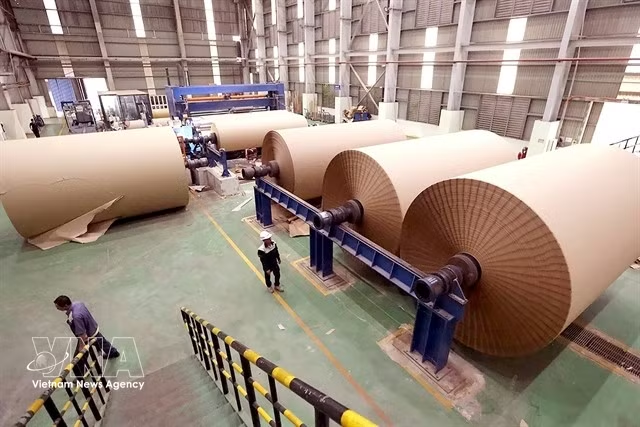
Domestic paper production reached about 6.34 million tonnes in 2025, while consumption rose to an estimated 7.77 million tonnes, up 10.8% from a year earlier, according to the Vietnam Paper and Pulp Association (VPPA).
Packaging paper accounted for more than 80% of total output, with demand expected to continue growing alongside e-commerce, logistics, exports and the shift away from plastic packaging.
The industry recycles more than 3.5 million tonnes of waste paper annually, providing a key source of raw materials while helping reduce landfill waste, conserve resources, lower greenhouse gas emissions and support jobs in the collection sector.
Unlike many manufacturing industries that rely on concentrated sources of raw materials, the recycled paper supply chain depends on a fragmented network of individual collectors, collection points, baling stations, traders and recycling mills.
Small-scale collectors account for a significant share of the industry's domestic raw material supply but many operate informally, lack business registration, do not use electronic invoices and continue to conduct transactions primarily in cash.
Industry representatives say this creates compliance challenges for paper manufacturers, which must document purchases for tax purposes despite dealing with thousands of small transactions across the collection chain.
The biggest obstacle for paper recycling businesses lies in raw material procurement, a representative of the Hai Phong-based HHP GLOBAL JSC said at a recent meeting with VPPA.
According to the representative, before waste paper reaches collection stations, hundreds or even thousands of transactions have already taken place.
Requiring complete seller information, invoices, supporting documents and payment records for every transaction creates an administrative burden that does not reflect operational realities.
Under the current tax regulations, tax obligations for household and individual businesses depend on revenue, business activity and the applicable tax calculation method.
The framework governing tax and invoice management for such businesses is being updated under the 2025 Law on Tax Administration and implementing decrees that took effect on July 1, 2026.
Industry participants say compliance costs are often passed on through higher transaction prices, increasing the cost of domestically sourced recycled paper.
Businesses also point to differences in value-added tax (VAT) treatment between domestic and imported waste paper. Purchases from domestic suppliers paying VAT under the direct method generally do not allow buyers to separately deduct VAT, with the full payment instead recorded as part of production costs.
By contrast, imported waste paper can qualify for VAT deductions when businesses meet the requirements under the VAT law and retain the necessary import tax documentation.
Manufacturers said the differing tax treatment could make imported waste paper more competitive than domestically collected material, despite the Government's broader objectives of promoting a circular economy, increasing resource efficiency and reducing emissions.
Centralised tax collection mechanism proposed
Industry representatives have proposed allowing manufacturers to declare and pay taxes on behalf of small-scale waste paper suppliers through a centralised mechanism, arguing it would improve tax compliance while reducing the administrative burden on businesses and informal collectors.
Under the proposal, eligible companies purchasing waste paper from individuals or household businesses will be allowed to generate electronic purchase records based on seller identification, weighing slips, delivery notes, warehouse receipts, payment documents and other transaction data. Companies will then declare and pay the seller's tax obligations at rates applicable under existing tax rules.
The industry is also seeking changes to allow manufacturers to deduct input value-added tax (VAT) on purchases supported by sales invoices issued under the direct tax method or electronic purchase documents.
Industry representatives said a centralised declaration and withholding mechanism will provide manufacturers with sufficient documentation to recognise production costs, while enabling tax authorities to monitor transactions through corporate accounting systems without imposing additional compliance requirements on small-scale collectors.
Paper manufacturers are also urging changes to environmental regulations governing imports of waste paper, which remains an important source of raw materials alongside domestic collection.
Under current environmental protection rules, companies importing waste paper for production must make an environmental protection deposit, with the amount calculated as 15%, 18% or 20% of a shipment's value, depending on the applicable category.
Businesses say lowering deposit rates, shortening refund periods and adopting a risk-based management system will improve cash flow and support investment while maintaining environmental oversight.
A representative of Miza JSC in Hanoi said a more differentiated policy was needed to reflect each company's level of compliance.
Companies with a strong compliance record, adequate environmental protection systems and no violations should benefit from a more favourable mechanism rather than being subject to the same deposit requirements as higher-risk businesses, the representative said.
Under the proposal, authorities will classify companies according to their compliance history. Businesses with a long record of meeting environmental requirements can qualify for lower deposit rates or bank guarantees, while firms with violations or limited operating history will remain subject to stricter deposit requirements and enforcement measures./.

E-commerce booms, packaging paper industry benefits significantly
One of the key growth drivers for the paper packaging industry is the boom in e-commerce, FiinGroup reported, forecasting that the size of Vietnam's e-commerce market will reach 60 billion USD by 2030, leading to a massive demand for corrugated cartons used for shipping.