Vietnamese shrimp exports to China offset weaker sales to US

China has become the main growth engine for Vietnam's shrimp exports, offsetting weaker sales to the US as exporters navigate trade uncertainty, high shipping costs and tougher market requirements.

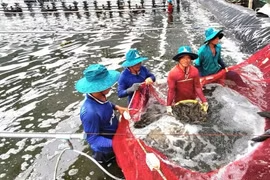
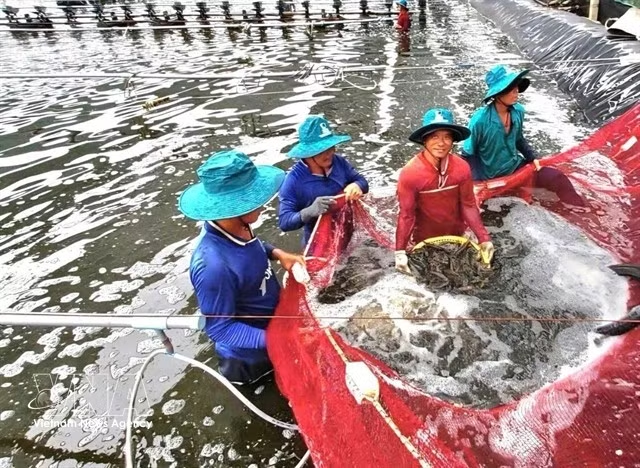
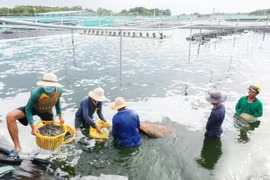
Vietnam's shrimp exports regained momentum in the first half of 2026 after a volatile period, supported by robust demand from mainland China and Hong Kong. (Photo: VNA)

Hanoi (VNS/VNA) – China has become the main growth engine for Vietnam's shrimp exports, offsetting weaker sales to the US as exporters navigate trade uncertainty, high shipping costs and tougher market requirements.

Vietnam's shrimp exports regained momentum in the first half of 2026 after a volatile period, supported by robust demand from mainland China and Hong Kong.

Strong demand from mainland China and Hong Kong helped lift Vietnam's shrimp exports 14.2% in the first half of 2026, industry data showed, highlighting a shift in the sector's export mix as geopolitical tensions and changing trade policies continue to reshape global seafood flows.

Data from the Vietnam Association of Seafood Exporters and Producers (VASEP) showed Vietnam's shrimp exports rose by 24% year-on-year to about 458 million USD in June, bringing first-half export earnings to 2.35 billion USD, up 14.2%.

Exports to China and Hong Kong totalled about 845 million USD in the first six months of the year, accounting for more than one-third of Vietnam's shrimp export revenue, according to VASEP.

Shipments to mainland China jumped 47% from a year earlier, the fastest growth among Vietnam's major export destinations, supported by recovering seafood demand, shorter delivery times and improving cross-border logistics.

Industry executives say recovering seafood consumption in China's large urban centres, coupled with Vietnam's geographic proximity, has shortened delivery times, lowered freight costs and helped preserve product quality for fresh and frozen shrimp.

Cross-border trade has also benefited from upgrades to border infrastructure, wider use of electronic customs clearance, closer quarantine coordination and risk-based customs management, reducing clearance times for perishable seafood products.

Many exporters have responded by expanding certified shrimp farms, strengthening product traceability systems and investing in higher-value processing to meet increasingly stringent requirements from Chinese buyers.

The outlook remains more challenging in the US, where shrimp exports fell by 15% year-on-year to about 290 million USD in the first half of 2026, according to VASEP.

Industry analysts said June's improvement in shipments to the US largely reflected exporters and importers accelerating deliveries ahead of potential changes to US tariff policy, rather than a sustained recovery in underlying consumer demand.

Logistics also remains a major headwind for exporters. Freight rates on trans-Pacific shipping routes remain volatile, while shortages of refrigerated containers and shipping delays continue to increase costs for frozen seafood exporters. Even short disruptions in transit times can significantly raise storage and cold-chain expenses.

Nguyen Quang Thanh, Deputy Director of Hoang Ha Logistics JSC, said exporters serving Europe faced similar challenges, with ocean freight costs on long-haul routes still above pre-pandemic levels and shipping lines frequently adjusting schedules in response to global supply chain disruptions.

European markets were also imposing stricter requirements on traceability, sustainability, carbon emissions, illegal fishing controls and environmental standards, adding to exporters' compliance costs.

Industry experts say China's rapid growth provides an opportunity for Vietnamese exporters to diversify their customer base and reduce reliance on other traditional export markets.

However, they caution that the US, the European Union and Japan remain critical destinations because they generate higher-value sales and will continue to shape the industry's long-term competitiveness.

Maintaining export growth will require more than expanding production capacity, analysts say. Improving logistics efficiency, diversifying shipping routes and making greater use of free trade agreements will be essential to lowering export costs, while further customs reforms and digitisation could help speed border clearance and strengthen the global competitiveness of Vietnamese shrimp.

With demand from China remaining strong, Vietnam's shrimp industry is moving closer to its target of 5 billion USD in exports this year. Whether that momentum can be sustained, however, will depend on exporters' ability to reduce logistics costs and adapt to evolving trade and regulatory requirements in key markets, including the US and Europe./.
VNA

See more

A corporate executive introduces the potential of Australia's construction material market (Photo: VNA)

Vietnamese construction material makers set sights on Australia

Co-hosted by the Vietnam Trade Office in Australia, the Australia-Vietnam Investment and Logistics Council, and the Northern Vietnam Steel Structure Association, the gathering drew business representatives, industry bodies, and experts in construction, inspection, legal affairs, and logistics.

Deputy Prime Minister Nguyen Van Thang speaks at a meeting with Vietnamese experts in finance and technology in Switherland. (Photo: VNA)

Deputy PM urges stronger Vietnam–Switzerland cooperation in finance, innovation

Deputy Prime Minister Nguyen Van Thang asked Zug and Swiss financial and technology firms, including Crypto Valley, to strengthen cooperation with Vietnam by promoting expert exchanges, providing policy advice on crypto asset market regulation, supporting the development of digital asset market infrastructure, and fostering business links in the fields of blockchain and innovation.

Illustrative photo (Photo: VNA)

Hanoi pilots digital consumer protection, e-commerce assurance scheme

Under a blueprint issued on July 27, 2026, the capital city aims to have 500 businesses and organisations participating in or connected to the scheme by 2028. It also targets 1,000 products on dedicated digital storefronts or linked online platforms, with at least 80% of products carrying traceability information or suitable identification codes.

A corner of Phu Quoc special zone in An Giang province (Photo: VNA)

An Giang aims to become leading maritime economic hub

Under the province's master plan for 2021–2030 with a vision to 2050, An Giang will prioritise investment in five strategic sectors: strategic infrastructure; processing industries and clean energy; trade, services, logistics and border-gate economy; high-quality tourism; and high-tech agriculture, ecological development and the circular economy.

Chairman of Da Nang city People's Committee Nguyen Manh Hung and delegates at the opening ceremony of the product showcase space at the International Passenger Terminal of Da Nang International Airport. (Photo: VNA)

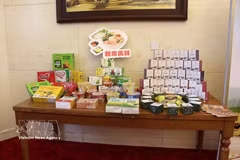
Da Nang opens showcase for signature local products at airport

Speaking at the opening ceremony, Deputy Director of the municipal Department of Industry and Trade Do Thi Quynh Tram said Da Nang is home to a wide range of distinctive OCOP products, rural industrial goods and local specialities. The new exhibition spaces will help connect high-quality local products with consumers, particularly tourists, while enhancing brand recognition and promoting the city’s image.

Deputy Prime Minister Ho Quoc Dung speaks at the meeting (Photo: VNA)

Deputy PM calls for long-term strategy for sustainable fisheries development

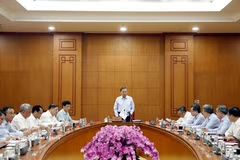
Localities that have acted decisively have made clear progress while those taking a passive approach continue to see violations, Deputy PM Ho Quoc Dung said, adding that closer coordination among ministries, sectors and local authorities is needed to establish a unified nationwide fisheries management system.

Participants in the business forum held in Veracruz state of Mexico on July 27 (Photo: VNA)

Vietnam, Mexico step up business connectivity

The Trade Office invited Veracruz businesses to attend the Vietnam International Sourcing Expo 2026, a major trade promotion event hosted by Vietnam’s Ministry of Industry and Trade, to explore partnership and sourcing opportunities with Vietnamese manufacturers and exporters.

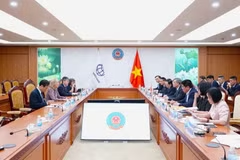
Deputy PM Nguyen Van Thang (L) meets with WTO Deputy Director-General Jennifer DJ Nordquist (Photo: VNA)

Deputy PM seeks WTO, WEF’s more support to Vietnam

As an active WTO member, Vietnam has been making active contributions to the organisation's agenda, including ratifying the first phase of the Agreement on Fisheries Subsidies, negotiating entry into the expanded Information Technology Agreement (ITA2), and preparing for its next Trade Policy Review scheduled for late 2026, Deputy Prime Minister Nguyen Van Thang said.

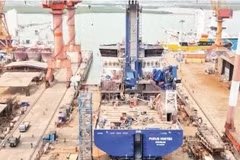
A modern commissioning service operation vessel for the offshore wind industry under construction at Ha Long shipyard. (Photo: nhandan.vn)

Shipbuilding helps shape Vietnam's maritime ecosystem, capabilities

Shipbuilding is increasingly viewed as an important component of Vietnam's marine economy. More than simply a manufacturing sector, it forms part of an integrated industrial ecosystem closely linked with metallurgy, mechanical engineering, electrical and electronic industries, automation, information technology and maritime logistics.