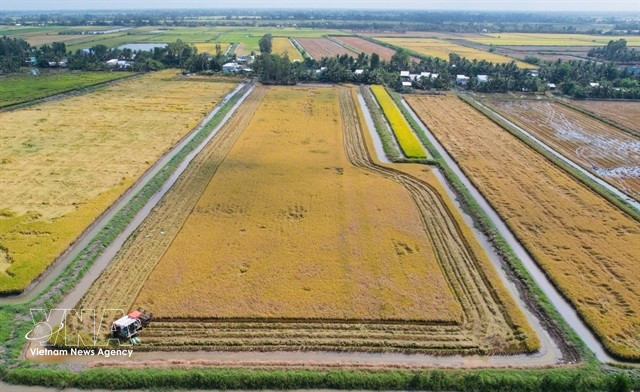
Hanoi (VNS/VNA) – Farmers in the Mekong Delta are getting high yields and good prices for rice grown under the rice – shrimp farming model.
In Ca Mau province, the 2025–26 rice crop on rice – shrimp fields has benefited from relatively favourable weather conditions, creating an enabling environment for farmers to achieve good yields.
Farmers in Nhuy Cam hamlet in the province’s Vinh Loc commune are currently harvesting a bumper crop.
Tran Van Vu, Secretary of the hamlet’s Party cell, who also heads the local cooperative group, said the 2025–26 rice crop has been one of the most successful in recent years for local farmers.
Yields reached 0.9–1 tonne per 1,000sqm and prices exceeded 8,000 VND (30 US cents) per kilogramme, he said.
After deducting costs, farmers earned 4.5–5 million VND per 1,000sqm.
Besides rice, farmers also earned incomes from giant river prawns and various other aquatic species raised under the model. The prawns are sold at 80,000–120,000 VND per kilogramme, depending on size, with the larger fetching more.
Nguyen Hoang Vu, Vice Chairman of the Vinh Loc commune People’s Committee in Ca Mau, said the commune cultivated nearly 9,000ha of rice in the 2025–26 crop, mostly the ST24 and BL9 rice varieties, under the model.
“These are high-quality rice varieties that meet export standards, are favoured by consumers and fetch high prices.”
Under the rice – shrimp farming model, which has been implemented in the delta for nearly 50 years, farmers grow rice in the rainy season and raise shrimp in the dry season, or intercrop rice and shrimp at the same time.
Both are considered clean products since farmers use few chemicals.
The model helps diversify income sources, reduce production risks and make full use of the natural ecosystem.
Nguyen Van Nam, a farmer in Ca Mau’s Bien Bach commune, said growing rice combined with raising giant river prawns in the field requires low costs and involves limited risks.
“Rice grows well and prawns are healthy and with few diseases, making this a sustainable model that helps farmers improve their livelihoods.”
Nguyen Thanh Hai, Chairman of the Bien Bach commune People’s Committee, said farmers can earn 80–100 million VND per hectare of rice – shrimp farming per year.
“The People’s Committee will encourage farmers to expand the model, considering it a suitable production approach amid increasingly complex climate change.”
The Ca Mau Department of Agriculture and Environment said the model not only brings immediate economic benefits but also has long-term significance for sustainability.
It helps farmers proactively respond to weather risks while opening up new directions for increasing the value of agricultural products through ecological and organic production processes, it said.
Across the Mekong Delta, the model is increasingly underlining its important role in restructuring the agricultural sector towards climate change adaptation, higher added value and expanding markets, particularly overseas.
The model delivers stable incomes while contributing to ecosystem protection and the sustainable use of land and water resources.
In An Giang province, rice – shrimp farming areas spread over more than 100,000ha in saltwater-affected zones, and have recorded high rice yields this year thanks to favourable weather, fewer pests and technical advances.
Tran Thanh Hiep, Deputy Director of its Department of Agriculture and Environment, said rice – shrimp farmers have basically completed harvesting their rice crop.
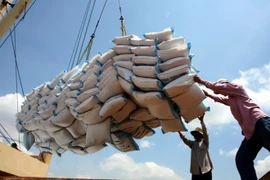
A large number of them have linked up with companies to secure outlets for their produce, especially high-quality grain for export.
Nguyen Van Hung, one of the first farmers to adopt the model in An Giang’s Dong Hoa commune, has a 3.5ha rice – shrimp field and uses organic methods.
He said: “Because rice in this area is grown on what used to be shrimp ponds, the soil is nutrient-rich, making it easier for farmers to use organic methods. This means less use of chemical fertilisers and, as a result, fewer pest and disease problems, which helps reduce input costs.”
The companies farmers tie up with buy their clean rice for export at 200 VND per kilogramme higher than market rates, he said.
His family earned around 350 million VND from rice and aquaculture in the most recent crop, much higher than in previous years, he added.
An Giang targets stabilising its rice – shrimp farming areas at more than 117,000ha by 2030.
The province expects the average income from this model to rise from 50–70 million VND per hectare per year now to 100–130 million VND by using technology, reorganising agriculture and expanding value-chain linkages./.