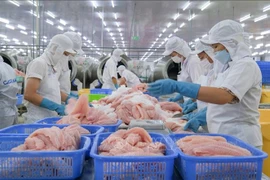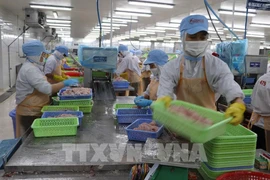
Tay Ninh (VNS/VNA) - Along with strong growth momentum of agricultural and seafood exports, cold storage is emerging as a strategic infrastructure component within the value chain.
However, the reality shows that Vietnam’s cold storage system is unevenly distributed, with facilities densely concentrated in some areas while remaining scarce in key raw material regions.
This imbalance not only increases logistical costs but also poses significant challenges to enhancing competitiveness and realising the ambition of reaching 100 billion USD in exports by 2030.
Nguyen Thanh Tung, chairman of the board of directors of New Era Cold Storage Joint Stock Company (NECS) in Phu An Thanh Industrial Park, Ben Luc commune, Tay Ninh province, said that logistics and cold storage were the "critical link” enabling businesses to proactively store goods, reduce pressure for urgent sales, cut costs, and improve export quality, especially as major markets tightened technical standards and carbon emission requirements.
However, Tung frankly acknowledged that the current cold storage system was unevenly distributed.
He said that although demand was very high, facilities are concentrated mainly in the South, particularly in Tay Ninh (formerly Long An), which benefited from expressway and seaport connectivity, he said.
Thanks to its advantageous location, seafood enterprises from the Mekong Delta, the Southeast region, and the Central Highlands often transport their products there for cold storage, making the area a major hub for cold chain infrastructure.
This situation created a paradox in which areas with developed infrastructure face localised excess capacity, while many production regions continue to lack on-site cold storage, he said.
Seafood and fruits and vegetables from the Central Highlands and the Mekong Delta must travel long distances for preservation, increasing logistics costs, raising the risk of losses, and generating additional emissions throughout the supply chain.
The imbalance in cold chain infrastructure is particularly evident in the fruit and vegetable sector.
Dang Phuc Nguyen, general secretary of the Vietnam Fruit and Vegetable Association (Vinafruit), noted that demand for cold storage was rising rapidly alongside the trend toward deep processing and frozen product exports.
However, many major production areas, especially in the Central Highlands, still lacked on-site cold storage, he noted.
After harvest, produce must be transported to distant provinces for freezing, increasing transportation costs and spoilage rates.
This not only affected business profitability but also reduced the competitiveness of Vietnamese agricultural products in international markets, he added.
Cold storage planning must prioritise placement in raw material regions with relatively adequate transport and energy infrastructure to reduce costs, minimie losses and maximise efficiency, said Nguyen.
Cold storage facilities cannot be concentrated solely along major logistics corridors or near seaports; they must be closely aligned with the agricultural production map.
Amid the restructuring of development space, Tay Ninh, following its administrative consolidation, is positioning itself as a modern industrial–urban–service centre of the region.
Huynh Van Son, vice chairman of the provincial People’s Committee, the emergence and development of large-scale logistics projects demonstrated this transformation.
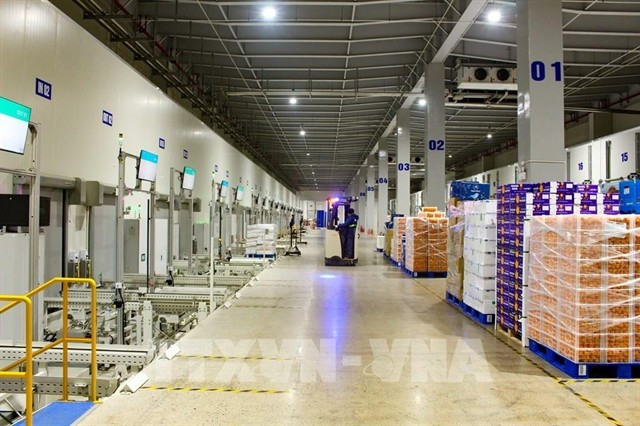
NECS is considered one of the flagship projects with an automated cold storage system capable of holding more than 110,000 pallets. It is not only a modern facility but also reflects bold investment, pioneering technology application, and a commitment to build a comprehensive logistics ecosystem within Vietnam.
This was not only a source of pride for the enterprise but also for the province, helping affirm the international competitiveness of Vietnamese businesses, said Son.
The project opens up strong opportunities for agricultural and seafood exports, key sectors of the province and the southern economic region, while creating jobs, contributing to local economic growth and elevating the province’s logistics position on the regional map.
From a strategic perspective, the province aims to become a cold logistics hub closely connected with cold storage networks and strategically located seaports.
However, the challenge lies not only in attracting investment but also in ensuring balanced planning to avoid overconcentration in certain areas while raw material regions lack preservation infrastructure.
During a working visit to Tay Ninh last month, Deputy Minister of Agriculture and Environment Phung Duc Tien stated that to achieve the 100 billion USD export target by 2030, the agricultural sector could not rely solely on expanding output but must focus on improving quality, preservation, and deep processing, in which cold storage played a key role.
Cold storage must be regarded as essential infrastructure, similar to transport systems or seaports, Tien stressed.
Investment in cold storage must be integrated into the overall planning of production regions, logistics centres, and export supply chains, avoiding fragmented development, he noted.
At the same time, he added that cold storage facilities must meet green transition and digital transformation requirements, in line with increasingly stringent international standards.
According to experts, digital transformation could contribute an additional 1.25%s to GDP growth.
If digital transformation went hand in hand with the green transition, and complied with environmental and emissions standards set by importing markets, Vietnam would not only keep pace but also strengthened its position as a leading supplier of high-quality agricultural products, said experts.
Therefore, the cold storage challenge is not simply about expanding capacity, but about ensuring proper planning that aligns facilities with production regions, integrates them with transport and energy infrastructure, supports appropriately scaled investment, and adopts modern, eco-friendly technologies.
Policies on capital support, electricity pricing for cold storage, and investment incentives need to be designed to promote balanced development across regions./.
Vietnam posts 13% rise in seafood exports in January
Growth in the first month of this year was driven mainly by Asian markets, particularly China, Japan and ASEAN, and by strong performance in key product groups such as pangasius and squid, octopus.