FIT boom creates new opportunities for Vietnam's tourism

According to Nguyen Trung Khanh, Director General of the Vietnam National Authority of Tourism (VNAT), FIT has become one of the defining trends in post-pandemic tourism. Increasingly, travellers are seeking flexibility, personalised experiences and authentic cultural engagement, prompting destinations worldwide to rethink their tourism products, services and marketing strategies.

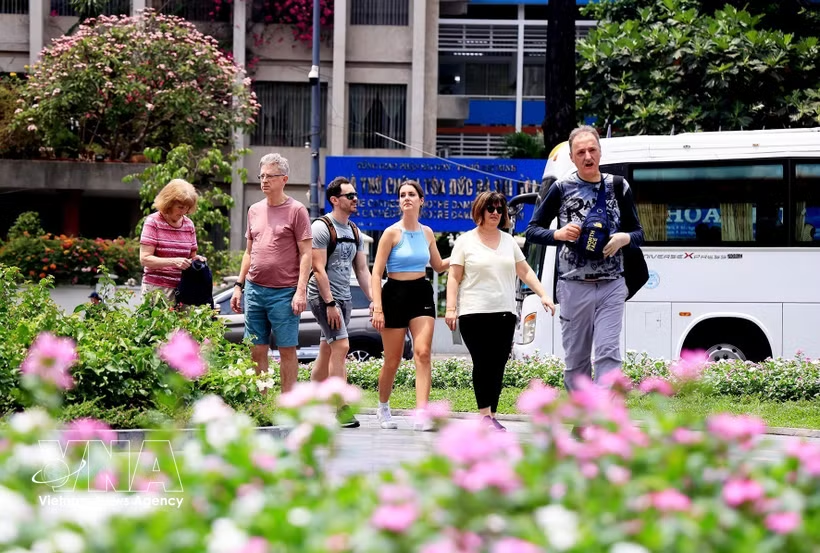
International tourists stroll through downtown Ho Chi Minh City. (Photo: VNA)

Hanoi (VNA) – As global tourism shifts away from traditional package holidays towards personalised, culturally immersive experiences, Free Independent Travellers (FIT) are emerging as one of the industry's fastest-growing and most valuable market segments, presenting fresh opportunities for Vietnam's tourism sector.

FIT reshaping global travel

​The rapid advancement of digital technologies and artificial intelligence (AI) is fuelling the rise of FIT travel, with more individuals and small groups choosing to design their own itineraries and book services independently rather than joining organised tours.

​According to Nguyen Trung Khanh, Director General of the Vietnam National Authority of Tourism (VNAT), FIT has become one of the defining trends in post-pandemic tourism. Increasingly, travellers are seeking flexibility, personalised experiences and authentic cultural engagement, prompting destinations worldwide to rethink their tourism products, services and marketing strategies.

​In Vietnam, a 2019 survey found that 54% of international visitors travelled on package tours, while 46% planned and booked their trips independently. Since COVID-19, the share of FIT visitors has continued to climb, supported by more liberal visa policies, the rapid growth of online travel platforms and AI-powered digital tools that simplify trip planning and cross-border bookings.

​Khanh described FIT as a high-value market segment, noting that independent travellers typically spend more on customised experiences. Expanding this segment would also help diversify Vietnam's visitor markets, reduce dependence on a limited number of source markets and improve the tourism industry's resilience to external shocks.

​He added that the rise of FIT presents an opportunity for Vietnam to move beyond mass tourism and build a more flexible, safe and experience-driven tourism ecosystem centred on individual travellers.

Every traveller a destination ambassador

​Successfully attracting FIT visitors offers benefits beyond tourism revenue. Each traveller can become a powerful ambassador, promoting Vietnam's welcoming people, rich cultural heritage and unique experiences through social media and global travel communities.

​Ly Xuong Can (Lee Cheng Kun), Vietnam's Tourism Ambassador to the Republic of Korea (RoK), said FIT travellers already account for a significant share of the Korean outbound tourism market and are expected to grow further as digital transformation accelerates. This trend, he said, calls on tourism businesses to embrace digital technologies, improve service quality and strengthen engagement with travellers across online platforms.

​Lee noted that today's travellers increasingly value safety, convenience and seamless experiences throughout their journeys. Cashless payments, particularly via QR codes, have become a preferred option for international visitors, while enhanced digital platforms can strengthen tourism connectivity between Vietnam and the RoK and better serve the expanding FIT market.

​Le Hoang Yen, Founder and CEO of Tatinta Corporation, said modern travellers are no longer choosing destinations alone but are seeking personalised experiences that combine wellness, education, local culture, cuisine and self-development.

​She pointed to the emerging "Trawell" (Travel + Well-being) concept, which integrates travel with healthy living to create more holistic and sustainable experiences. Delivering such experiences, she said, requires an integrated service ecosystem that keeps travellers connected and supported throughout every stage of their journey.

Vietnam is well positioned to capitalise on this trend thanks to increasingly favourable visa policies, expanding healthcare services, a skilled workforce and a rich cultural heritage. Beyond medical and wellness tourism, the country has strong potential to develop healing retreats, personal growth programmes, community-based tourism and immersive cultural experiences that cater to the evolving preferences of international travellers.

According to VNAT, as global tourism continues to embrace personalisation, digitalisation and sustainability, tapping into the growing FIT market, accelerating digital transformation and developing emerging travel segments will be crucial to unlocking new growth, enhancing competitiveness and reinforcing Vietnam's appeal as a leading destination on the global tourism map./.
VNA

See more

The “5 Cua O” heritage train brings new experience to travellers (Photo: VNA)

Heritage trains carve new niche in Vietnam’s tourism strategy

On a weekend morning, the “5 Cua O” (Hanoi Five Gates) heritage train pulled out of Hanoi Railway Station to the strains of “xam tau dien” - a traditional folk music echoing through a community carriage. Outside the window, the bustle of the Old Quarter gradually receded and the iron span of the historic Long Bien Bridge slid into view.

Sun PhuQuoc Airways launches two new routes to Chengdu

Sun PhuQuoc Airways launches two new routes to Chengdu

As the first airline to operate scheduled nonstop flights between Phu Quoc and Chengdu, Sun PhuQuoc Airways is also introducing launch offers of up to 20% off fares, complimentary Sun World Hon Thom Cable Car tickets, and exclusive privileges across the integrated Sun Group ecosystem.

Secretary of the Party Committee of Khanh Hoa province Tran Phong (right) meets with Indian Ambassador to Vietnam Tshering Wangchuk Sherpa. (Photo: VNA)

Khanh Hoa looks to draw more travellers from India

Indian arrivals to Vietnam have risen sharply from around 100,000 before 2016 to 750,000 in 2025, 4.5 times higher than in 2019, driven by expanding direct air routes. The number of Vietnamese visitors to India has also maintained an average annual growth rate of 17–20%.

The cave, Thang (Victory) Cave, is named after a local resident who first identified its location. (Photo: Published by VNA)

New cave with rare stalactites, cave pearls discovered in Phong Nha – Ke Bang

Located between Voi (Elephant) Cave and Ma Da Lake in the Ma Da Valley, within the park’s strictly protected zone, the cave measures about 3,000 metres in length and 70 metres in average width, with several chambers extending beyond 100 metres. It has two entrances leading to separate branches. While the main entrance covers about 5 sq.m, the exit is narrow, allowing passage for only one adult at a time.

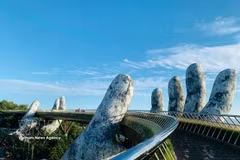
From Da Nang, tourists can easily access attractions such as Sun World Ba Na Hills with its iconic Golden Bridge. (Photo: VNA)

Da Nang emerges as hub for multi-destination travel

Da Nang’s appeal has been further strengthened after being ranked second on Lonely Planet’s list of Asia’s most attractive summer destinations. The recognition underscores the city’s growing role as a tourism and leisure hub in the region.

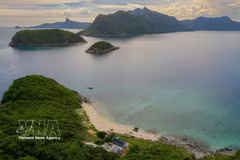
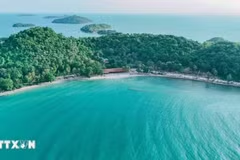
Con Dao tops Travel + Leisure’s list of the world’s 30 hidden islands around the world for off-the-grid adventure and seclusion. (Photo: VNA)

Con Dao named world’s top hidden island destination

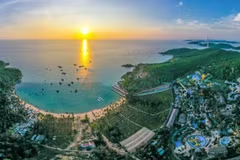
According to the Vietnam National Authority of Tourism, Con Son, the largest island in the Con Dao archipelago, is renowned for its dramatic granite cliffs, pristine beaches and crystal-clear waters off Vietnam’s southeastern coast.

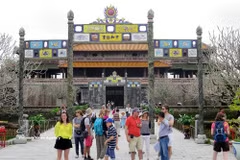
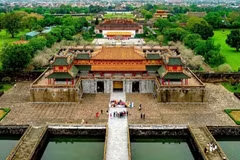
Visitors explore the Hue Imperial Citadel. (Photo: VNA)

Vietnam shines as Southeast Asia’s “gem”: French daily

The publication said Hanoi often leaves visitors with an immediate impression of energy and vitality, marked by its busy streets and constant movement. Beneath the bustling urban rhythm, however, lies a city rich in history and culture, featuring iconic landmarks such as the Temple of Literature, Hoan Kiem Lake, the Hanoi Opera House, the Ho Chi Minh Mausoleum and the One Pillar Pagoda.

Seen from above, Hue Imperial Citadel glows brilliantly at the heart of the heritage city. (Photo: nhandan.vn)

Heritage resources fuel Hue’s new growth ambitions

Hue is simultaneously stepping up efforts to attract investment into tourism, services and cultural industries. In the first five months of 2026, the city secured more than 19 trillion VND in newly registered investment capital, with projects planned in coastal tourism, lagoon-based ecotourism, cultural spaces along the Perfume River, convention and exhibition centres, night-time economy projects and cultural innovation hubs.

With its crystal-clear waters and majestic scenery, Hoa Binh lake, located within the reservoir area of the Hoa Binh Hydropower Plant, has become an unmissable destination for visitors to Phu Tho province. (Photo: VNA)

Phu Tho moves to unlock tourism potential after administrative mergence

With coordinated efforts in planning, infrastructure development, product diversification, human resources training, digital transformation and destination branding, Phu Tho is well-positioned to transform tourism into a spearhead economic sector and a new engine of sustainable growth in the years ahead.

The Eye Mountain, one of the signature attractions of the Non Nuoc Cao Bang UNESCO Global Geopark. (Photo: VNA)

Cao Bang seeks to boost sustainable tourism

During the first five months of 2026, Cao Bang welcomed nearly 1.3 million visitors, generated 1.43 trillion VND (54.3 million USD) in tourism revenue, and recorded an average accommodation occupancy rate of 53%.