From Phu Quoc to Sa Pa: Why Vietnam’s tourism is accelerating in Southeast Asia

In less than a decade, Phu Quoc has grown from around 1.45 million visitors in 2016 to more than 8.1 million in 2025. In the same year, Sa Pa welcomed around 4.3 million visitors, while tourism revenue increased more than 11 times compared with the period before synchronised investment was introduced.

Vietnam is emerging as one of Southeast Asia’s most attractive tourism “hot spots”, increasingly sought after and loved by international visitors. (Source: Sun Group)

Hanoi (VNA) - Leading US business magazine Fortune has described Vietnam as an emerging tourism “hot spot” in Southeast Asia, driven by the strong rise of destinations such as Phu Quoc and Sa Pa. Behind the record numbers of international arrivals is the convergence of more open policies and the growing role of the private sector in shaping world-class tourism ecosystems.

New “growth engines” of Vietnam’s tourism

For many years, Thailand was almost the default choice for international travellers visiting Southeast Asia. According to Fortune, however, that landscape is changing rapidly. In 2025, Vietnam welcomed more than 21 million international visitors for the first time, up 20% from the previous year and setting a new record for the country’s tourism industry. Notably, in the same year, Vietnam also surpassed Thailand to become the most popular destination for Chinese travellers, with around 5.3 million arrivals.​

Beyond growth in visitor numbers, tourism now contributes nearly 10% of Vietnam’s GDP and is expected to generate around 41 billion USD in revenue in 2026. Speaking to Fortune, Dr. Le Hong Hiep, Senior Fellow and Coordinator of the Vietnam Studies Programme at the ISEAS – Yusof Ishak Institute in Singapore, said Vietnam is now competing directly with Thailand and Malaysia to become a leading destination in the region.
picture2.jpg
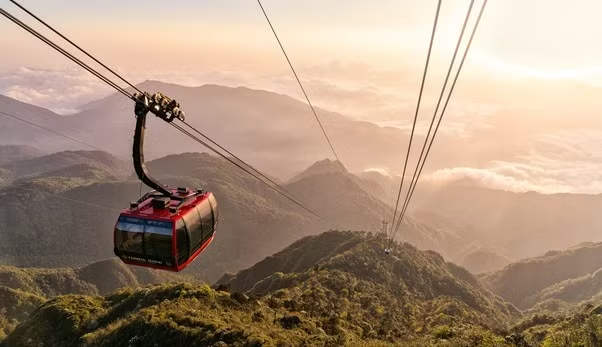
The Fansipan cable car is regarded as a turning point in repositioning Sa Pa’s tourism, helping drive strong growth in visitor arrivals to the mountain town. (Sun Group)

What stands out is that this growth momentum is no longer concentrated only in major cities, but is spreading to destinations rich in local identity. Data from Klook cited by Fortune showed that visitor numbers to both Phu Quoc and Sa Pa more than doubled in 2025. According to CS Soong, Vice President of Corporate Development at Klook, travellers are increasingly prioritising destinations closely connected with nature and local culture.

In less than a decade, Phu Quoc has grown from around 1.45 million visitors in 2016 to more than 8.1 million in 2025. In the same year, Sa Pa welcomed around 4.3 million visitors, while tourism revenue increased more than 11 times compared with the period before synchronised investment was introduced. Meanwhile, Da Nang continues to affirm its position as a dynamic tourism hub, with an increasingly rich system of resorts, entertainment offerings and international events.

Two driving forces behind Vietnam’s tourism breakthrough

According to Fortune, behind these growth figures are two important drivers: increasingly open policies and the strong participation of the private sector in destination development.

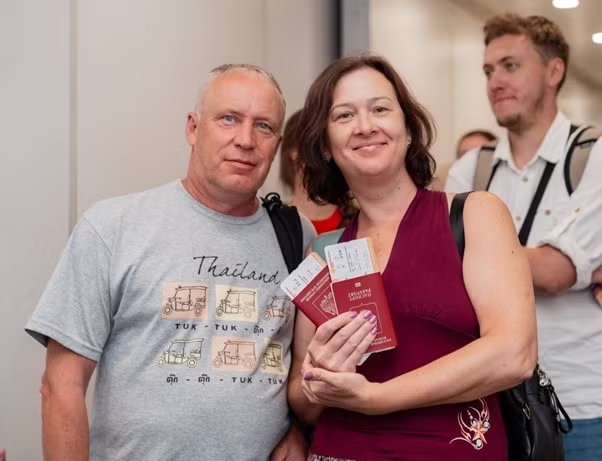
The first is visa policy. Vietnam has expanded visa exemptions to 39 countries and territories, while extending the length of stay for several key markets, making it easier for international travellers to choose Vietnam. Alexandra Murray, Vice President and Regional Head of Southeast Asia at Hilton, told Fortune that relaxed visa policies help travellers make faster decisions, especially for longer leisure trips.
picture3.jpg
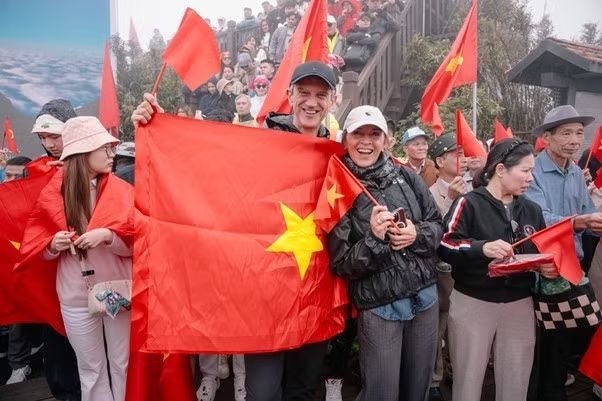
Relaxed visa policies, particularly Phu Quoc’s visa-free entry and stay of up to 30 days for international visitors, have opened a “gateway” for more foreign tourists to come to Vietnam. (Sun Group)

At the same time, Vietnam has made strong investments in transport infrastructure and international connectivity. New flight routes continue to be launched, while major infrastructure projects are being implemented, including facilities serving APEC 2027 in Phu Quoc. These developments are laying the groundwork for Vietnam to attract higher-value visitor segments such as leisure, MICE and wellness tourism.

​However, Fortune noted that infrastructure and policy are only necessary conditions. The success of a destination does not lie only in bringing tourists there, but also in creating experiences that make them want to stay longer, spend more and return.

This is also where the private sector is making a clear imprint, shifting from the exploitation of natural resources to the creation of complete tourism ecosystems.
picture4.jpg
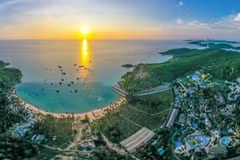
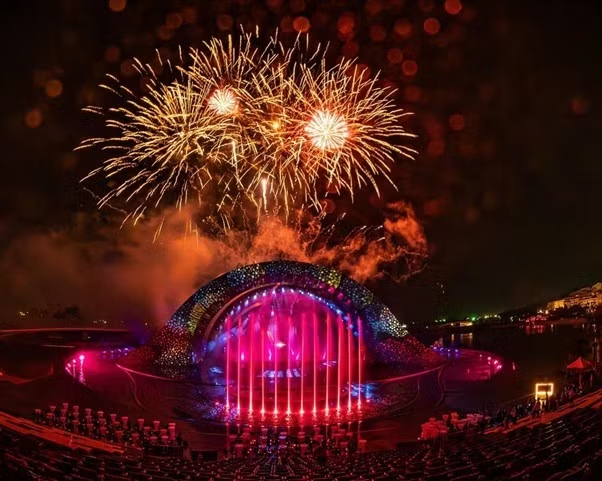
The synchronised resort and entertainment ecosystem in Phu Quoc has created more distinctive experiences, allowing visitors to enjoy a full day of activities and extend their stays. (Source: Sun Group)

Phu Quoc is a prime example. From an island once known mainly for its natural scenery, the southern part of Phu Quoc has been developed into a large-scale tourism, resort and entertainment ecosystem.

​Over nearly a decade, Sun Group has gradually shaped a new look for the area with Sun World Hon Thom, the world’s longest three-rope cable car system, Sunset Town, Kiss Bridge, multimedia shows and nightly fireworks displays. Together, these offerings create experiences that extend from daytime into the night, encouraging visitors to stay longer and spend more.

​The presence of international hotel brands such as JW Marriott Phu Quoc, New World Phu Quoc and La Festa Phu Quoc – Curio Collection by Hilton has further elevated service quality. The combination of domestic developers and leading global hotel management brands is expected to strengthen the destination’s appeal to international travelers.

​In Sa Pa, the turning point has not come only from the Fansipan cable car, but also from the repositioning of the destination itself. The Sun World Fansipan Legend complex, together with Hotel de la Coupole – MGallery Sa Pa, has transformed Sa Pa from a trekking destination into a four-season hub for resort stays, culture and experiential travel, allowing the town to make better use of its natural values and the distinctive identity of Vietnam’s northwest region.
picture5.jpg
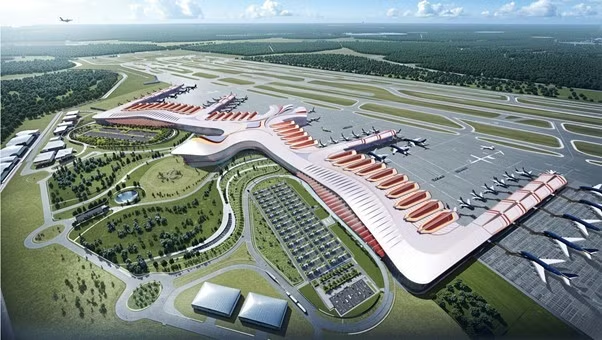
Rendering of the future Phu Quoc International Airport. (Source: Sun Group)

Beyond destination development, Vietnamese businesses are also expanding partnerships with international corporations. Fortune cited the expansion project of Phu Quoc International Airport, developed by Sun Group in cooperation with Changi Airport Group. This investment, along with many others, is being accelerated ahead of APEC 2027 in Phu Quoc. According to Alexandra Murray, the pace at which large-scale tourism projects are being implemented in Vietnam is something she has “never seen in any other country, even in the Middle East.”

At the same time, Fortune emphasised that growth can only be truly sustainable when it goes hand in hand with quality. According to experts interviewed by the magazine, Vietnam is making efforts to learn while developing, drawing lessons from other countries and paying close attention to international best practices in pursuit of sustainable and long-term results./.

VNA

See more

The “5 Cua O” heritage train brings new experience to travellers (Photo: VNA)

Heritage trains carve new niche in Vietnam’s tourism strategy

On a weekend morning, the “5 Cua O” (Hanoi Five Gates) heritage train pulled out of Hanoi Railway Station to the strains of “xam tau dien” - a traditional folk music echoing through a community carriage. Outside the window, the bustle of the Old Quarter gradually receded and the iron span of the historic Long Bien Bridge slid into view.

Sun PhuQuoc Airways launches two new routes to Chengdu

Sun PhuQuoc Airways launches two new routes to Chengdu

As the first airline to operate scheduled nonstop flights between Phu Quoc and Chengdu, Sun PhuQuoc Airways is also introducing launch offers of up to 20% off fares, complimentary Sun World Hon Thom Cable Car tickets, and exclusive privileges across the integrated Sun Group ecosystem.

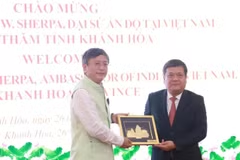
Secretary of the Party Committee of Khanh Hoa province Tran Phong (right) meets with Indian Ambassador to Vietnam Tshering Wangchuk Sherpa. (Photo: VNA)

Khanh Hoa looks to draw more travellers from India

Indian arrivals to Vietnam have risen sharply from around 100,000 before 2016 to 750,000 in 2025, 4.5 times higher than in 2019, driven by expanding direct air routes. The number of Vietnamese visitors to India has also maintained an average annual growth rate of 17–20%.

The cave, Thang (Victory) Cave, is named after a local resident who first identified its location. (Photo: Published by VNA)

New cave with rare stalactites, cave pearls discovered in Phong Nha – Ke Bang

Located between Voi (Elephant) Cave and Ma Da Lake in the Ma Da Valley, within the park’s strictly protected zone, the cave measures about 3,000 metres in length and 70 metres in average width, with several chambers extending beyond 100 metres. It has two entrances leading to separate branches. While the main entrance covers about 5 sq.m, the exit is narrow, allowing passage for only one adult at a time.

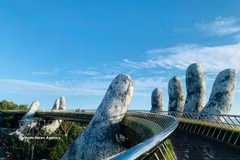
From Da Nang, tourists can easily access attractions such as Sun World Ba Na Hills with its iconic Golden Bridge. (Photo: VNA)

Da Nang emerges as hub for multi-destination travel

Da Nang’s appeal has been further strengthened after being ranked second on Lonely Planet’s list of Asia’s most attractive summer destinations. The recognition underscores the city’s growing role as a tourism and leisure hub in the region.

Con Dao tops Travel + Leisure’s list of the world’s 30 hidden islands around the world for off-the-grid adventure and seclusion. (Photo: VNA)

Con Dao named world’s top hidden island destination

According to the Vietnam National Authority of Tourism, Con Son, the largest island in the Con Dao archipelago, is renowned for its dramatic granite cliffs, pristine beaches and crystal-clear waters off Vietnam’s southeastern coast.

Visitors explore the Hue Imperial Citadel. (Photo: VNA)

Vietnam shines as Southeast Asia’s “gem”: French daily

The publication said Hanoi often leaves visitors with an immediate impression of energy and vitality, marked by its busy streets and constant movement. Beneath the bustling urban rhythm, however, lies a city rich in history and culture, featuring iconic landmarks such as the Temple of Literature, Hoan Kiem Lake, the Hanoi Opera House, the Ho Chi Minh Mausoleum and the One Pillar Pagoda.

Seen from above, Hue Imperial Citadel glows brilliantly at the heart of the heritage city. (Photo: nhandan.vn)

Heritage resources fuel Hue’s new growth ambitions

Hue is simultaneously stepping up efforts to attract investment into tourism, services and cultural industries. In the first five months of 2026, the city secured more than 19 trillion VND in newly registered investment capital, with projects planned in coastal tourism, lagoon-based ecotourism, cultural spaces along the Perfume River, convention and exhibition centres, night-time economy projects and cultural innovation hubs.

With its crystal-clear waters and majestic scenery, Hoa Binh lake, located within the reservoir area of the Hoa Binh Hydropower Plant, has become an unmissable destination for visitors to Phu Tho province. (Photo: VNA)

Phu Tho moves to unlock tourism potential after administrative mergence

With coordinated efforts in planning, infrastructure development, product diversification, human resources training, digital transformation and destination branding, Phu Tho is well-positioned to transform tourism into a spearhead economic sector and a new engine of sustainable growth in the years ahead.

The Eye Mountain, one of the signature attractions of the Non Nuoc Cao Bang UNESCO Global Geopark. (Photo: VNA)

Cao Bang seeks to boost sustainable tourism

During the first five months of 2026, Cao Bang welcomed nearly 1.3 million visitors, generated 1.43 trillion VND (54.3 million USD) in tourism revenue, and recorded an average accommodation occupancy rate of 53%.