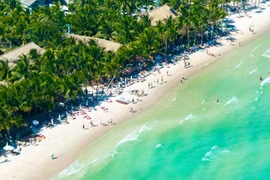
Hanoi (VNA) – Rather than simply praising its turquoise waters, white-sand beaches, or luxury resorts, the Republic of Korea's edition of National Geographic gave Phu Quoc a special description: a “mythical world” in the middle of the ocean.
In a feature titled "A Phu Quoc Fantasy", published in its June 2026 issue, travel writer Cha Seong-min takes readers on a journey across Pearl Island through a blend of legends, cultural stories, and modern experiences. His conclusion is that what makes Phu Quoc so captivating is not only its natural beauty, but also the stories woven into every destination.
Notably, instead of beginning with stunning beaches or world-class resorts – as is often the case in articles about tropical islands – Cha Seong-min opens his journey with the legends of Pearl Island. From tales of pirates searching for treasure in An Thoi Archipelago, to the legend of Ong Ngau and Ba Ngau behind Kiss Bridge, and the story of tears transformed into pearls, each destination is presented as a chapter in the storybook of Phu Quoc.
Discovering Phu Quoc through its legends
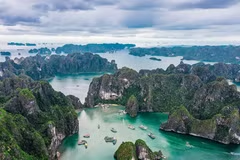
Cha Seong-min’s journey begins at An Thoi Archipelago in South Phu Quoc. According to the writer, in the 17th century, the area’s more than 20 islands served as an ideal hideout for pirate fleets thanks to its rugged terrain and dense network of islands. That story becomes the prologue to his adventure to Hon Thom Island, which he describes as a land of treasure hunts amid the seas of southern Vietnam.
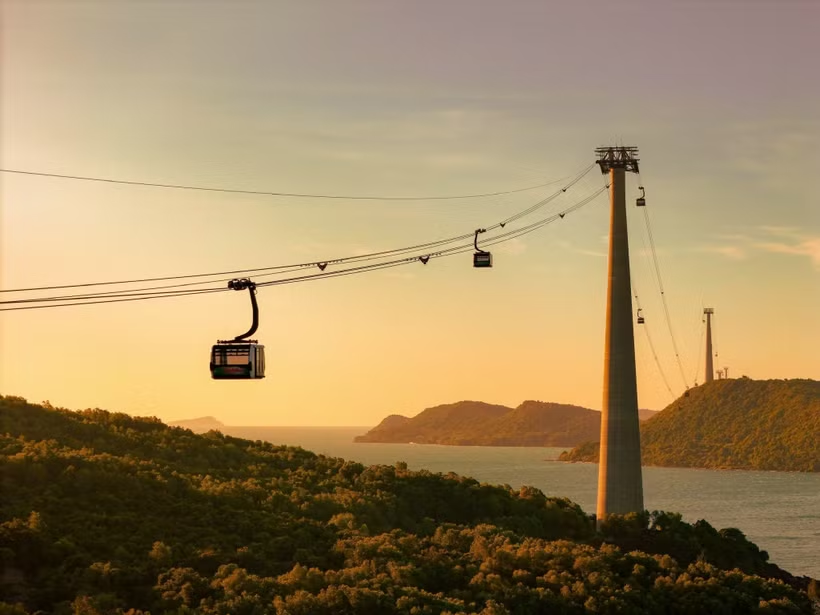
From the moment he boarded the world’s longest three-wire cable car system, stretching nearly 8 km, the author felt as though he had stepped into a real adventure. Beneath the cabin lay emerald waters, islands scattered across the sea, and small fishing boats quietly drifting on the surface. According to Cha Seong-min, the scenery combined the serenity of a tropical seascape with the atmosphere of treasure maps from classic adventure stories.
That feeling reached its climax when he experienced the Roaring Timber Coaster at Sun World Hon Thom. Racing through tropical forests at speeds approaching 80 km/h, the Korean writer likened himself to an explorer searching for lost treasure. “It was hard to tell whether the shaking came from the wooden tracks or from my own pounding heartbeat,” he wrote.
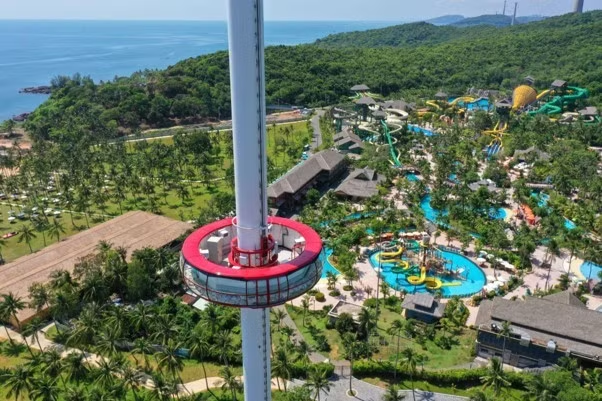
From the 120-metre-high Eagle Eye observation tower, Hon Thom unfolds in its entirety, with endless tropical forests, a water park, the cable car stretching toward the horizon, and vast seas embracing the island. According to Cha Seong-min, few places in the world combine pristine nature and a large-scale entertainment ecosystem so naturally.
Leaving Hon Thom behind, the journey continues to Sunset Town, which he describes as a slice of the Mediterranean set along a tropical coastline. Rows of pastel-colored buildings cascading down the hillside reminded him of Italy’s Amalfi Coast. Yet the attraction that left the deepest impression was not the architecture, but Kiss Bridge.
“At first glance, it seems to be nothing more than a pedestrian bridge stretching out to sea. But once you learn the story behind it, you understand why it has become the symbol of Sunset Town,” Cha Seong-min wrote.

In the article, the author devotes considerable attention to the legend of Ong Ngau and Ba Ngau, which inspired the bridge’s design. Its two branches extend toward one another but stop just 30 centimetres apart above the sea. According to him, that small gap is what makes the structure so distinctive, turning the moment when couples approach from opposite sides and reach out toward each other into one of the most emotional images in South Phu Quoc.
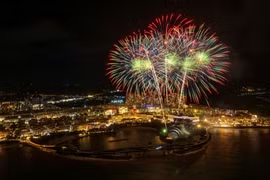
Beyond its architecture, Sunset Town also impressed the Korean journalist with its entertainment ecosystem that stretches from late afternoon into the night. He made particular mention of the Awaken Sea extreme sports performance, featuring jetski and flyboard displays as well as aerial stunts performed right beneath Kiss Bridge. As darkness falls, the experience continues with Kiss of the Sea, a multimedia spectacle combining water, fire, light, lasers, and fireworks, which the author describes as a “mythical world” brought to life on the ocean’s surface.

More than a resort island, it is a place where every destination tells a story
According to Cha Seong-min, what sets Phu Quoc apart is not only its natural landscapes or the scale of its tourism developments, but also the way the island preserves and tells its own stories. In the article, he references the legend that pearls were formed from the tears of a mermaid before explaining that Phu Quoc is known as “Pearl Island” not only because of its renowned pearl farming industry, but also because of the shimmering beauty nature has bestowed upon the island.
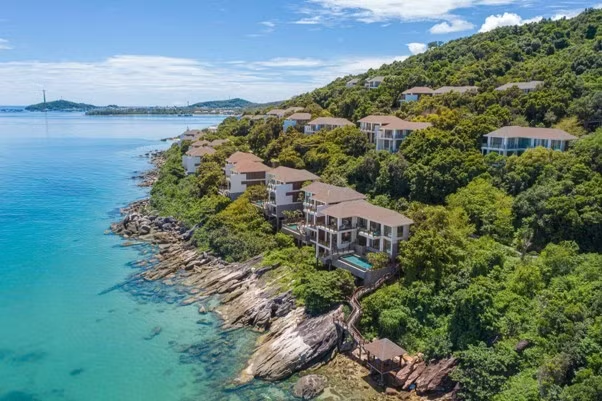
The Korean writer also expressed particular fondness for Premier Village Phu Quoc Resort, which he viewed as a harmonious blend of architecture and nature. Ocean-facing villas tucked beneath forest canopies, floor-to-ceiling windows opening onto the sea, monkeys appearing beside swimming pools, and the rare opportunity to watch both sunrise and sunset from the same destination all reinforced his sense of connection between people and nature.
Throughout the article, from the pirate legends of An Thoi Archipelago and the tale of Ong Ngau and Ba Ngau at Kiss Bridge to the story of pearls, Cha Seong-min argues that these layers of “cultural sediment” add depth to the journey of discovering Pearl Island.
Concluding the feature, the National Geographic writer notes that Phu Quoc is far more than a famous resort island. What keeps visitors returning is not only its beautiful beaches or modern experiences, but the way nature, history, and mythology intertwine across every corner of the island. That, he says, is why he calls Phu Quoc a “mythical world” in the middle of the ocean—a place where every trip is not merely a journey to discover a destination, but a journey into stories that continue to be written on Pearl Island./.