Green tourism charts a new course for Vietnam

With its rich agricultural ecosystem, where each region boasts unique produce, culinary traditions, and farming practices, Vietnam is well positioned to develop and expand the farm-to-table model. Cities and provinces, such as Hanoi, Thai Nguyen, Da Nang, Hue, Can Tho, Lam Dong, and Vinh Long, are already embracing the model as part of their green tourism strategies.

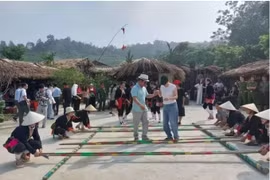
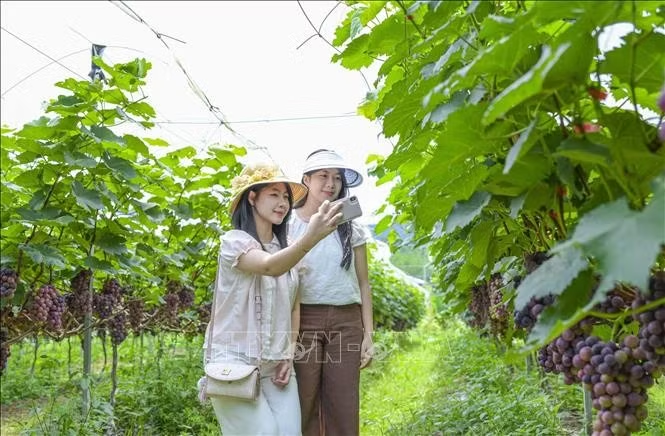
Visitors pose for a photo beneath lush, fruit-laden grape trellises in Muong Phang commune, Dien Bien province. (Photo: VNA)

Hanoi (VNA) - As travellers increasingly seek eco-friendly lifestyles, organic food, and authentic local experiences, farm-to-table tourism is emerging as one of Vietnam’s most promising tourism trends, adding value to the country’s agricultural products while promoting a greener and more sustainable tourism industry.

At Thanh Nga Luxury’s high-tech farm in the northern province of Ninh Binh, visitors can wander through nearly five hectares of state-of-the-art greenhouses equipped with automated irrigation systems. Along the way, they discover the cultivation techniques and nutritional value of various crops before picking and savoring fresh tomatoes, cucumbers, and golden melons straight from the vines.

Le Thi Nga, owner of Thanh Nga Luxury, said the site is one of four clean-farming projects the company has developed across Ninh Binh and Thanh Hoa provinces.

To guarantee premium quality and food safety, the company has partnered with four Japanese organisations to introduce organic fertiliser technology and smart sensor systems that regulate airflow and temperature, minimising environmental risks and optimising crop production.

The company is now expanding into experiential tourism by developing educational farm tours for students and families, complete with creative photo spots and interactive 3D installations celebrating Vietnam’s agricultural heritage.

With its rich agricultural ecosystem, where each region boasts unique produce, culinary traditions, and farming practices, Vietnam is well positioned to develop and expand the farm-to-table model. Cities and provinces, such as Hanoi, Thai Nguyen, Da Nang, Hue, Can Tho, Lam Dong, and Vinh Long, are already embracing the model as part of their green tourism strategies.

Vu Van Tuyen, Director of Travelogy Vietnam and Vice Chairman of the Vietnam Community Tourism Association, said the true attraction lies not on the dining table but in the journey that brings the food there.

When visitors harvest vegetables, pick tea leaves, catch fish in mountain streams, or prepare traditional dishes alongside local residents, they are immersing themselves in culture rather than simply enjoying a meal.

Farm-to-table tourism transforms local farmers into storytellers and hosts while allowing communities to benefit directly from tourism, making it a natural fit with Vietnam’s rural development and sustainable tourism goals.

According to Tuyen, with strategic investment, the model has the potential to become a signature tourism product for Vietnam.

Challenges remain, however. Building a successful farm-to-table destination requires investment in clean farming technologies, visitor facilities, environmental management systems, and quality infrastructure. Most Vietnamese farms are still relatively small and lack the capacity to welcome tourists on a regular basis.

In many places, the concept has yet to evolve beyond simple farm visits and produce tasting, falling short of offering an immersive experience that showcases the entire agricultural journey.

Limited hospitality and storytelling skills among farmers also affect the quality of visitor experiences.

Doan Thi Thanh Van, Executive Director of Lux Travel DMC, which specialises in high-end inbound tourism, said international travelers increasingly place sustainability at the heart of their travel choices. Hands-on activities such as planting, harvesting, and enjoying freshly prepared local produce are among the experiences they value most.

She stressed that success depends on creating a seamless experience that combines quality food with compelling stories about local culture, traditional farming practices, and sustainable living.

Tuyen echoed the call for stronger collaboration among farmers, restaurants, accommodation providers, tour operators, and local authorities to build integrated tourism products rooted in local identity.

He also highlighted the importance of training rural communities in hospitality, food safety, environmental management, storytelling, branding, and digital marketing to enhance competitiveness.

If developed effectively, farm-to-table tourism could become a powerful bridge linking agriculture, culture, and tourism, delivering richer experiences for visitors while creating lasting economic and social benefits for local communities and advancing Vietnam’s green tourism ambitions./.

VNA

See more

Located about 200 km from Hanoi, Ta Xua in Son La province is widely regarded as one of the most spectacular cloud-hunting destinations in northern Vietnam. (Photo: VNA)

Ta Xua sets sights on sustainable tourism

Ta Xua is rolling out a campaign titled “Bringing Ta Xua to the world” and aims to establish the image of “Ta Xua - a sea of clouds, majestic nature and Mong cultural identity” during the 2028-2030 period.

The fireworks display by the Portuguese team at the final night of the Da Nang International Fireworks Festival (DIFF) 2026 on July 11, 2026. The Portuguese team claims the championship title. (Photo: VNA)

Da Nang greets over 2.72 million visitors during DIFF 2026

On July 11, the day of the DIFF 2026 finale, accommodation establishments in the city served about 131,000 visitors, an increase of 16% from a year earlier. International visitors totalled 52,400, up 27% year-on-year, while domestic visitors reached 78,600, an increase of nearly 10%.

Under the proposal prepared by the VRC, the tourist train will travel approximately 190 km, connecting Hue, Dong Ha, My Trach, Dong Hoi and Tho Loc stations. (Illustrative photo: VNA)

Hue–Phong Nha tourist train to be launched on September 1

The central province of Quang Tri is working with the Vietnam Railways Corporation (VRC) to complete the project, which is expected to create a distinctive railway tourism product linking major heritage sites and scenic destinations across Vietnam's north-central region while strengthening regional tourism connectivity.

At a working session with the Vietnamese Embassy in Moscow (Photo: VNA)

Quang Ninh targets Russian travellers as arrivals surge

Quang Ninh is looking to build partnerships to steer more Russian visitors to Ha Long Bay and other local attractions. Beyond the UNESCO World Heritage Site of Ha Long Bay, the province holds diverse advantages in marine tourism, cultural attractions, luxury resorts and wellness services.

A ferry boat is carrying passengers in Phu Quoc (Photo: VNA)

Ministry orders tighter ferry safety after Phu Quoc boat capsize

The Vietnam Maritime and Waterway Administration, Vietnam Register, and provincial construction department were instructed to coordinate with the Border Guard, Coast Guard, public security and local authorities to determine the cause of the accident, deal with its aftermath, identify and fix any state management lapses, offer support to victims and their families, and report regularly on the investigation’s progress.

Bac Ninh's tourist attractions draws large crowds after the release of the hit music video Bac Bling. (Photo: VNA)

Beyond the trend: From viral hits to lasting tourism appeal

Across Vietnam and around the world, travel inspired by music and film has become an increasingly influential trend. Cultural blockbusters can provide destinations with extraordinary visibility and a level of publicity that money alone often cannot buy. But attracting visitors is only the beginning.

Vietnamese Ambassador to Bulgaria Nguyen Thi Minh Nguyet (L) and Bulgarian Minister of Tourism Ilin Dimitrov. (Photo: VNA)

Vietnam, Bulgaria seek more substantive, sustainable tourism cooperation

Both sides considered tourism as one of the most promising areas of bilateral cooperation, noting its role not only in promoting economic growth but also in enhancing people-to-people exchanges, mutual understanding and broader collaboration in trade, investment, education and culture.

Russian tourists experience the glass bridge at the TTC World – Valley of Love tourist site in Da Lat, Lam Dong province. (Photo: VNA)

Russian tourist arrivals to Vietnam nearly triple in first half

The Association of Tour Operators of Russia (ATOR) reported that Vietnam ranked fourth among the best-selling package tour destinations in the Russian market in July, capturing a 7.8% market share, up 3.2 percentage points year-on-year. The country overtook Thailand (4.7%) and China (4.3%).

At the award ceremony (Photo: VNA)

VITA Awards 2026 honour 106 winners

The winners were recognised for breakthrough and innovative tourism policies in 2025, best tourism villages, leading destinations, top attractions and parks, standout new tourism products, top travel companies, and best-in-class lodging and dining, among others.

A visitor enjoys hands-on farming activities, including preparing the soil, planting vegetables and watering crops, in Tra Que Vegetable Village in Hoi An Tay ward, Da Nang city. (Photo: VNA)

Vietnam invites travellers on multi-sensory journey

Vietnam's appeal lies not in a single attraction but in the seamless combination of authentic experiences rooted in local culture. From colourful highland markets and traditional festivals to centuries-old craft villages, all remain an integral part of everyday life.

UAE Ambassador to Vietnam Bader Almatrooshi speaks at the conference, themed "Vietnam: A New Destination of Halal Tourism", held in Khanh Hoa province on July 8, 2026. (Photo: VNA)

Vietnam emerging as new destination for Halal tourism

Vietnam will continue to improve institutional frameworks and standards, develop human resources, expand Halal-certified services, strengthen international cooperation, promote business partnerships, and build the country's brand as a new destination for Halal tourism.

Thung Nham Ecotourism Area adopts green tourism practices. (Photo: VNA)

Vietnam pushes circular tourism to drive green growth

Unlike conventional sustainable tourism, circular tourism goes beyond reducing environmental impacts. It embraces a regenerative approach in which every journey contributes to restoring ecosystems, preserving cultural heritage and strengthening the resilience of local communities.