Foreigners experience Vietnam’s digital government through level-2 e-ID services

Since July 2025, immigration authorities have processed 84,831 applications, with Republic of Korean, Chinese and Japanese nationals accounting for the largest numbers of registered users.

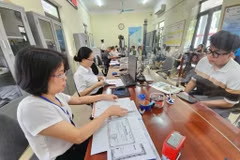
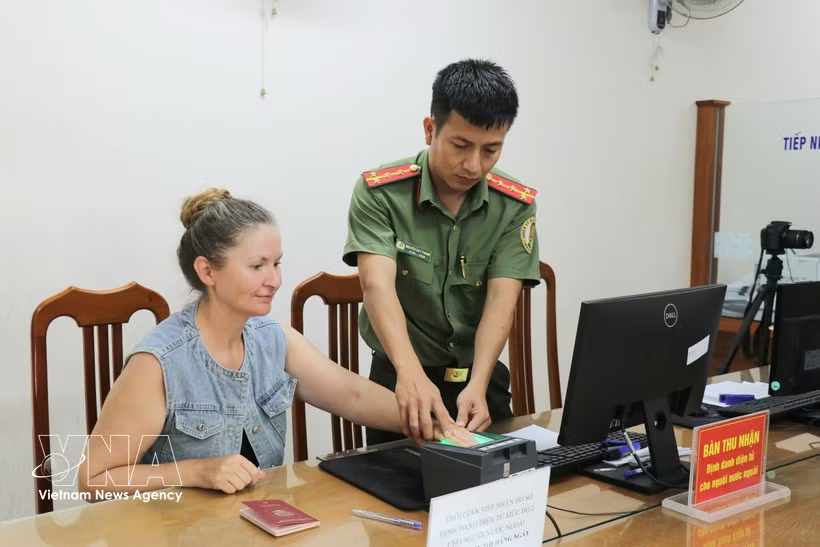
A foreign national completes level-2 e-ID registration procedures in Vietnam. (Photo: VNA)

Hanoi (VNA) – As Vietnam accelerates digital transformation under Resolution No. 57 on breakthroughs in science and technology development, innovation, and national digital transformation, foreigners living in the country are increasingly benefiting from more convenient, transparent and user-friendly public services, reflecting the Government’s commitment to placing citizens and businesses at the centre of governance.

Following the implementation of Government Decree No. 69, foreigners holding valid temporary or permanent residence cards are eligible to apply for level-2 electronic identification (e-ID) accounts. Applications can be submitted at immigration offices under the Ministry of Public Security or the provincial-level Departments of Public Security, where biometric information is collected to enable access to a wide range of digital public services.

Kim Ji Eun, President of the Korea Global School (KGS) System, was among the first foreign nationals to register for a level-2 e-ID account in Hanoi. During her first experience with Vietnam's public administrative services on June 25, 2025, Kim said she was most impressed not by the processing speed, but by the transparency of the procedure and the ease with which users could track their applications.

vnanet-kim-ji-eun.jpg
Kim Ji Eun, President of the Korea Global School (KGS) System (Photo: VNA)

“As a foreign investor, I appreciate Vietnam’s efforts to reform administrative procedures and digitalise public services. These reforms help reduce paperwork, shorten processing time and create a more business-friendly environment,” she said.

Jeong Young Oh, KGS Principal, who has lived in Vietnam for more than a decade, said the country’s digital transformation has become increasingly visible in daily life.

He shared that at airports, he can now simply present his electronic boarding pass together with his VNeID account on his mobile phone instead of carrying paper documents as before.

American English teacher Samuel Herbert Brinkerhoff, who has worked in several countries, said digital identity systems are becoming a global trend and Vietnam is making steady progress in catching up with international practices.

According to Deputy Director of the Department of Immigration Dang Tuan Viet, level-2 e-ID accounts enable foreign residents to verify their identity through biometric authentication, complete selected administrative procedures online and access services such as banking, healthcare and insurance without repeatedly presenting passports or residence cards.

Since July 2025, immigration authorities have processed 84,831 applications, with Republic of Korean, Chinese and Japanese nationals accounting for the largest numbers of registered users.

Despite the progress, challenges remain. Language barriers require immigration authorities to provide multilingual support, while many foreign employees working in industrial parks find it difficult to arrange time to complete registration procedures. In addition, differences in policy interpretation among government agencies can still create administrative bottlenecks.

Kim Ji Eun cited the recruitment of foreign principals for international schools as one example, where overlapping requirements between labour and education authorities can delay administrative procedures. She expressed confidence that stronger inter-agency coordination will further improve Vietnam’s investment environment and accelerate comprehensive digital transformation.
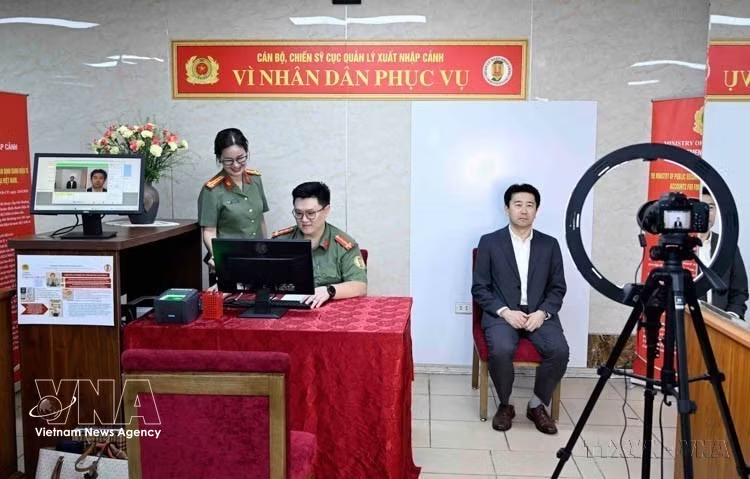
vnanet-nguoi-nuoc-ngoai-lam-dinh-danh-dien-tu-muc-2-tai-cuc-xnc.jpg
A foreign national completes level-2 e-ID registration procedures at Department of Immigration. (Photo: VNA)

Speaking at the National Innovation Day on October 1, 2025, Party General Secretary To Lam reaffirmed that science and technology, innovation and digital transformation are key drivers of Vietnam’s future development as it is aiming to secure an upper-middle income status by 2030, and become a developed, high-income country by 2045.

Alongside digital technologies, experts believe governance reform remains equally important to ensure that public services become more transparent, efficient and responsive to the needs of citizens, businesses and international residents.

The experiences of foreigners living in Vietnam suggest that the country’s digital transformation is increasingly delivering practical benefits. As innovation is combined with administrative reform, Vietnam is steadily building a modern digital government that places users at the heart of public service delivery./.



VNA

See more

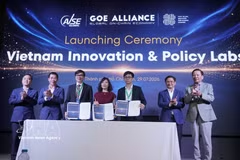
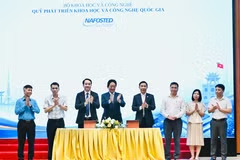
Representatives of participating organisations sign an agreement and officially launch the Vietnam Innovation & Policy Labs, an independent policy research and advisory organisation, at the Vietnam Global Innovation Connect (VGIC) 2026 in Ho Chi Minh City on July 29. (Photo: VNA)

Technology, talent to drive Vietnam’s digital leap forward: forum

The Vietnam Global Innovation Connect (VGIC) 2026 serves as a platform for dialogue among policymakers, enterprises, startups, investors and the global Vietnamese expert community to transform knowledge, technology and resources into practical initiatives and projects that contribute to the country's development.

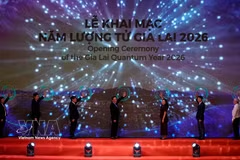
Delegates mark the launch of Gia Lai Quantum Year 2026. (Photo: VNA)

Gia Lai launches Quantum Year 2026

Held under the theme "Quantum Connectivity – Mastering Technology – Breakthrough Development", Quantum Year 2026 centres on four pillars: science, technology, education and training, and innovation ecosystem development.

AI offers both opportunities, challenges for Vietnam’s growth

AI offers both opportunities, challenges for Vietnam’s growth

Dr. Ho Duc Thang, a full-time member of the National Assembly’s Committee for Cultural and Educational, said productivity is the key to sustaining double-digit economic growth, and AI has greater potential to improve productivity than any previous technology.

Attracting sci-tech talent plays a critical role. (Photo: VNA)

Sci-tech seen as lever for Vietnam’s new growth phase

Raising the level of scientific and technological development is the only way to break out of the middle-income trap. Without it, Vietnam will remain stuck in low-value segments, said Dr. Le Xuan Sang, Deputy Director of the Institute of Vietnam and World Economy.

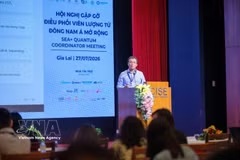
A speaker addresses the SEA+ Quantum Coordinator Meeting held in Gia Lai province on July 27. (Photo: VNA)

Regional conference strengthens Southeast Asia’s quantum technology ecosystem

Stronger networks linking government agencies, research institutes, universities, businesses and scientific organisations will provide a solid foundation for faster and more effective development of quantum technology, contributing to the sustainable development of each country and the region as a whole, said a Gia Lai official.

VAST Vice President Prof. Dr. Tran Tuan Anh speaks at an event in Vienna. (Photo published by VNA)

VAST expands global partnerships through science and people-to-people diplomacy

During a working visit to Austria from July 19-23, a VAST delegation led by Vice President Prof. Dr. Tran Tuan Anh held a series of meetings with leading research institutions and international organisations, including the International Institute for Applied Systems Analysis (IIASA), the Austrian Academy of Sciences, the Vienna University of Technology (TU Wien), and the International Atomic Energy Agency.

The Quantum Hackathon for Social Good 2026 (QC4SG 2026) kicks off in Quy Nhon, Gia Lai province, on July 24. (Photo: VNA)

Int’l quantum computing hackathon kicks off in Gia Lai

As a key activity within the technology component of the Gia Lai Quantum Year 2026, the event brings together nearly 100 contestants across 26 teams, including students, PhD candidates, young researchers, startups, and tech talents, alongside 50 domestic and international experts, mentors, and judges.

The National Foundation for Science and Technology Development under the Ministry of Science and Technology signs funding agreements for five Vietnam-Japan joint research projects in semiconductors for 2026 at a ceremony on July 22 (Photo: https://baochinhphu.vn/)

Vietnam, Japan launch five joint semiconductor research projects

The signing and implementation of the five projects mark a concrete step toward realising the Party and State’s policies on science – technology development, innovation and digital transformation, with the semiconductor industry identified as one of strategic technologies fundamental to national competitiveness and technological autonomy.

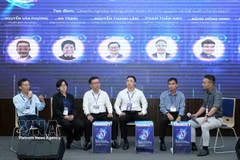
Speakers at the workshop held in Ho Chi Minh City on July 22 (Photo: VNA)

Vietnam urged to develop sovereign AI in digital era

Data has become a strategic asset and a key resource for socio-economic development, as well as a foundation of national competitiveness. As a result, effective data governance, utilisation and protection have become increasingly urgent for organisations and businesses.

(Illustrative photo; VietnamPlus)

Expert calls for secure national digital archives system

Building a national electronic archives system is not merely a matter of investing in technological infrastructure. It must be designed in an integrated manner from the outset, encompassing system architecture, governance procedures, and data protection mechanisms, to ensure long-term security, integrity, and data sovereignty.

Dr. Vo Duc Thang, Assistant Professor at the National Taiwan University of Science and Technology and President of the Vietnam Innovative and Intellectual Network in Taiwan (China), speaks at a seminar on the semiconductor industry. (Photo: VNA)

Vietnam can deepen role in global semiconductor supply chain: Taiwan-based expert

Vietnam’s biggest takeaway from Taiwan isn’t just cutting-edge technology alone, but how to build an entire semiconductor ecosystem from the ground up, said Dr. Vo Duc Thang, Assistant Professor at the National Taiwan University of Science and Technology (Taiwan Tech) and President of the Vietnam Innovative and Intellectual Network in Taiwan (China) (VIN Taiwan) told the Vietnam News Agency.

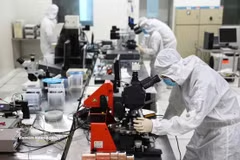
The need to develop human resources for the atomic energy and nuclear power sectors is becoming increasingly urgent. (Illustrative photo from the Vietnam Government Portal)

Vietnam needs tens of thousands of nuclear power workers by 2035

According to the Agency for Radiation and Nuclear Safety under the Ministry of Science and Technology, human resources will be among the decisive factors determining whether the country can successfully implement its nuclear power programme on schedule.