AI offers both opportunities, challenges for Vietnam’s growth

Dr. Ho Duc Thang, a full-time member of the National Assembly’s Committee for Cultural and Educational, said productivity is the key to sustaining double-digit economic growth, and AI has greater potential to improve productivity than any previous technology.

vnanet-ai.jpg
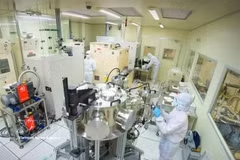
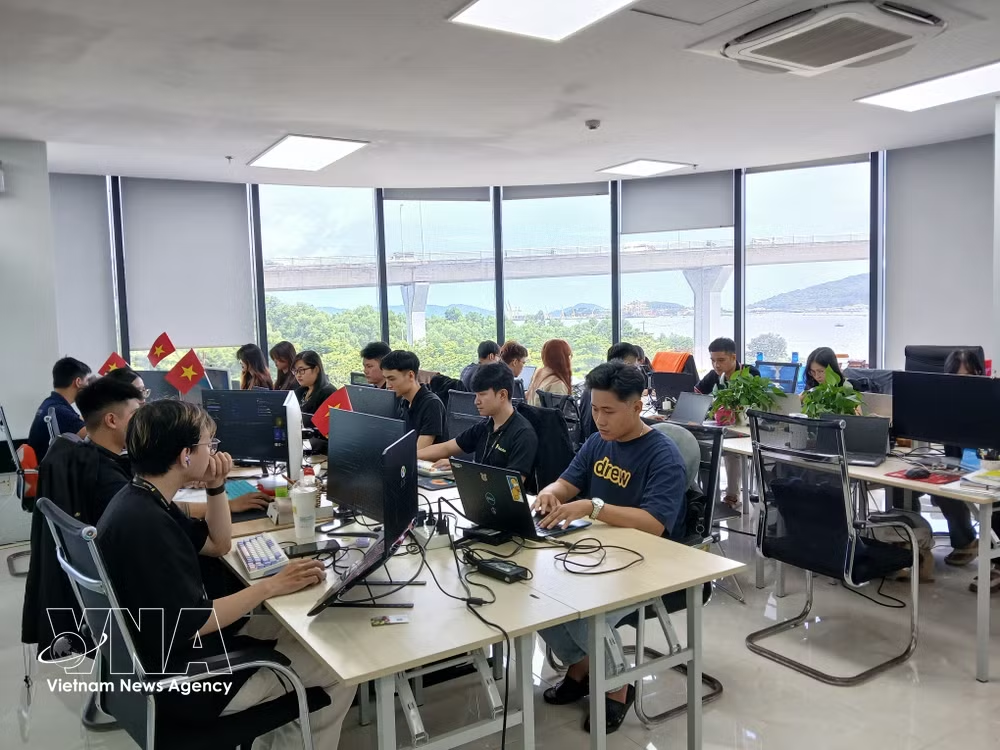
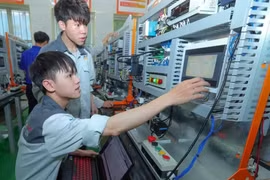
Da Nang city aims to become one of Vietnam’s three largest semiconductor and integrated circuit (IC) hubs, with a workforce of about 5,000 highly skilled professionals meeting global standards. (Illustrative photo: VNA)

Hanoi (VNA) – As Vietnam is striving to achieve ambitious growth targets in the 2026–2030 period, artificial intelligence (AI) offers an opportunity to transform its growth model; but without adequate infrastructure, skilled human resources, quality data and an enabling policy framework, the technology could also widen inequality, disrupt employment and increase technological dependence, experts cautioned.

Dr. Ho Duc Thang, a full-time member of the National Assembly’s Committee for Cultural and Educational, said productivity is the key to sustaining double-digit economic growth, and AI has greater potential to improve productivity than any previous technology.

Research led by Prof. Dr. Tran Tho Dat estimates that AI could make a significant contribution to Vietnam’s GDP growth over the coming decades. Depending on different development scenarios, AI could add between 0.72 and 2.05 percentage points to annual GDP growth by 2030, with an even larger impact by 2045 (1.92–4 percentage points).

While these projections depend on various assumptions, they demonstrate that effective policies and implementation capacity could substantially influence the country’s long-term economic performance.

The study also identifies information and communications technology, finance – banking, science – technology, and processing – manufacturing as the sectors likely to generate the greatest benefits from AI. Together, they account for about 37% of GDP but could contribute more than half of AI’s overall economic impact thanks to their high level of digitalisation, data abundance and strong spillover effects.

Despite its enormous potential, AI does not automatically create economic value. Dr. Nguyen Dinh Truc, Director of the Institute of Vietnam and World Economy, noted that productivity gains will only materialise when AI is integrated into business operations, supported by reliable data, capable personnel and stronger accountability. Simply using AI tools for drafting documents or generating reports may improve convenience but does not necessarily enhance enterprise-wide productivity.

The labour market is also expected to undergo significant changes.

Rather than replacing workers outright, AI is reshaping the division of labour, with entry-level and routine jobs facing the greatest pressure. Meanwhile, experienced professionals who can evaluate and effectively apply AI-generated results are likely to benefit the most. This could widen the gap between high-skilled and low-skilled workers, as well as between large enterprises with strong digital capabilities and smaller firms with limited resources, Thang said.

Infrastructure and data remain major challenges. Building advanced AI systems requires substantial computing capacity and energy resources, while excessive reliance on foreign platforms could expose Vietnam to technological dependence. At the same time, poor-quality or biased data may reduce AI reliability and create risks related to privacy, cybersecurity and misinformation.

Experts therefore stress that Vietnam should move beyond simply adopting AI to creating value through AI. Priority should be given to sectors with the greatest economic impact, while AI infrastructure should be developed as shared national infrastructure to improve access for businesses, particularly small- and medium-sized enterprises.

Alongside investment in infrastructure, Vietnam also needs financial mechanisms to support technology enterprises, incentives for research and development, and policies that promote innovation while ensuring the safe and responsible use of AI.

Ultimately, experts agree that people will remain at the centre of AI-driven development. Equipping the workforce with professional expertise, critical thinking and the ability to verify AI-generated information will be essential to ensuring that AI becomes a sustainable engine of Vietnam’s future economic growth./.

VNA

See more

Attracting sci-tech talent plays a critical role. (Photo: VNA)

Sci-tech seen as lever for Vietnam’s new growth phase

Raising the level of scientific and technological development is the only way to break out of the middle-income trap. Without it, Vietnam will remain stuck in low-value segments, said Dr. Le Xuan Sang, Deputy Director of the Institute of Vietnam and World Economy.

A speaker addresses the SEA+ Quantum Coordinator Meeting held in Gia Lai province on July 27. (Photo: VNA)

Regional conference strengthens Southeast Asia’s quantum technology ecosystem

Stronger networks linking government agencies, research institutes, universities, businesses and scientific organisations will provide a solid foundation for faster and more effective development of quantum technology, contributing to the sustainable development of each country and the region as a whole, said a Gia Lai official.

VAST Vice President Prof. Dr. Tran Tuan Anh speaks at an event in Vienna. (Photo published by VNA)

VAST expands global partnerships through science and people-to-people diplomacy

During a working visit to Austria from July 19-23, a VAST delegation led by Vice President Prof. Dr. Tran Tuan Anh held a series of meetings with leading research institutions and international organisations, including the International Institute for Applied Systems Analysis (IIASA), the Austrian Academy of Sciences, the Vienna University of Technology (TU Wien), and the International Atomic Energy Agency.

The Quantum Hackathon for Social Good 2026 (QC4SG 2026) kicks off in Quy Nhon, Gia Lai province, on July 24. (Photo: VNA)

Int’l quantum computing hackathon kicks off in Gia Lai

As a key activity within the technology component of the Gia Lai Quantum Year 2026, the event brings together nearly 100 contestants across 26 teams, including students, PhD candidates, young researchers, startups, and tech talents, alongside 50 domestic and international experts, mentors, and judges.

The National Foundation for Science and Technology Development under the Ministry of Science and Technology signs funding agreements for five Vietnam-Japan joint research projects in semiconductors for 2026 at a ceremony on July 22 (Photo: https://baochinhphu.vn/)

Vietnam, Japan launch five joint semiconductor research projects

The signing and implementation of the five projects mark a concrete step toward realising the Party and State’s policies on science – technology development, innovation and digital transformation, with the semiconductor industry identified as one of strategic technologies fundamental to national competitiveness and technological autonomy.

Speakers at the workshop held in Ho Chi Minh City on July 22 (Photo: VNA)

Vietnam urged to develop sovereign AI in digital era

Data has become a strategic asset and a key resource for socio-economic development, as well as a foundation of national competitiveness. As a result, effective data governance, utilisation and protection have become increasingly urgent for organisations and businesses.

(Illustrative photo; VietnamPlus)

Expert calls for secure national digital archives system

Building a national electronic archives system is not merely a matter of investing in technological infrastructure. It must be designed in an integrated manner from the outset, encompassing system architecture, governance procedures, and data protection mechanisms, to ensure long-term security, integrity, and data sovereignty.

Dr. Vo Duc Thang, Assistant Professor at the National Taiwan University of Science and Technology and President of the Vietnam Innovative and Intellectual Network in Taiwan (China), speaks at a seminar on the semiconductor industry. (Photo: VNA)

Vietnam can deepen role in global semiconductor supply chain: Taiwan-based expert

Vietnam’s biggest takeaway from Taiwan isn’t just cutting-edge technology alone, but how to build an entire semiconductor ecosystem from the ground up, said Dr. Vo Duc Thang, Assistant Professor at the National Taiwan University of Science and Technology (Taiwan Tech) and President of the Vietnam Innovative and Intellectual Network in Taiwan (China) (VIN Taiwan) told the Vietnam News Agency.

The need to develop human resources for the atomic energy and nuclear power sectors is becoming increasingly urgent. (Illustrative photo from the Vietnam Government Portal)

Vietnam needs tens of thousands of nuclear power workers by 2035

According to the Agency for Radiation and Nuclear Safety under the Ministry of Science and Technology, human resources will be among the decisive factors determining whether the country can successfully implement its nuclear power programme on schedule.

Technologies for developing digital government infrastructure and cashless payment solutions are showcased at an exhibition. (Photo: VNA)

Vietnam approves national digital transformation strategy for 2026 - 2030

Vietnam aims to become a developed digital nation where digital transformation is implemented comprehensively across all sectors and serves as the country's principal development model. The strategy envisions a modern system of national governance powered by data and AI, strong domestic capabilities in strategic digital technologies, platforms and products, and firm protection of national digital sovereignty.