Experts urge balanced AI adoption in cultural industries

As Vietnam identifies cultural industries as a new driver of economic growth and national branding, AI is expected to play an increasingly important role in strengthening their competitiveness.

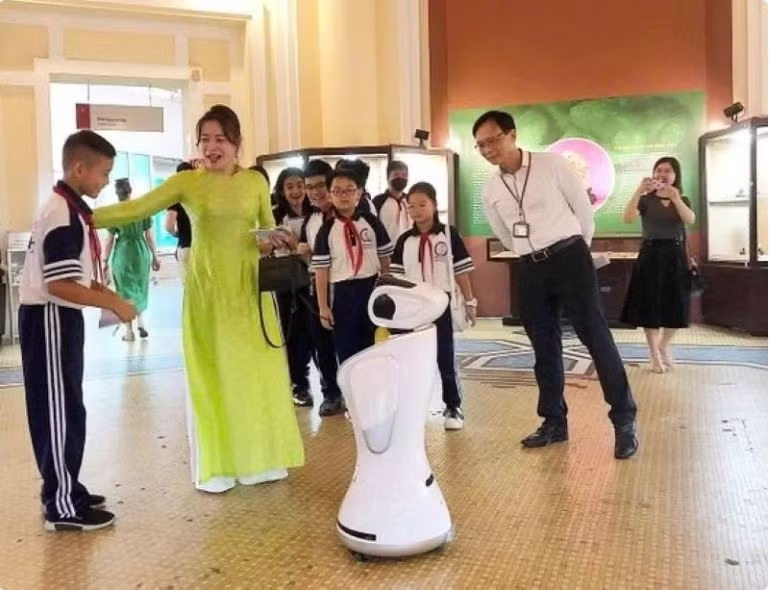
An artificial intelligence-powered robot guides visitors through the Ho Chi Minh City Museum of History. (Photo: nhandan.vn)

Hanoi (VNA) – As artificial intelligence (AI) transforms the creation, production and distribution of cultural products while opening new opportunities for cultural heritage preservation and global outreach, experts say its full potential can only be realised with stronger legal frameworks, richer data resources and a highly skilled workforce.

AI is becoming a core technology across cultural industries, enabling businesses to optimise production, reduce costs, personalise user experiences, and develop higher-value-added cultural products. As Vietnam identifies cultural industries as a new driver of economic growth and national branding, AI is expected to play an increasingly important role in strengthening their competitiveness.

In the film industry, AI is mainly used to support production through image restoration, automatic subtitling, dubbing, audience analytics and content personalisation on distribution platforms. In music, it assists with composing melodies, arranging, audio processing, noise reduction and creating demo recordings.

The publishing sector employs AI for manuscript editing, translation, text summarisation and conversion of printed books into audiobooks, while journalism and media organisations use it to analyse data and accelerate information processing. AI is also enhancing audience experiences in the performing arts and showing strong potential in video game development.

Beyond these fields, AI is being applied in advertising, cultural tourism, handicraft production and product design, helping improve productivity, quality and competitiveness.

Despite these opportunities, experts warn that AI adoption also poses significant challenges.

Dr. Tran Kim Ba of the Vietnam Academy of Social Sciences said copyright is among the most pressing concerns as AI models are trained on vast datasets that include images, music, books and films, increasing the risk of copyright infringement and unauthorised use of creative works.

Another major obstacle is data availability. Much of Vietnam's cultural heritage and historical archives have yet to be digitised, limiting AI's ability to learn from and generate content that reflects the country's cultural identity.

A shortage of skilled professionals also remains a bottleneck. Cultural industries require a workforce with both artistic expertise and digital and AI capabilities, but such interdisciplinary professionals remain scarce. Meanwhile, high investment costs for data infrastructure and licensed software make AI adoption difficult for many small- and medium-sized enterprises and independent artists.

Experts say Vietnam can learn from countries that have successfully integrated AI into their cultural sectors. The Republic of Korea uses AI to analyse audience preferences, automate translation, support music and film production, and boost global promotion of Korean cultural content. China has focused on AI applications in filmmaking and video games while Singapore has developed digital museums and libraries, and Japan continues to advance AI in its animation industry.

Vietnam is seen as having strong potential in video games, music, film and animation based on folk culture, they added.

To maximise AI's benefits, specialists stress the need for coordinated policies covering regulation, technology and human resources development.

Hoang Van Tam, Founder and CEO of DigiTech Solutions, said AI should be used to process data, support research, suggest ideas and optimise workflows, while humans remain responsible for setting values, verifying content and making final decisions.

Experts also call for Vietnamese language, history, traditions and indigenous knowledge to be incorporated into AI training data to ensure AI-assisted content reflects the country's cultural identity. Cultural experts and creators should review AI-generated works to prevent inaccuracies, homogenisation and the erosion of national identity.

It is necessary to develop high-quality human resources while enhancing partnerships between arts and technology training institutions to build a both creative and tech-savvy workforce.

Ethical AI use is also essential, experts said, noting that without clear legal frameworks and ethical standards, AI could undermine creativity, cultural identity and the livelihoods of creative workers.

Dang Tran Cuong, Director of the Cinema Department under the Ministry of Culture, Sports and Tourism, held that laws should protect intellectual property and also encourage innovation.

While AI can enhance creativity, it cannot replace the human emotions, lived experiences and cultural values that define artistic creation, Ba stressed, adding that the true value of any cultural product lies in the beauty distilled from the cultural identity and heritage of its community and nation./.

VNA

See more

My Nghiep weaving village in Khanh Hoa province strives to keep tradition alive. (Photo: VNA)

Resolution paves way for Vietnam to unleash soft power

The implementation of Resolution No. 06 alongside the cultural diplomacy strategy sends a clear message: by combining its rich cultural heritage with proactive diplomacy, innovation and digital transformation, Vietnam would strengthen its competitiveness on the global stage.

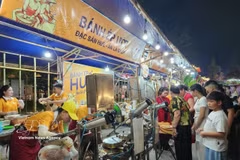
Visitors sample Hue's traditional specialties during the Hue Traditional Cuisine Week 2024. (Photo: VNA)

Hue city named among Asia's top destinations for traditional cuisine

Hue stood out for its imperial cuisine, a culinary tradition rooted in the city's history as the capital of the Nguyen Dynasty. Renowned for its refined flavours, meticulous preparation and artistic presentation, Hue's cuisine reflects centuries of royal and cultural traditions.

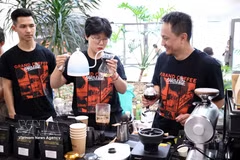
A barista demonstrates coffee brewing for visitors at the event. (Photo: VNA)

Central Vietnam's specialties inspire innovative coffee beverages

Businesses and coffee artisans in Da Nang city are reimagining the central region's signature specialties through creative coffee beverages, offering visitors distinctive flavours while adding value to OCOP (One Commune One Product) items and strengthening links between agriculture, culture, tourism and commerce.

Over 100 young overseas Vietnamese from 32 countries and territories join the Vietnam Summer Camp 2026. (Photo: VNA)

Vietnam Summer Camp 2026 wrapped up

Held from July 12 to 25 across eight cities and provinces, Vietnam Summer Camp 2026 offered a rich array of experiences. Participants explored historical landmarks, visited iconic cultural heritage sites such as the imperial city of Hue, Hoi An ancient town, and the My Son Sanctuary, and engaged in charitable activities valued at over 300 million VND (11,400 USD), including the installation of a "Youth Bookshelf."

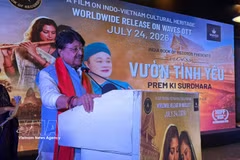
India's Madhya Pradesh Cabinet Minister Kailash Vijayvargiya speaks at the event. (Photo: VNA)

Film inspired by Vietnamese Quan Ho folk singing released globally

Produced by the India Book of Records (IBR) based on an idea by Prof. Dr. Chu Bao Que, "Love Garden" weaves Quan Ho folk singing into a bridge connecting past and present. The storyline follows a young Indian woman from Madhya Pradesh state who travels to the heartland of Quan Ho in northern Vietnam and performance stages in Hanoi to trace memories of her late mother.

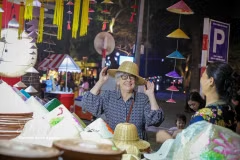
A foreigner is drawn to Vietnam's traditional products at the Hanoi Tourism Gift Festival 2025. (Photo: VNA)

Vietnamese souvenirs tell everyday stories, drive creative economy

Today’s souvenirs capture the rhythm of everyday life: a “banh mi” (Vietnamese baguette) lapel pin, a sketchbook of Hanoi’s tangled streets, and illustrations of daily life in Ho Chi Minh City. They work because they paint a Vietnam that feels authentic, approachable and alive. Simple, compelling stories are giving cultural souvenirs a whole new appeal.

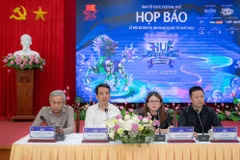
The organisers of the Hue Wonderverse Music Fest 2026 hold a press conference on the festival in the central city of Hue (Photo courtesy of the event's Organising Committee)

Hue to host international heritage, music festival

Themed "City Awakening – Awakening Heritage," Hue Wonderverse Music Fest 2026 aims to offer an immersive experience that combines Hue's rich cultural heritage with contemporary music, art and cutting-edge performance technology.

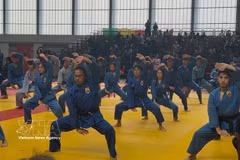
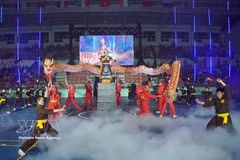
Martial artists perform in a mass demonstration at the opening ceremony. (Photo: VNA)

Ho Chi Minh City international traditional martial arts championship opens

Nguyen Nam Nhan, Deputy Director of the municipal Department of Culture and Sports and head of the organising committee, said Vietnamese traditional martial arts embody the essence of martial arts excellence, fostering a philosophy of life that upholds the values of Truth, Goodness, and Beauty, while continuing to gain recognition among the international community.

Deputy Minister of Foreign Affairs Ngo Le Van, Chairman of the Vietnam National Commission for UNESCO, addresses the session. (Photo: VNA)

UNESCO endorses vision for restoring Thang Long Imperial Citadel's central axis

The committee commended Vietnam for fulfilling the commitments it has made since the citadel was inscribed on the UNESCO World Heritage List in 2010, as well as for implementing recommendations from the committee and its advisory bodies. It also praised the country's efforts to preserve the site's cultural, historical and social values, transforming the imperial citadel into a space for public engagement, cultural exchange and historical education. The committee further welcomed the long-term vision as an important basis for the proposed restoration of Kinh Thien Palace in line with the approved conservation strategy.