New e-commerce law strengthens accountability across digital marketplace

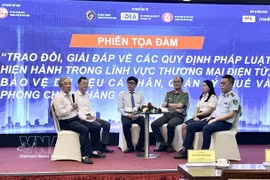
Instead of focusing mainly on protecting consumers as previously, the Law on E-commerce clearly defines the legal responsibilities of all participants in the digital marketplace, including e-commerce platforms, businesses, online sellers, key opinion leaders (KOLs), key opinion consumers (KOCs) and affiliate marketers.

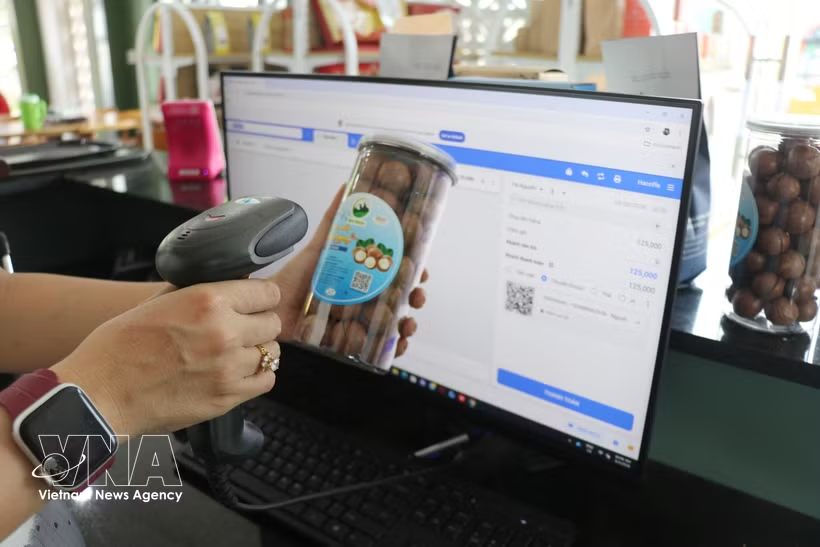
Agricultural and OCOP products from Nhan Co commune in Lam Dong province have their information digitised, are labelled with QR codes for traceability, and put on e-commerce platforms. (Photo: VNA)

Ho Chi Minh City (VNA) – Nearly one month after Vietnam's Law on E-commerce took effect, businesses, online platforms and digital content creators are adjusting to a new regulatory environment that places greater emphasis on transparency, accountability and law compliance.

Instead of focusing mainly on protecting consumers as previously, the law clearly defines the legal responsibilities of all participants in the digital marketplace, including e-commerce platforms, businesses, online sellers, key opinion leaders (KOLs), key opinion consumers (KOCs) and affiliate marketers.

Under the new rules, product promotion must be based on verified information and legal documentation rather than exaggerated marketing claims.

Vo Truong Duy, a content creator and affiliate marketer, said every product featured in a livestream session is now checked against product registration documents, labels, distributors and advertising regulations before being introduced to consumers.

Content creators also noted that absolute claims such as "100% effective" or "guaranteed cure" are no longer acceptable. Reviewing legal documents before each livestream session not only reduces compliance risks but also strengthens the credibility of both creators and businesses.

The changes extend beyond livestream sales. Companies say the new law has reshaped their entire e-commerce operations, from seller identification and product traceability to tax management and information disclosure.

Dang La Huy, head of e-commerce operations at Cocoon Vietnam, said compliance now begins during product development and continues through quality testing, packaging and product descriptions.

Previously, companies only needed to provide products to influencers for promotion. Today, both businesses and content creators must carefully verify every piece of information before publishing it online, he said.

Businesses have also welcomed stronger cooperation between platforms and regulators to combat counterfeit goods and intellectual property violations.

Nguyen Huu Tho, an e-commerce representative of Be' Balane Vietnam, said improved complaint mechanisms on e-commerce platforms and stricter legal requirements have made it easier to detect and remove counterfeit products while protecting legitimate businesses.

For his part, Nguyen Huu Tuan, Director of the E-commerce and Digital Technology Development Centre under the Ministry of Industry and Trade's Agency of E-commerce and Digital Economy, noted digital platforms have actively upgraded their systems to comply with the new law. Major platforms have strengthened product monitoring, enhanced seller verification, improved transaction data storage and introduced more transparent complaint-handling procedures for consumers.

He said the ministry is also stepping up public awareness campaigns so that platforms, businesses and consumers fully understand their rights and obligations.

Nguyen Lam Thanh, a representative of TikTok Vietnam, said seller and content creator verification is one of the law's key requirements. TikTok Shop and other major platforms have begun deploying technical solutions to verify millions of seller accounts in line with the law enforcement roadmap.

In addition to verifying sellers' identities, they are required to monitor product quality, handle consumer complaints and establish automated mechanisms to detect products that violate platform rules or Vietnamese law.

Thanh added that consumer trust in sellers and content creators is essential to the long-term growth of e-commerce, making efforts to eliminate counterfeit goods and misleading products both a legal obligation and a business necessity. Sellers who repeatedly violate platform rules or Vietnamese law may face sanctions, including permanent removal from the platform.

The regulatory changes come as Vietnam's e-commerce market continues to expand rapidly.

According to market research firm Metric, the sector grew by 20–22% in the first half of 2026. Revenue generated by the country's four largest e-commerce platforms exceeded 291 trillion VND (11 billion USD), up 44% year-on-year. Although official brand stores account for fewer than 3% of all online shops, they generated more than one-third of the market's total revenue./.

VNA

See more

Students practice microcontroller programming at the Vietnam-Korea College of Technology in Bac Ninh province (Photo: VNA)

Vietnam – one of most attractive destinations for leading US semiconductor companies: expert

Vietnam has built a solid semiconductor and electronics industry before joining ITSI, attracting major US semiconductor companies. Intel Products Vietnam is one of Intel's largest assembly and testing facilities worldwide, while chip design companies such as Synopsys, Cadence, Marvell and Qualcomm have established engineering and research centres in the Southeast Asian country.

Lawmakers on August 9 discuss a draft law amending and supplementing a number of articles of the Law on the State Bank of Vietnam, the Law on Anti-Money Laundering and the Law on Credit Institutions. (Photo: VNA)

Lawmakers discuss measures to ensure banking system safety, support digital economy

The draft law sets out provisions to control conflicts of interest when commercial banks act as agents managing collateral for corporate bonds. In this regard, Deputy Le Van The of Ninh Binh province said he supported the move, noting that it could provide a more professional approach to collateral management and help strengthen investor confidence if properly regulated.

A company in Da Nang operates a customer relationship management system supported by AI chatbots. (Photo: VNA)

AI drives rise of sleepless enterprises in Vietnam

The concept of a sleepless enterprise does not necessarily mean making employees stay on the job all the time. Instead, it's about building intelligent systems that can respond to customers, process transactions, monitor operations, analyse data and flag risks continuously.

Head of the Vietnam Trade Office in Australia Tran Thi Thanh My (Photo: VNA)

Vietnam, Australia eye 20 bln USD trade target

The head of the Vietnam Trade Office in Australia hoped that the visit by Party General Secretary and State President To Lam will mark a new milestone, opening the door for firms on both sides to forge stronger links and launch concrete cooperation agendas, helping hit that 20 billion USD trade goal sooner rather than later.

Phu Quoc pepper products, granted three stars under the OCOP programme in An Giang province, are displayed at an exhibition of outstanding OCOP products from the Mekong Delta. (Photo: VNA)

Phu Quoc leverages OCOP programme to take local specialities global

Better known as one of Vietnam’s premier island destinations, Phu Quoc is leveraging its “One Commune, One Product” (OCOP) programme to transform traditional specialities into internationally recognised products, integrating local agriculture, food processing and tourism to promote sustainable economic growth.

Production at an FDI enterprise in Tay Ninh province. (Photo: VNA)

FTA Index 2025 to be unveiled later this month

The index is designed to provide valuable information not only for State management agencies but also as an important reference for businesses, foreign investors, and industry associations in planning investment and business activities in Vietnam.

Air Premia, a carrier of the Republic of Korea, will resume flights between Incheon and Ho Chi Minh City from November 5. (Photo: The Courtesy of Air Premia)

Air Premia to resume Incheon–Ho Chi Minh City route from November

Flights will depart Incheon International Airport at 6:40 pm (RoK time) and arrive at Tan Son Nhat International Airport in Ho Chi Minh City at 11 pm (Vietnam time). Return flights will leave Ho Chi Minh City at 12:30 am on Mondays, Tuesdays, Thursdays, Fridays and Sundays, landing in Incheon at 7:40 am.

Production at Viet Hai High-Tech Structure Production Company Limited in Vung Ang Economic Zone. Ha Tinh province aims to develop Vung Ang Economic Zone into a regional centre for industry, energy, seaports and logistics (Photo: VNA)

Revised master plan of Vung Ang EZ approved

The adjustment aims to create a more rational development framework to maximise the zone’s potential and advantages while providing a legal foundation for construction management and ensuring sustainable development.

Illustrative image (Photo: VNA)

Vietnam looks to domestic market to sustain wood industry growth

Vietnam’s wood sector has long been a top foreign-currency earner. Exports of wood and wooden products neared 17.3 billion USD in 2025, reaching more than 160 countries and territories and clearing the high bars set by the US, the European Union and Japan.

Delegates at the event (Photo: VNA)

Vietnam remains key market for Polish food producers

The campaign promotes selected European Union agricultural and food products, including fresh, chilled and frozen beef and pork, fresh apples, apple juice and dried apples, targeting consumers, importers, distributors, retailers and the hospitality sector.