NA Standing Committee debates revisions to real estate business law

Chairman Man said the amendment of the Law on Real Estate Business must move in lockstep with a clean-up of rules governing land, housing, investment, planning, construction and finance. The amendments, he said, must fully codify principles laid out in the Party Central Committee’s third plenum resolution on land-law reform while making the legal framework coherent, free of overlap and more enforceable.

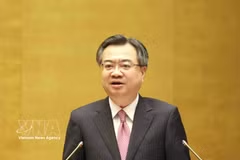
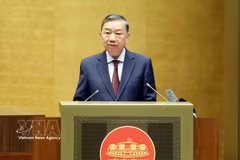
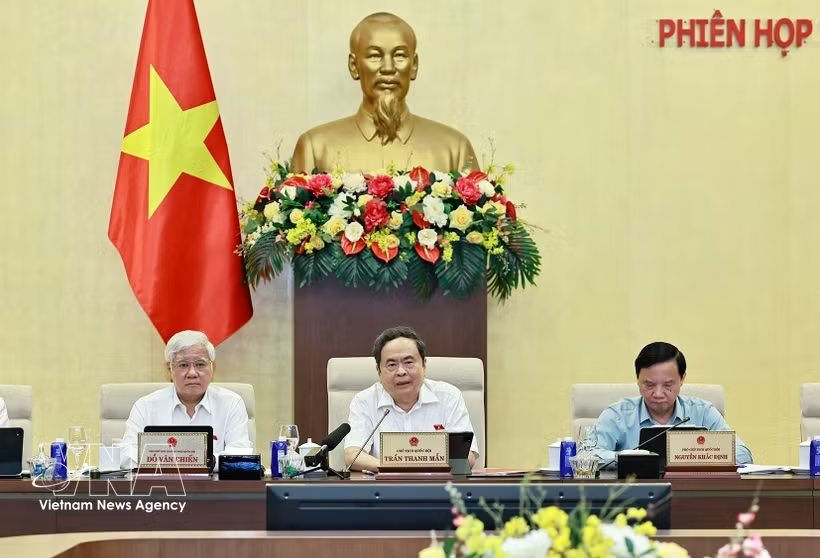
NA Chairman Tran Thanh Man speaks at the meeting (Photo: VNA)

Hanoi (VNA) - The National Assembly (NA) Standing Committee opened debate on amending the Law on Real Estate Business in Hanoi on July 29, with NA Chairman Tran Thanh Man chairing the discussions as part of its ongoing fourth session.

Chairman Man said the amendment of the Law on Real Estate Business must move in lockstep with a broader clean-up of rules governing land, housing, investment, planning, construction and finance. The amendments, he said, must fully codify principles laid out in the Party Central Committee’s third plenum resolution on land-law reform while making the legal framework coherent, free of overlap and more enforceable.

After nearly two years of implementation, the law has exposed a string of weaknesses that demand a timely fix to catch up with reality, Man noted.

One sticking point is the rule on deposits and off-plan home sales. The current 5% deposit cap is too low to lock in a buyer’s commitment, opening the door to speculation, paper flipping and arbitrary contract cancellations, he added.

At the same time, a requirement that developers can only take deposits after a project has full business eligibility, a construction permit or completed infrastructure has choked off legitimate early-stage funding, forcing builders to lean more heavily on costly bank loans. He called for solutions to both problems.

On planning, he pointed to discrepancies between land use planning and real estate business conditions. Planning systems in many localities remain disjointed, and detailed zoning updates have lagged master plans and land use frameworks. Rules capping the residential share in mixed-use projects continue to trip up investment approvals and product sales licenses.

Given those gaps, he said lawmakers should zero in on several policy priorities, including revamping deposit and early-financing mechanisms, spelling out rules for investment cooperation agreements and expressions of interest before projects can be marketed, and ensuring compliance with maximum limits, with bank guarantees, oversight and safeguards to protect the interests of all parties.
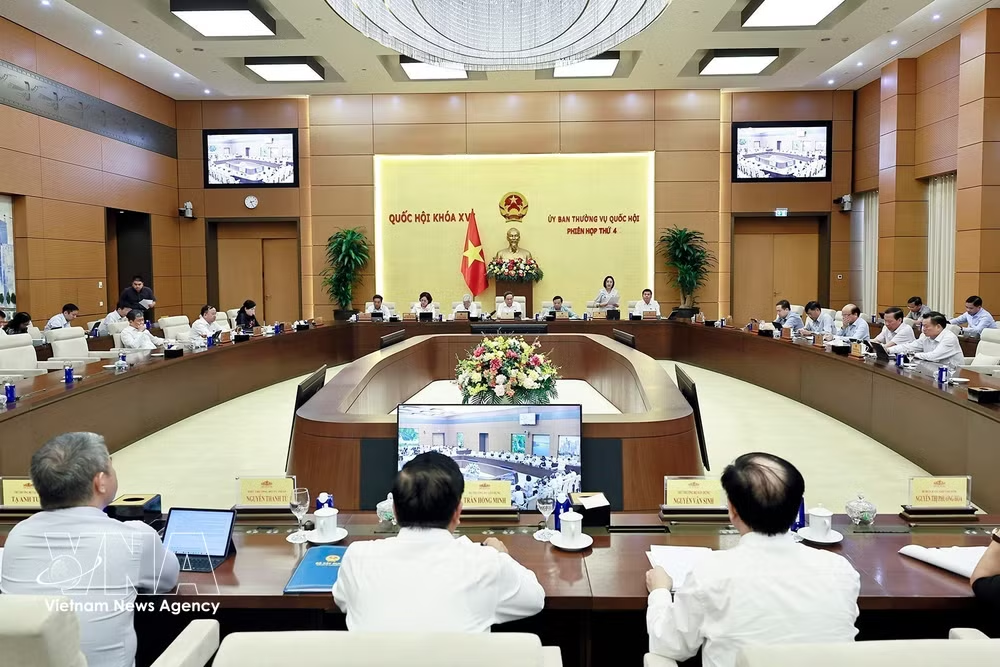
vnanet-o.jpg
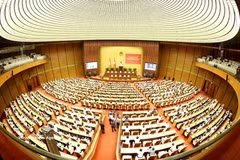
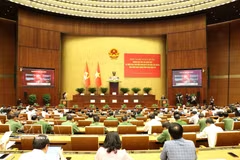
Overview of the session (Photo: VNA)

The top legislator also pushed to standardise property identification and plug it into a national data system. Each unit brought to market would carry a unique identification code bundling full details on legal status, zoning, mortgages, transaction history and other relevant data.

Project information will have to go live on the national data system before any deposits are taken or deals closed. Transactions without the required identification code would get no legal recognition.

The revision is not about simply tightening or loosening the reins. Rather, it’s about erecting a transparent, stable and highly predictable legal framework that is consistent with the Land Law, Housing Law, Law on Credit Institutions and other related laws, he said.

According to a government report, the draft law aims to promote decentralisation and delegation of authority, cut business conditions, simplify administrative procedures, accelerate digital transformation, and develop a fully integrated national data system.

The draft law revises regulations on the approval of full or partial transfers of real estate projects by shifting the decision-making authority from the Prime Minister to provincial-level People’s Committees, while also removing or revising the Ministry of Construction’s inspection responsibilities in the real estate business sector.

Representing the reviewing agency, Chairman of the NA’s Committee for Economic and Financial Affairs Phan Van Mai said its standing members agreed on the need to revise the law./.


VNA

See more

☕ Afternoon briefing on July 29

☕ Afternoon briefing on July 29

The national teleconference held to study, disseminate and implement the resolutions adopted at the 14th Party Central Committee’s recent third meeting, the issuance of the national programme on child protection and child labour prevention and reduction for 2026–2030, and one Vietnamese killed in the July 28 earthquake in Japan’s Kumamoto prefecture are among news highlights on July 29.

Vansy Kuamua (right), member of the Lao People's Revolutionary Party (LPRP) Central Committee and Deputy Head of its Commission for Propaganda and Training, receives Deputy Editor-in-Chief of the Communist Review of Vietnam Nguyen Ngoc Ha on July 28. (Photo: VNA)

Vietnam, Laos enhance cooperation in Party theoretical work

The Communist Review will continue to work closely with its Lao counterpart to translate the concept of "strategic cohesion" in Vietnam–Laos relations into concrete actions, in line with the orientation set by the high-ranking leaders of the two Parties.

Politburo member, Secretary of the Party Central Committee, Chairman of the Party Central Committee's Commission for Policies and Strategies Nguyen Thanh Nghi speaks at the national conference to disseminate and implement resolutions adopted at the third plenum of the 14th Party Central Committee on July 29. (Photo: VNA)

Party resolution sets roadmap for renewing national development model

Under the new development model, Vietnam will be self-reliant, innovative, humane, sustainable and globally integrated, with people at the heart of development. Science and technology, innovation, digital transformation and artificial intelligence are designated as the main growth drivers, while higher productivity and more efficient resource allocation serve as core principles.

Politburo member and Minister of Public Security General Luong Tam Quang speaks at a national conference held on July 29 to disseminate and implement the resolutions adopted at the third plenum of the 14th Party Central Committee. (Photo: VNA)

Party Central Committee adopts new mindset for national security, social development in new era

For the first time, the 14th National Party Congress placed maintaining a peaceful and stable environment at the forefront of the country's development objectives. It also set the goal of building a society that is orderly, civilised, secure, safe, socially protected and development-oriented, with the long-term ambition of significantly reducing crime and ultimately creating a society free of crime, accidents, social evils and corruption.

Party General Secretary and State President To Lam delivers the opening remarks at the third plenum of the 14th Party Central Committee on July 20. (Photo: VNA)

Vietnam advances proactive, comprehensive approach to national security

Party General Secretary and State President To Lam stressed that security is a prerequisite for development and called for a fundamental shift in the national security strategy. Instead of dealing with individual risks after they arise, Vietnam must strengthen resilience, improve preparedness and proactively safeguard the country.

Secretary of the municipal Party Committee Tran Luu Quang meets with Thai Ambassador to Vietnam Urawadee Sriphiromya on July 28, 2026. (Photo: sggp.org.vn)

Ho Chi Minh City looks to boost cooperation with Thailand, Cambodia, Philippines

Secretary of the municipal Party Committee Tran Luu Quang hosted separate meetings with Thai Ambassador to Vietnam Urawadee Sriphiromya and a delegation of Thai businesses, newly appointed Cambodian Consul General Luon Bunvadh, and newly appointed Consul General of the Philippines Querobine Deapera Laccay, on July 28.

An overview of the conference at the central venue, Dien Hong Hall of the National Assembly House in Hanoi on July 29. (Photo: VNA)

National teleconference disseminates resolutions of 14th Party Central Committee’s third session

According to the agenda, participants are expected to study a series of resolutions and conclusions adopted at the third plenum. These cover key strategic issues, including renewing Vietnam’s development model; building and developing the country into a strong sea-based nation; fostering a disciplined, safe, civilised, harmonious and developed society; and the National Security Strategy.

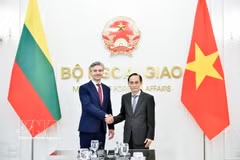
Permanent Deputy Prime Minister Pham Gia Tuc (right) meets with Lithuanian Minister of Foreign Affairs Kestutis Budrys in Hanoi on July 28. (Photo: chinhphu.vn)

Permanent Deputy PM receives Lithuanian Foreign Minister

Permanent Deputy Prime Minister Pham Gia Tuc called the Lithuanian Foreign Minister’s official visit a contribution to the traditional friendship between the two countries as well as the substantive development of the Vietnam–EU Comprehensive Strategic Partnership.

☀️ Morning digest on July 29

☀️ Morning digest on July 29

Vietnamese leaders' meetings with the President of the Supreme People's Court of Laos and the President of the National Assembly of Cambodia, Minister of Foreign Affairs Le Hoai Trung's talks with his Lithuanian counterpart Kestutis Budrys, and the second political consultation between the foreign ministries of Vietnam and Panama are among news highlights on July 28 evening.

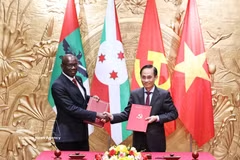
Politburo member, Minister of Foreign Affairs Le Hoai Trung (R) and Secretary General of Burundi’s National Council for the Defence of Democracy–Forces for the Defence of Democracy (CNDD-FDD) Révérien Ndikuriyo exchange the memorandum of understanding on cooperation between the two Parties. (Photo: VNA)

Vietnam, Burundi seek measures to enhance bilateral ties

Speaking highly of Burundi’s achievements under the leadership of the CNDD-FDD, Trung said the two countries should strengthen solidarity and play a greater role in maintaining peace and stability in their respective regions and globally, thereby creating favourable conditions for achieving their development goals.

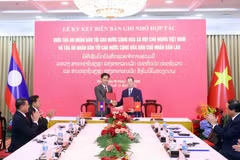
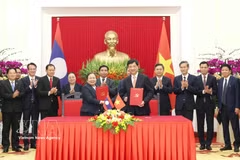
Chief Justice of the Supreme People's Court of Vietnam Nguyen Van Quang and President of the Supreme People's Court of Laos Phayvy Syboualypha sign a new memorandum of understanding (MoU) on cooperation between the two courts. (Photo: VNA)

Vietnamese, Lao supreme courts deepen cooperation

The two chief justices reaffirmed that the great friendship, special solidarity, comprehensive cooperation and strategic cohesion between Vietnam and Laos are an invaluable asset of the two nations. They agreed to continue effectively implementing high-level agreements reached by the two Parties and States, thereby further strengthening cooperation between the two judicial systems.