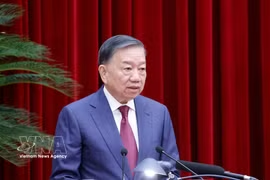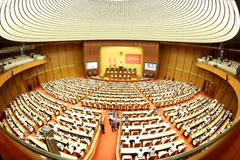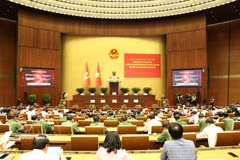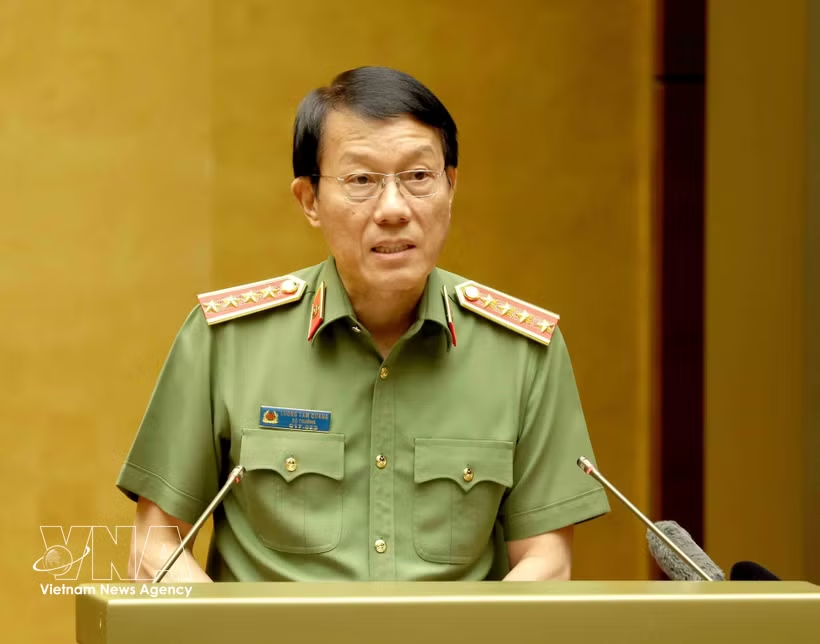
Hanoi (VNA) – The Party Central Committee has introduced a new strategy for national security and social development in the new era, aiming to ensure peace, stability and high-quality sustainable development while improving people's well-being and achieving Vietnam's two centenary goals, Politburo member and Minister of Public Security General Luong Tam Quang said at a national conference on July 29 to disseminate and implement resolutions adopted at the third plenum of the 14th Party Central Committee.
He noted that, for the first time, the 14th National Party Congress placed maintaining a peaceful and stable environment at the forefront of the country's development objectives. It also set the goal of building a society that is orderly, civilised, secure, safe, socially protected and development-oriented, with the long-term ambition of significantly reducing crime and ultimately creating a society free of crime, accidents, social evils and corruption.
Despite major breakthroughs that have made Vietnam one of the world's leading countries in terms of peace, stability and security, Quang acknowledged that challenges remain. The four major risks identified by the Party have yet to be fully addressed, while an increasingly volatile global environment and emerging non-traditional security threats pose unprecedented challenges.
Against this backdrop, he said, Vietnam requires new mindset, new approaches and higher standards in safeguarding national security. National security must become an enabler of development, providing the foundation for rapid, sustainable growth and higher living standards. The new national security strategy aims to ensure that operations of the administrations at all levels remain uninterrupted, critical infrastructure continues functioning, the economy avoids severe disruption and society remains stable under all circumstances.
The strategy sets out six guiding principles, reflecting the Party's updated mindset on national security, and introduces seven specific objectives, expanding on previous national security strategies to address new challenges.
Key priorities include safeguarding the Party's ideological foundation, leadership role, combat capacity and the strength of the socialist system. It also calls for stronger protection of the legitimate interests of Vietnamese organisations and citizens abroad and deeper international cooperation on security.
To achieve these goals, the resolution outlines nine major groups of tasks and measures, including some introduced for the first time, such as protecting the political system and institutions against all contingencies, safeguarding emerging domains and technologies, responding proactively to new forms of security threats and crises, enhancing human security and making public trust a core pillar of the national security strategy.
The minister stressed that national security in the new era extends beyond protecting the Party, the State, the people, the political system and national sovereignty. It now encompasses safeguarding the foundations of national development and ensuring the stable operation of the economy, society and technology. He underscored that all development strategies must strengthen national resilience and that security must never be sacrificed for economic growth.
He also highlighted another resolution on building an orderly, safe, healthy, civilised, harmonious and development-oriented society, describing it as the first strategic Party document dedicated to this objective.
The resolution targets the establishment of the foundations for such a society by 2030, with longer-term goals extending to 2045. Among its key targets are reducing social order crimes by 10% annually, ensuring that by 2030 at least 50% of commune-level localities and 20% of provincial-level localities are drug-free, completing the development of a digital government, placing Vietnam among ASEAN's top three and the world's top 50 in digital government, and among the world's top 15 in the Global Cybersecurity Index.
Other targets include raising the national public administration satisfaction index (SIPAS) above 88%, ensuring universal access to schools, teachers and learning materials, achieving an upper secondary education completion rate of at least 85%, providing annual health check-ups for all citizens while moving towards universal free hospital care, maintaining unemployment below 3%, and improving access to cultural services nationwide.
The resolution also aims to raise Vietnam's Human Development Index (HDI) to around 0.8, increase life expectancy to about 75.5 years, and place the country among the world's 40 happiest nations, while addressing urban disorder, pollution, traffic congestion and flooding.
To support implementation, it identifies eight groups of tasks and measures, including three breakthrough priorities: promoting a culture of respect for the rule of law and public service ethics, developing the Vietnamese people for a new era, and building a modern system of social governance that supports development from the grassroots level.
Quang said the Politburo has also adopted two action programmes containing 79 and 59 specific tasks, respectively, following the principle of "six clarities" – clearly defining responsibilities, tasks, timelines, authority and expected outcomes.
He concluded that the two resolutions establish a new strategic vision for protecting national security across all domains while building a people-centred society that improves both material and spiritual well-being, providing a new foundation and driving force for implementing the resolutions of the 14th National Party Congress./.
See more
Vietnam–Australia relationship has matured, underpinned by strong political trust: Australian expert
The state visit to Australia by Party General Secretary and State President To Lam represents an opportunity for both countries to translate strategic ambitions into concrete outcomes, said Layton Pike, a member of the Australia–Vietnam Policy Institute (AVPI)'s advisory board.
New impetus for deeper Vietnam–Australia ties
Party General Secretary and State President To Lam's state visit comes as the Vietnam–Australia Comprehensive Strategic Partnership is booming. Leaders expect it will inject new momentum, making ties deeper, more substantive and more effective.
National Assembly reviews bill on WMD non-proliferation
Most deputies agreed on the need for the law, saying it will help complete the legal framework for implementing Vietnam’s international commitments and proactively prevent, detect and stop the proliferation of nuclear, chemical and biological weapons and related delivery systems.
Vietnam to remain active player in shaping ASEAN’s future: minister
Entering a new era of national development with the aspiration of building a strong and prosperous country, the mindset of "growing alongside ASEAN" will guide Vietnam’s more proactive, positive, and substantive contributions to the ASEAN Community and the co-creation of the region’s shared future, noted Minister of Foreign Affairs Le Hoai Trung.
Economic police asked to reinforce core role in combat against corruption, economic crimes
NA Chairman Tran Thanh Man asked the Economic Police to take the lead in applying sci-tech advances, leveraging data analytics, enhancing the capabilities of digital investigation and financial flow tracing, while proactively identifying emerging risks to economic, financial, data, and supply chain security.
Top Vietnamse leader’s upcoming Australia visit to pave way for substantive ties: Scholar
Professor Carl Thayer, a Vietnam and Southeast Asia expert at the University of New South Wales, saw substantial untapped potential for long‑term cooperation between Vietnam and Australia in specialised areas like energy transition, climate change adaptation and risk governance.
Thailand's parliamentary leader concludes official visit to Vietnam
Thailand attaches great importance to its Comprehensive Strategic Partnership with Vietnam, and the two countries share a solid foundation of friendship, many common strategic interests and significant potential for cooperation, said President of the National Assembly and Speaker of the House of Representatives of Thailand Sophon Zaram.
33rd Diplomatic Conference wraps up in Hanoi
Foreign relations are no longer viewed simply as relations with the outside world but as an integral component of national comprehensive strength and a responsibility shared by the entire Party, people, armed forces and political system.
Parliamentary cooperation forms key pillar of Vietnam–Thailand ties: top leader
Party General Secretary and State President To Lam urged the effective implementation of the action plan for the Vietnam–Thailand Comprehensive Strategic Partnership for 2026–2031 and expressed his hope to welcome the King and Queen of Thailand on a visit to Vietnam soon.
Top leader's visit expected to further deepen Vietnam-Australia comprehensive strategic partnership: official
The upcoming state visit to Australia by Party General Secretary and State President To Lam is expected to generate fresh momentum for deepening bilateral relations, deliver practical benefits to people and businesses in both countries, and make a positive contribution to peace, stability, cooperation and development in the region.
Lawmakers seek legal reforms to promote telecom infrastructure data sharing
A deputy of Ha Tinh province said there is currently no clear legal basis for sharing technical infrastructure data. While the issue may be less apparent under normal circumstances, it could hamper local coordination and response during storms, floods and other disasters when detailed infrastructure data is not readily available.
Criteria on APEC 2027 projects should be made public: lawmakers
Lawmakers called on the drafting body to clearly lay out the scope, eligible parties, and implementation guidelines, and to share the list or criteria for determining which projects and works qualify for the special policies.
Get-together celebrates 59th founding anniversary of ASEAN
Despite differences in history, culture, languages, religions, levels of development, and social conditions, ASEAN member states have chosen to respect one another, build consensus, and pursue shared regional interests. It’s the unity in diversity that has shaped ASEAN’s identity, strength, resilience, and central role in the regional architecture.
☕ Afternoon briefing on August 7
The following is a brief review of the day’s events as reported by the Vietnam News Agency.
33rd Diplomatic Conference: Vietnam's foreign policy wins praise from Canadian expert
Vina Nadjibulla, former Vice President for Research and Strategy at the Asia Pacific Foundation of Canada, credited pragmatic diplomacy with allowing Vietnam to build relationships with a range of partners without becoming overly dependent on any single country. That approach, she noted, has become more relevant as major-power rivalry heats up, the global economy fragments, and pressure mounts on countries to pick sides.
Legislators review bills to streamline administrative procedures in agriculture, environment
Presenting the draft law on amending and supplementing several articles of 10 laws concerning administrative procedures and business conditions in the agriculture and environment sector, Minister of Agriculture and Environment Trinh Viet Hung said it is designed to institutionalise the Party's policy of reducing and simplifying administrative procedures and business conditions, while promoting decentralisation, innovation, and more effective state governance.
Vietnam-Australia Comprehensive Strategic Partnership set for new breakthrough after top leader’s Australia visit
As the highest-level external activity of the Vietnamese Party and State, and the first State visit by a Vietnamese State President to Australia, the trip holds particular historical significance, serving as an important milestone to translate high-level political commitments into concrete outcomes and further strengthen political trust between the two countries.
Vietnam, Australia to further strengthen cooperation
The messages posted on Australian Government media platforms highlighted Australia and Vietnam as close regional partners with a long-standing friendship. This will be General Secretary and President Lam’s first visit to Australia since being appointed as President in April and it is also the first in-person meeting between the two leaders.
Lawmakers mull over various bills in group debates
The legislative package includes a draft Law on Urban Development, a bill amending and supplementing several articles of 10 laws that govern administrative procedures and business conditions in agriculture and environment, and the draft Law amending and supplementing several articles of the Law on Radio Frequencies, the Law on Telecommunications, the Law on E-Transactions, and the Law on Technology Transfer.
Vietnam remains active contributor to ASEAN Community Vision 2045
Vietnam's 31-year journey with ASEAN stands as compelling testimony to its strong commitment to regional integration, as well as its pioneering spirit, sense of responsibility, and proactive contributions to building a united and resilient ASEAN Community.