Top leader urges unified action to implement Party Central Committee's strategic decisions

Party General Secretary and State President To Lam urged the entire Party and political system to firmly grasp the guiding principles, new elements and interconnections among the Party Central Committee's decisions and strategic shifts, stressing that correct understanding is the foundation for unified action.

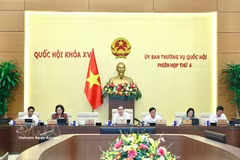
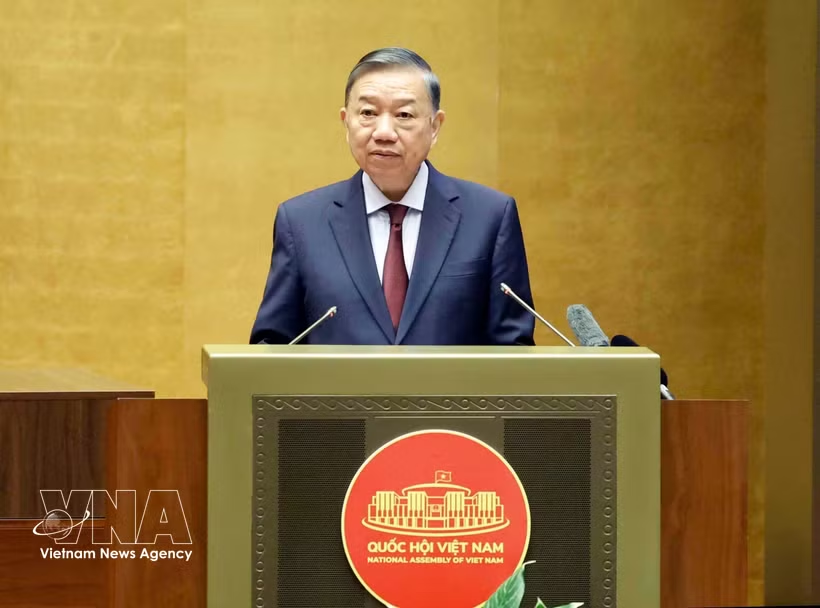
Party General Secretary and State President To Lam speaks at the national teleconference held in Hanoi on July 29 to study, disseminate and implement the resolutions adopted at the Party Central Committee’s recent third meeting. (Photo: VNA)

Hanoi (VNA) – Party General Secretary and State President To Lam on July 29 called on the entire Party and political system to fully grasp the Party Central Committee's new strategic decisions and major policy shifts to ensure concerted implementation, stressing that every resolution must be translated into practical, accountable action programmes tailored to each ministry, sector and locality.

In his remarks at a national teleconference in Hanoi on July 29 to study, disseminate and implement the resolutions adopted at the committee’s recent third meeting, the top leader said the third plenum had reached broad consensus on major decisions concerning Party and political system building, national development and defence.

The outcomes represent an important step in implementing the Resolution of the 14th National Party Congress, linking the agenda in 2026 with longer-term goals through 2030 and 2045, he said, stressing that the decisions are all aimed at strengthening the Party's leadership, enhancing national governance, development and defence, improving the efficiency of the political system, unlocking resources, raising people's living standards, and advancing the country's development.

He urged the entire Party and political system to firmly grasp the guiding principles, new elements and interconnections among the Party Central Committee's decisions and strategic shifts, stressing that correct understanding is the foundation for unified action.

According to him, the decisions form an interconnected and integrated framework aimed at comprehensively reforming the country's leadership, governance, development and defence. The Party building, institutional restructuring and cadre development must strengthen the Party's leadership and governing capacity while improving the effectiveness of the political system. Development space and national resources must be managed in a unified and efficient manner. The development model must be driven by productivity, knowledge, technology, innovation and people, while remaining firmly grounded in Vietnam's realities.

National defence, security, foreign affairs and environmental protection must take a proactive approach to risk prevention, enhance resilience and adaptability, and safeguard the country, he noted, adding that these tasks are closely interconnected and that weaknesses in any single area would undermine overall implementation.

The leader instructed ministries, sectors and localities to urgently translate the Party decisions into practical action plans with clear priorities and close coordination across sectors.

Resolutions must go hand in hand with action programmes, he said, adding that implementation plans should reflect the realities and specific conditions of each ministry, sector, locality and grassroots organisation.

Each programme, he said, should clearly define objectives, tasks, responsible agencies, coordination mechanisms, resources, implementation timelines, expected outputs, evaluation indicators and accountability.

He also instructed authorities to review and integrate programmes implementing the Resolution of the 14th National Party Congress, previous Party resolutions and documents adopted at the third plenum. Overlapping tasks should be consolidated, resources coordinated toward common objectives and clear accountability ensured to avoid duplication and fragmented implementation.

For new or unprecedented issues, he called for clearly defining guiding principles, responsibilities, pilot mechanisms, resources and oversight measures, while stressing that the absence of precedent must not be used as an excuse for delay, nor should implementation be rushed without adequate preparation.

He also underscored the need to promptly institutionalise the Party’s policies into clear, practical and enforceable legal regulations, urging competent authorities to proactively resolve issues within their mandate and immediately report matters beyond their authority together with proposed solutions, in order to avoid legal gaps, inconsistent guidance and unnecessary burdens for people and businesses.

Regarding the two-tier local administration model, General Secretary and President Lam said the Party Central Committee has no plans to readjust commune-level administrative boundaries, as the system is operating stably and effectively. Any proposed changes must be genuinely necessary, based on legal and practical considerations, receive public consensus, and better serve socio-economic development and people's interests.

He also stressed that implementation must follow a clear roadmap, with priorities in the second half of 2026 focused on ensuring smooth operations, removing bottlenecks and fulfilling socio-economic targets.
vnanet-national-conference-disseminating-party-resolutions-2.jpg
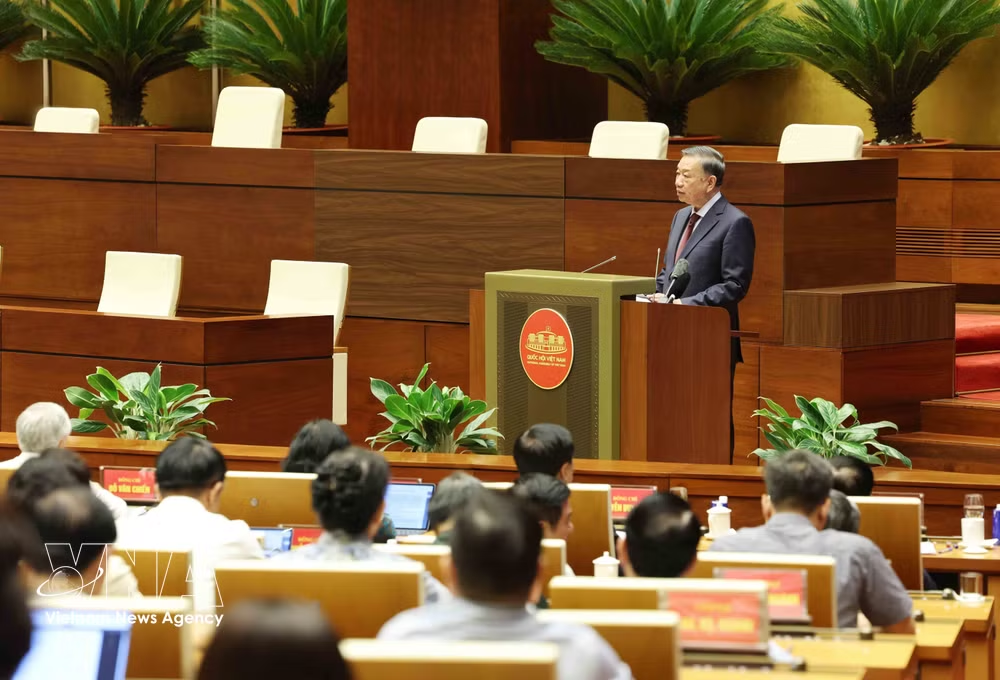
Party General Secretary and State President To Lam speaks at the national teleconference in Hanoi on July 29. (Photo: VNA)

The General Secretary and President stressed that improving implementation capacity is essential to ensuring the effective operation of the political system. Under the Party’s unified leadership, each agency must fully perform its assigned responsibilities. The Politburo and Secretariat of the Party Central Committee will provide leadership, direction and supervision; the National Assembly and the People’s Councils at all levels will institutionalise, decide on, and oversee policies; the Government, ministries, sectors, and local authorities will organise implementation and allocate resources; while the Vietnam Fatherland Front and mass organisations will step up communications, public mobilisation, supervision and social oversight. The functions of each institution must remain clearly defined and coordinated.

The leader also highlighted the need for clearer decentralisation. The central level should focus on strategic planning, institutions, shared platforms and major resources, while provincial-level authorities should concretise policies, organise development space, coordinate resources, and create favourable conditions for commune-level administrations. As the frontline of public governance, communes must be capable of directly addressing the needs of citizens and businesses and assume responsibility for the tasks assigned to them.

He stressed that decentralisation must go hand in hand with adequate human resources, financial support, data, digital infrastructure and power control. Data should be accurate, complete, up-to-date and shared across agencies according to their authority, eliminating the need for citizens to repeatedly provide information already available in State databases.

General Secretary and President Lam called for continued efforts to build a contingent of capable, ethical and responsible officials, and strengthen accountability among leaders. Officials who work ineffectively or avoid responsibility should be replaced, whereas those who are honest, innovative and willing to act for the common good should be protected and encouraged.

He also underlined the importance of strengthening inspection and supervision from the outset of implementation, with greater use of data and measurable outcomes in evaluating performance. Public feedback, together with opinions from businesses, experts and grassroots officials, should serve as an important channel for assessing policy effectiveness. At the same time, communication efforts should proactively counter false and distorted information while remaining open to constructive criticism.

Concluding his remarks, the top leader urged Party committees and organisations, authorities and heads of agencies at all levels to move immediately from planning to action, with clearly defined responsibilities, timelines and implementation conditions. The effectiveness of every work must ultimately be measured by concrete improvements in governance, better public services and higher levels of public satisfaction, turning commitments into tangible results, he said./.
VNA

See more

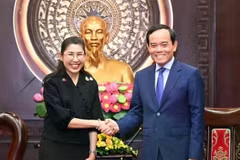
Secretary of the municipal Party Committee Tran Luu Quang meets with Thai Ambassador to Vietnam Urawadee Sriphiromya on July 28, 2026. (Photo: sggp.org.vn)

Ho Chi Minh City looks to boost cooperation with Thailand, Cambodia, Philippines

Secretary of the municipal Party Committee Tran Luu Quang hosted separate meetings with Thai Ambassador to Vietnam Urawadee Sriphiromya and a delegation of Thai businesses, newly appointed Cambodian Consul General Luon Bunvadh, and newly appointed Consul General of the Philippines Querobine Deapera Laccay, on July 28.

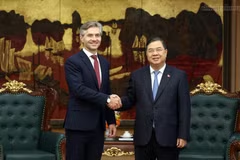
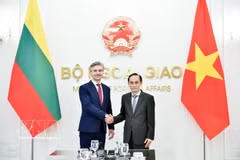
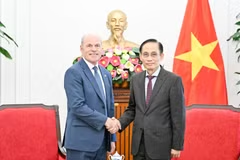
Permanent Deputy Prime Minister Pham Gia Tuc (right) meets with Lithuanian Minister of Foreign Affairs Kestutis Budrys in Hanoi on July 28. (Photo: chinhphu.vn)

Permanent Deputy PM receives Lithuanian Foreign Minister

Permanent Deputy Prime Minister Pham Gia Tuc called the Lithuanian Foreign Minister’s official visit a contribution to the traditional friendship between the two countries as well as the substantive development of the Vietnam–EU Comprehensive Strategic Partnership.

☀️ Morning digest on July 29

☀️ Morning digest on July 29

Vietnamese leaders' meetings with the President of the Supreme People's Court of Laos and the President of the National Assembly of Cambodia, Minister of Foreign Affairs Le Hoai Trung's talks with his Lithuanian counterpart Kestutis Budrys, and the second political consultation between the foreign ministries of Vietnam and Panama are among news highlights on July 28 evening.

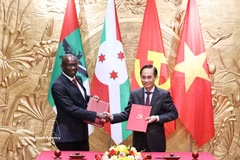
Politburo member, Minister of Foreign Affairs Le Hoai Trung (R) and Secretary General of Burundi’s National Council for the Defence of Democracy–Forces for the Defence of Democracy (CNDD-FDD) Révérien Ndikuriyo exchange the memorandum of understanding on cooperation between the two Parties. (Photo: VNA)

Vietnam, Burundi seek measures to enhance bilateral ties

Speaking highly of Burundi’s achievements under the leadership of the CNDD-FDD, Trung said the two countries should strengthen solidarity and play a greater role in maintaining peace and stability in their respective regions and globally, thereby creating favourable conditions for achieving their development goals.

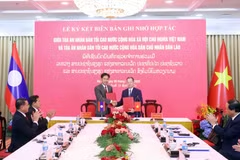
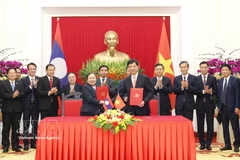
Chief Justice of the Supreme People's Court of Vietnam Nguyen Van Quang and President of the Supreme People's Court of Laos Phayvy Syboualypha sign a new memorandum of understanding (MoU) on cooperation between the two courts. (Photo: VNA)

Vietnamese, Lao supreme courts deepen cooperation

The two chief justices reaffirmed that the great friendship, special solidarity, comprehensive cooperation and strategic cohesion between Vietnam and Laos are an invaluable asset of the two nations. They agreed to continue effectively implementing high-level agreements reached by the two Parties and States, thereby further strengthening cooperation between the two judicial systems.

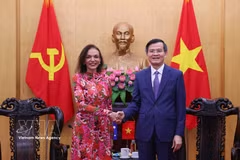
Politburo member, President of the Ho Chi Minh National Academy of Politics Doan Minh Huan (R) receives MP Anne Aly, Australian Minister for Small Business, Minister for International Development, and Minister for Multicultural Affairs in Hanoi on July 28. (Photo: VNA)

Vietnam, Australia expand cooperation in high-quality human resources development

Huan spoke highly of the positive development of the Vietnam-Australia Comprehensive Strategic Partnership, affirming that the two countries still have substantial potential for cooperation in high-quality human resources development, science and technology, innovation, national governance and sustainable development.

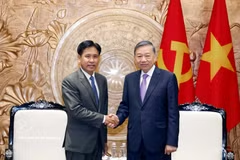
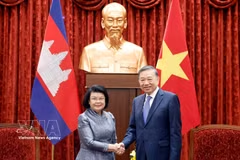
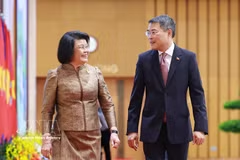
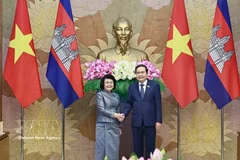
General Secretary of the Communist Party of Vietnam (CPV) Central Committee and State President To Lam on July 28 receives President of the Cambodian National Assembly Samdech Khuon Sudary. (Photo: VNA)

Top Vietnamese leader receives Cambodian National Assembly President

They also stressed the important role of the Parties in providing strategic direction for bilateral and trilateral relations and agreed to make full use of existing cooperation mechanisms, including meetings among the three Prime Ministers, parliamentary leaders, defence ministers, public security/interior ministers, and foreign ministers.

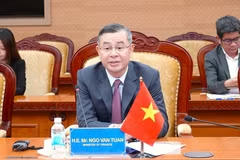
Vietnamese Minister of Finance Ngo Van Tuan speaks at the meeting with Australian Minister for International Development Anne Aly. (Photo: Courtesy of the Finance Ministry)

Vietnam, Australia step up cooperation in strategic sectors

Tuan said Australia is one of Vietnam's important development partners, noting that cooperation between the two countries has consistently focused on practical outcomes and aligned with Vietnam's development priorities. He expressed his appreciation for Australia's continued support and voiced his confidence that the bilateral ties would become increasingly substantive and effective.

Minister of Foreign Affairs Le Hoai Trung (R) receives Canadian Ambassador to Vietnam James Nickel. (Photo: Ministry of Foreign Affairs)

Vietnam ready to work with Canada towards early upgrade of bilateral ties: FM

Affirming that Vietnam always attaches importance to its Comprehensive Partnership with Canada, Trung welcomed Canada’s strategic orientations towards the Indo-Pacific, including its support for the Association of Southeast Asian Nations (ASEAN)'s centrality and its recognition of Vietnam’s role as a gateway for trade with the region.

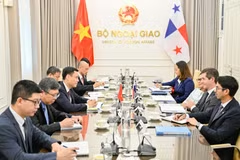
At the second political consultation between the Ministries of Foreign Affairs of Vietnam and Panama on July 28 in Hanoi. (Photo: Courtesy of Ministry of Foreign Affairs)

Vietnam, Panama hold second political consultation to deepen bilateral ties

Giang reaffirmed that Vietnam highly evaluates Panama's role and position in Latin America and wants to further strengthen the traditional friendship and cooperation between the two countries. He said Vietnam and Panama, with their strategic geographical locations, could serve as gateways linking the economies of ASEAN and Latin America.

Five individuals expelled from Party for serious violations

Five individuals expelled from Party for serious violations

The individuals violated Party regulations, State laws, regulations on things Party members are prohibited from doing, and rules on setting an example, causing very serious consequences, sparking public concern and severely damaging the reputation of Party organisations, localities and their respective agencies and units.

The National Assembly (NA) Standing Committee on July 28 discusses proposed amendments to the 2024 Land Law during its fourth meeting. (Photo: VNA)

Seven policy groups proposed for amendments to Land Law

Minister of Agriculture and Environment Trinh Viet Hung said the Government had approved seven policy orientations for revising the law, focusing on planning, land allocation, compensation, land pricing, land use rights, administrative reform and stronger oversight.

At the meeting between Minister of Foreign Affairs Le Hoai Trung (R) and MP Anne Aly, Australian Minister for Small Business, Minister for International Development, and Minister for Multicultural Affairs. (Photo: Ministry of Foreign Affairs)

Vietnam seeks more Australian ODA for climate action, infrastructure development

Sharing Vietnam’s new development orientations following the third meeting of the 14th Party Central Committee, Trung underscored the country’s priorities in science and technology, innovation, digital transformation, private-sector development and high-quality human resources. These are areas in which Australia has considerable strengths and offer substantial potential for expanded cooperation between the two countries.