Party resolution sets roadmap for renewing national development model

Under the new development model, Vietnam will be self-reliant, innovative, humane, sustainable and globally integrated, with people at the heart of development. Science and technology, innovation, digital transformation and artificial intelligence are designated as the main growth drivers, while higher productivity and more efficient resource allocation serve as core principles.

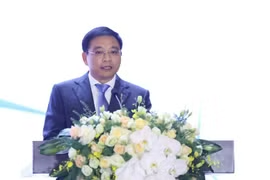
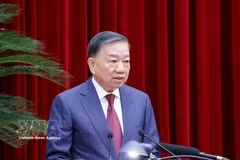
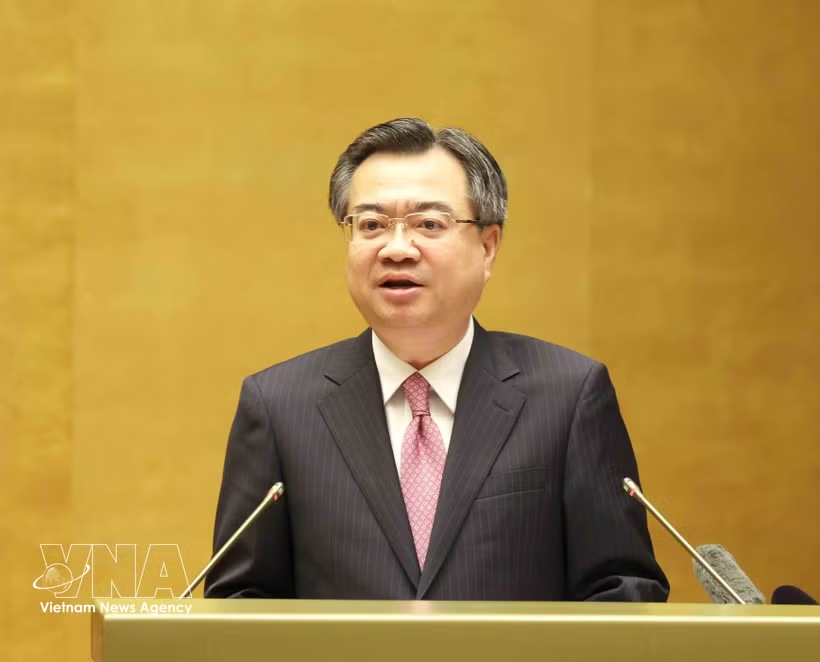
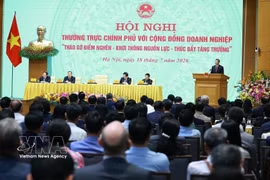
Politburo member, Secretary of the Party Central Committee, Chairman of the Party Central Committee's Commission for Policies and Strategies Nguyen Thanh Nghi speaks at the national conference to disseminate and implement resolutions adopted at the third plenum of the 14th Party Central Committee on July 29. (Photo: VNA)

Hanoi (VNA) - Chairman of the Party Central Committee's Commission for Policies and Strategies Nguyen Thanh Nghi has presented the key contents of Resolution No. 19-NQ/TW on renewing the national development model, highlighting institutional breakthroughs and modernised national governance as the foundation for creating new development capacity and achieving rapid and sustainable growth.

Addressing a national conference to disseminate and implement resolutions adopted at the third plenum of the 14th Party Central Committee on July 29, Nghi outlined the core directions, goals and implementation roadmap of the resolution, which was issued on July 28.

According to the official, the Party Central Committee said that after four decades of Doi moi (renewal), Vietnam has made historic achievements, including becoming an upper middle-income country in 2025. However, the current development model has yet to meet the requirements for fast and sustainable development amid profound global changes and the country's new strategic ambitions, particularly its goal of achieving double-digit economic growth.

The resolution therefore establishes a comprehensive framework for transforming Vietnam's development model through 2030, 2035 and 2045, with a vision to 2050, focusing on five guiding principles.

The first affirms the Party's comprehensive, absolute, and direct leadership, the State's role as a development facilitator, the strength of the great national unity bloc, and the supervisory, social criticism and consensus-building roles of the Vietnam Fatherland Front and other socio-political organisations; while identifying the renewal of development model and the creation of a comprehensive development ecosystem as strategic tasks for advancing socialism in Vietnam and realising the nation’s development aspirations.

The second identifies institutional reform and innovation in national organisation, governance and operations as the breakthrough needed to create new development capacity. Under the new development model, Vietnam will be self-reliant, innovative, humane, sustainable and globally integrated, with people at the centre of development. Science and technology, innovation, digital transformation and artificial intelligence are designated as the main growth drivers, while higher productivity and more efficient resource allocation serve as core principles.

The remaining principles stress modern national governance based on the effective interaction of the State, the market and society; mobilising all resources; strengthening strategic autonomy; and using institutional innovation, governance effectiveness, public service quality and problem-solving capacity as key performance indicators.

The resolution sets the targets of completing the foundations of the new development model by 2030, largely completing the transition to a self-reliant, innovative, people-centred, sustainable and globally integrated development model by 2035 and fully establishing the new model by 2045.

Looking ahead to 2130, Vietnam envisions becoming a highly developed socialist nation that is civilised, modern, rich in cultural identity, and distinguished by strong innovation capacity and enduring vitality.

To achieve these goals, it identifies a series of tasks and solutions.

Institutional reform and national governance are placed at the centre, with priorities including improving the Party’s leadership and governance capacity, Party building, organisational and personnel work, and reforming to the implementation of the Party’s resolutions. It also focuses on building a development-oriented State, renewing the relationship between the State, the market and society, developing a legal framework that is clear, practical, coherent, stable, easy to implement and adaptable to change, establishing controlled regulatory sandbox mechanisms, advancing digital government, shared data and digital platforms, streamlining the political system for greater efficiency and effectiveness, and piloting the socialist commune- and ward-level governance model.

Economic measures include building a new growth model driven by productivity, innovation, science and technology, digital and green transformation, renewing traditional growth drivers and utilising emerging growth engines. It also prioritises modernising infrastructure, reforming markets and the financial system, optimising resource allocation, advancing industrialisation and ecological agriculture, developing competitive industries and businesses, and positioning urban areas and the maritime economy as key engines of growth.

Other priorities cover social development, culture and human development, environmental protection, national defence and security, and foreign affairs, with an emphasis on modern governance, social resilience, high-quality education and healthcare, cultural development, green growth, climate adaptation, and proactive international integration.

According to Nghi, the Politburo has also adopted an action programme comprising 51 key tasks and solutions and 40 major targets, with a clear implementation roadmap and responsibilities assigned to relevant agencies./.
VNA

See more

☕ Afternoon briefing on July 29

☕ Afternoon briefing on July 29

The national teleconference held to study, disseminate and implement the resolutions adopted at the 14th Party Central Committee’s recent third meeting, the issuance of the national programme on child protection and child labour prevention and reduction for 2026–2030, and one Vietnamese killed in the July 28 earthquake in Japan’s Kumamoto prefecture are among news highlights on July 29.

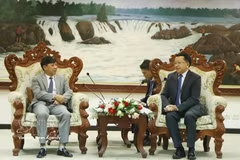
Vansy Kuamua (right), member of the Lao People's Revolutionary Party (LPRP) Central Committee and Deputy Head of its Commission for Propaganda and Training, receives Deputy Editor-in-Chief of the Communist Review of Vietnam Nguyen Ngoc Ha on July 28. (Photo: VNA)

Vietnam, Laos enhance cooperation in Party theoretical work

The Communist Review will continue to work closely with its Lao counterpart to translate the concept of "strategic cohesion" in Vietnam–Laos relations into concrete actions, in line with the orientation set by the high-ranking leaders of the two Parties.

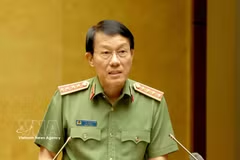
Politburo member and Minister of Public Security General Luong Tam Quang speaks at a national conference held on July 29 to disseminate and implement the resolutions adopted at the third plenum of the 14th Party Central Committee. (Photo: VNA)

Party Central Committee adopts new mindset for national security, social development in new era

For the first time, the 14th National Party Congress placed maintaining a peaceful and stable environment at the forefront of the country's development objectives. It also set the goal of building a society that is orderly, civilised, secure, safe, socially protected and development-oriented, with the long-term ambition of significantly reducing crime and ultimately creating a society free of crime, accidents, social evils and corruption.

Party General Secretary and State President To Lam delivers the opening remarks at the third plenum of the 14th Party Central Committee on July 20. (Photo: VNA)

Vietnam advances proactive, comprehensive approach to national security

Party General Secretary and State President To Lam stressed that security is a prerequisite for development and called for a fundamental shift in the national security strategy. Instead of dealing with individual risks after they arise, Vietnam must strengthen resilience, improve preparedness and proactively safeguard the country.

Secretary of the municipal Party Committee Tran Luu Quang meets with Thai Ambassador to Vietnam Urawadee Sriphiromya on July 28, 2026. (Photo: sggp.org.vn)

Ho Chi Minh City looks to boost cooperation with Thailand, Cambodia, Philippines

Secretary of the municipal Party Committee Tran Luu Quang hosted separate meetings with Thai Ambassador to Vietnam Urawadee Sriphiromya and a delegation of Thai businesses, newly appointed Cambodian Consul General Luon Bunvadh, and newly appointed Consul General of the Philippines Querobine Deapera Laccay, on July 28.

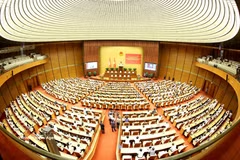
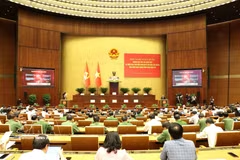
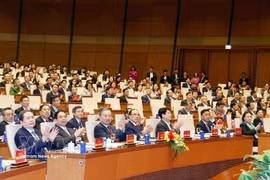
An overview of the conference at the central venue, Dien Hong Hall of the National Assembly House in Hanoi on July 29. (Photo: VNA)

National teleconference disseminates resolutions of 14th Party Central Committee’s third session

According to the agenda, participants are expected to study a series of resolutions and conclusions adopted at the third plenum. These cover key strategic issues, including renewing Vietnam’s development model; building and developing the country into a strong sea-based nation; fostering a disciplined, safe, civilised, harmonious and developed society; and the National Security Strategy.

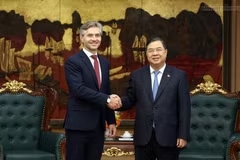
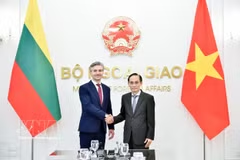
Permanent Deputy Prime Minister Pham Gia Tuc (right) meets with Lithuanian Minister of Foreign Affairs Kestutis Budrys in Hanoi on July 28. (Photo: chinhphu.vn)

Permanent Deputy PM receives Lithuanian Foreign Minister

Permanent Deputy Prime Minister Pham Gia Tuc called the Lithuanian Foreign Minister’s official visit a contribution to the traditional friendship between the two countries as well as the substantive development of the Vietnam–EU Comprehensive Strategic Partnership.

☀️ Morning digest on July 29

☀️ Morning digest on July 29

Vietnamese leaders' meetings with the President of the Supreme People's Court of Laos and the President of the National Assembly of Cambodia, Minister of Foreign Affairs Le Hoai Trung's talks with his Lithuanian counterpart Kestutis Budrys, and the second political consultation between the foreign ministries of Vietnam and Panama are among news highlights on July 28 evening.

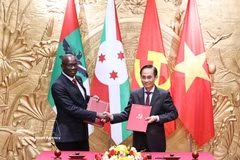
Politburo member, Minister of Foreign Affairs Le Hoai Trung (R) and Secretary General of Burundi’s National Council for the Defence of Democracy–Forces for the Defence of Democracy (CNDD-FDD) Révérien Ndikuriyo exchange the memorandum of understanding on cooperation between the two Parties. (Photo: VNA)

Vietnam, Burundi seek measures to enhance bilateral ties

Speaking highly of Burundi’s achievements under the leadership of the CNDD-FDD, Trung said the two countries should strengthen solidarity and play a greater role in maintaining peace and stability in their respective regions and globally, thereby creating favourable conditions for achieving their development goals.

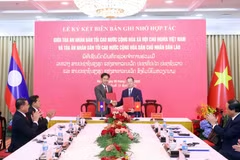
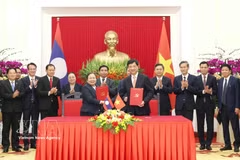
Chief Justice of the Supreme People's Court of Vietnam Nguyen Van Quang and President of the Supreme People's Court of Laos Phayvy Syboualypha sign a new memorandum of understanding (MoU) on cooperation between the two courts. (Photo: VNA)

Vietnamese, Lao supreme courts deepen cooperation

The two chief justices reaffirmed that the great friendship, special solidarity, comprehensive cooperation and strategic cohesion between Vietnam and Laos are an invaluable asset of the two nations. They agreed to continue effectively implementing high-level agreements reached by the two Parties and States, thereby further strengthening cooperation between the two judicial systems.

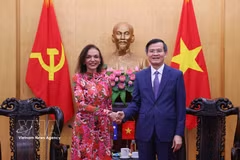
Politburo member, President of the Ho Chi Minh National Academy of Politics Doan Minh Huan (R) receives MP Anne Aly, Australian Minister for Small Business, Minister for International Development, and Minister for Multicultural Affairs in Hanoi on July 28. (Photo: VNA)

Vietnam, Australia expand cooperation in high-quality human resources development

Huan spoke highly of the positive development of the Vietnam-Australia Comprehensive Strategic Partnership, affirming that the two countries still have substantial potential for cooperation in high-quality human resources development, science and technology, innovation, national governance and sustainable development.

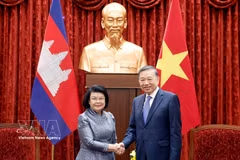
General Secretary of the Communist Party of Vietnam (CPV) Central Committee and State President To Lam on July 28 receives President of the Cambodian National Assembly Samdech Khuon Sudary. (Photo: VNA)

Top Vietnamese leader receives Cambodian National Assembly President

They also stressed the important role of the Parties in providing strategic direction for bilateral and trilateral relations and agreed to make full use of existing cooperation mechanisms, including meetings among the three Prime Ministers, parliamentary leaders, defence ministers, public security/interior ministers, and foreign ministers.

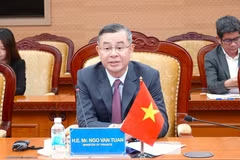
Vietnamese Minister of Finance Ngo Van Tuan speaks at the meeting with Australian Minister for International Development Anne Aly. (Photo: Courtesy of the Finance Ministry)

Vietnam, Australia step up cooperation in strategic sectors

Tuan said Australia is one of Vietnam's important development partners, noting that cooperation between the two countries has consistently focused on practical outcomes and aligned with Vietnam's development priorities. He expressed his appreciation for Australia's continued support and voiced his confidence that the bilateral ties would become increasingly substantive and effective.