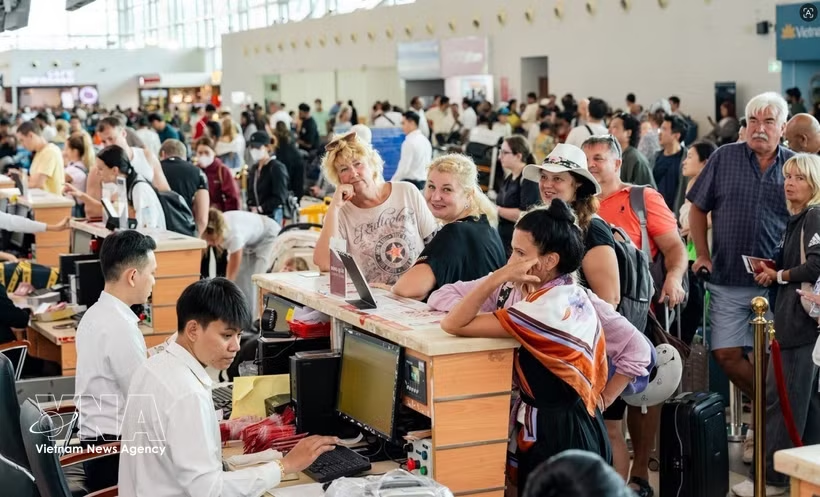
Phu Quoc International Airport sees 44% rise in takeoffs, landings

The number of aircraft takeoffs and landings neared 27,919, an increase of more than 8,500 flights, or almost 44%. The surge came as the airport sustained high-intensity operations while fast-tracking a major expansion to prepare for the APEC Economic Leaders’ Week 2027.

Passengers arrive at Phu Quoc International Airport. (Photo: VNA)

An Giang (VNA) – Since Sun Group took over the operation of Phu Quoc International Airport on January 1, 2026, passenger volumes have repeatedly set records, with more than 4.48 million passengers served during January - July, up nearly 38% annually.

The number of aircraft takeoffs and landings neared 27,919, an increase of more than 8,500 flights, or almost 44%. The surge came as the airport sustained high-intensity operations while fast-tracking a major expansion to prepare for the APEC Economic Leaders’ Week 2027.

The airport has upgraded passenger touchpoints, delivering site-wide Wi-Fi, faster 4G/5G connectivity, and more optimised flight information displays. An electronic toll collection system at entry and exit points has cut vehicle transit time.

A standout technology deployment is Sun Express, a biometric system and automated gate using facial recognition that lets passengers clear security and board quickly, safely and without physical contact.

To improve convenience and ease terminal congestion, the airport has rolled out check-in at La Festa Phu Quoc, Curio Collection by Hilton, and New World Phu Quoc Resort. Passengers can check in and get boarding passes before leaving their hotels, while luggage is accepted on site and transported directly for standard security screening.

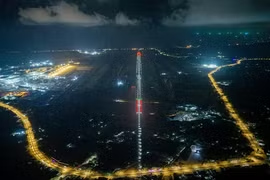
The entire 3,300m Runway 2 was completed in roughly eight months of construction - a record-breaking pace. It is the first and most critical piece of a broader infrastructure complex that includes a VIP terminal, Terminal 2, an upgrade of Runway 1, an aviation fuel storage facility and underground fueling system, an in-flight catering facility, and a maintenance hangar for large aircraft.

Nguyen Ba Quan, Director of Phu Quoc International Airport, called it a highly significant construction project completed within an extremely tight timeframe and amid difficult weather. Most importantly, construction had to proceed while the airport stayed fully operational, even as takeoffs, landings and passenger traffic surged in the early months of this year.

On July 27, a flight inspection and calibration aircraft - Beechcraft B300 King Air 350ER from the King Air 300 series, registered in the Czech Republic and operated by a mixed Vietnamese-Czech crew, performed an approach to Runway 28R to check and calibrate the Instrument Landing System/Distance Measuring Equipment, approach lighting and Precision Approach Path Indicator systems at the 28R end.

On July 28, two additional calibration flights were carried out on Runway 2. It is a cornerstone of the airport expansion designed for the APEC Economic Leaders’ Week 2027. At 3,300m long and 45m wide, built to ICAO Code E and ICAO 4E standards, it can handle wide-body jets such as the Boeing 787, Airbus A350 and Boeing 777, and Code F aircraft when needed.

The runway provides a critical foundation for Phu Quoc to receive official and commercial international flights from the 21 APEC member economies, along with thousands of delegates during the week.

Putting Runway 2 into operation will also pave the way for the subsequent upgrade of the existing Runway 1 to 3,500m, gradually establishing a globally standardised two-runway system at the airport.

Sun Airport JSC has invested in the expansion with a total capital of 22 trillion VND (846 million USD).

Covering 1,050 ha, the project will lift the airport’s annual capacity to 20 million passengers from 2027. Under a second phase, capacity is expected to rise to 50 million a year.

At Terminal 2, 90% of structural work and roof structure installation are completed. The installation of aviation equipment is underway, while finishings have reached around 30%.

Around 3,000-3,500 engineers, workers and supervisory staff are on the Terminal 2 construction site each day. The goal is to complete the entire Terminal 2 roof structure in August, allowing subsequent stages to proceed.

The VIP terminal has finished 100% of structural and steel-frame works and is now in the mechanical-and-electrical installation and finishing phase.

Meanwhile, Runway 2 is completed, and calibration flights have been conducted, with acceptance and commissioning set for September 2026.

Earlier, the first aircraft apron, Apron 1C, completed all structural works and became operational on April 16, following three months of construction./.

VNA

See more

New Zealand apples on sale at a supermarket in Vietnam (Photo: VNA)

Vietnamese consumers develop taste for Australian, New Zealand fruit

According to statistics from the Department of Customs, in the first six months of 2026, Vietnam imported 102.8 million USD worth of fruit, vegetables and flowers from Australia, up 55.7% from the same period last year. Australia's share of total imports rose from 5.5% to 6.51%, highlighting the growing position of the market as a supplier. Imports from New Zealand reached 78.04 million USD, up 20.4% year-on-year.

Semiconductor products, chips and components displayed at a ceremony to launch a national centre for semiconductor chip pilot production support in Hanoi on June 26. (Photo: VNA)

US semiconductor push offers Vietnam opportunities, policy challenges

The Vietnam-US semiconductor partnership is therefore not simply a “golden opportunity” arising from geopolitical shifts, but also a long-term test of Vietnam’s institutional reform and implementation capacity. If domestic capacity cannot keep pace, adjusting targets toward quality and execution, rather than simply expanding the number of projects, will be essential.

Workers process fruit for export at the Chanh Thu factory in Cho Lach commune, Vinh Long province. (Photo: VNA)

Vietnam works to maintain edge in key agricultural market

According to Le Hang, Deputy Secretary-General of the Vietnam Association of Seafood Exporters and Producers (VASEP), China and Hong Kong (China) remained bright spots for Vietnam’s aquatic exports in July, with revenue exceeding 267 million USD, up 24.7% year-on-year.

An estimated 6,300 workers are needed by the semiconductor industry in Bac Giang province during the 2025-2030 period. (Photo: VNA)

India's semiconductor strategy complementary to Vietnam's chip sector: expert

Sudhanshu Mittal, Director of Engineering Solutions at the National Association of Software and Service Companies (Nasscom) of India, noted that during the state visit to India by General Secretary of the Communist Party of Vietnam Central Committee and President To Lam in May, the two countries signed a number of cooperation agreements, with semiconductors identified as a priority area alongside artificial intelligence (AI), cybersecurity, and advanced technologies.

At the working session between Vietnamese Minister of Finance Ngo Van Tuan (right) and RMIT University’s Vice-Chancellor and President Professor Alec Cameron in Sydney on August 10 (Photo: tapchikinhtetaichinh.vn)

Vietnam, Australia seek to expand investment in rice value chain

During General Secretary of the Communist Party of Vietnam Central Committee and President To Lam’s state visit to Australia from August 9-12, Vietnamese Minister of Finance Ngo Van Tuan, authorised by the General Secretary and President, held working sessions with SunRice Group CEO Paul Serra and RMIT University’s Vice-Chancellor and President Professor Alec Cameron in Sydney on August 10.

Students practice microcontroller programming at the Vietnam-Korea College of Technology in Bac Ninh province (Photo: VNA)

Vietnam – one of most attractive destinations for leading US semiconductor companies: expert

Vietnam has built a solid semiconductor and electronics industry before joining ITSI, attracting major US semiconductor companies. Intel Products Vietnam is one of Intel's largest assembly and testing facilities worldwide, while chip design companies such as Synopsys, Cadence, Marvell and Qualcomm have established engineering and research centres in the Southeast Asian country.

Lawmakers on August 9 discuss a draft law amending and supplementing a number of articles of the Law on the State Bank of Vietnam, the Law on Anti-Money Laundering and the Law on Credit Institutions. (Photo: VNA)

Lawmakers discuss measures to ensure banking system safety, support digital economy

The draft law sets out provisions to control conflicts of interest when commercial banks act as agents managing collateral for corporate bonds. In this regard, Deputy Le Van The of Ninh Binh province said he supported the move, noting that it could provide a more professional approach to collateral management and help strengthen investor confidence if properly regulated.

A company in Da Nang operates a customer relationship management system supported by AI chatbots. (Photo: VNA)

AI drives rise of sleepless enterprises in Vietnam

The concept of a sleepless enterprise does not necessarily mean making employees stay on the job all the time. Instead, it's about building intelligent systems that can respond to customers, process transactions, monitor operations, analyse data and flag risks continuously.

Head of the Vietnam Trade Office in Australia Tran Thi Thanh My (Photo: VNA)

Vietnam, Australia eye 20 bln USD trade target

The head of the Vietnam Trade Office in Australia hoped that the visit by Party General Secretary and State President To Lam will mark a new milestone, opening the door for firms on both sides to forge stronger links and launch concrete cooperation agendas, helping hit that 20 billion USD trade goal sooner rather than later.