Vietnamese retailer helps expand market access in Canada

Established in 1981 as a family-run grocery store, Lucky Supermarket and Dong Phuong Group have grown into one of the largest Asian food retail and distribution networks in Western Canada. Over the past 45 years, the business has evolved beyond serving the Vietnamese community to become an important distribution channel for Vietnamese agricultural products, food and consumer goods.

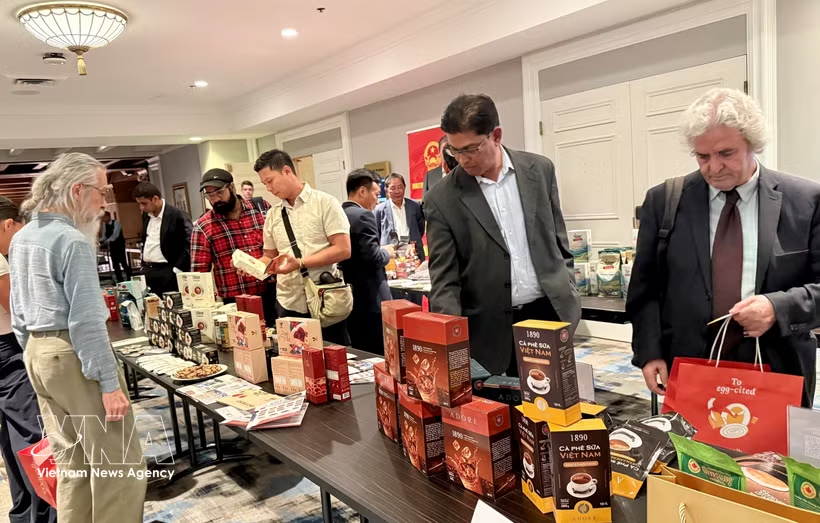
Canadian importers view Vietnamese coffee and cocoa products at a trade promotion event in Canada. (Photo: VNA)

Ottawa (VNA) – An integrated retail and distribution network built over more than four decades is helping expand the presence of Vietnamese products in Canada, providing domestic exporters with greater access to one of the world's most demanding consumer markets.

Established in 1981 as a family-run grocery store, Lucky Supermarket and Dong Phuong Group have grown into one of the largest Asian food retail and distribution networks in Western Canada. Over the past 45 years, the business has evolved beyond serving the Vietnamese community to become an important distribution channel for Vietnamese agricultural products, food and consumer goods.

Lucky currently operates nine supermarkets in Edmonton, Calgary, Winnipeg and Surrey, with each outlet covering between 2,300 sqm and 5,000 sqm. Supporting the retail chain is Dong Phuong Group, which manages import, logistics and wholesale distribution for Lucky as well as other retail networks across Canada.

According to Tran Thu Quynh, Trade Counsellor at the Vietnamese Embassy in Canada, Lucky and Dong Phuong Group are among the pioneering enterprises operating both wholesale and retail systems. Besides supplying Lucky's own stores, Dong Phuong also distributes products to several major supermarket chains in Canada, enabling Vietnamese goods to reach a broader range of consumers.

A notable feature of the company's business model is its direct sourcing network in Vietnam, allowing products to be shipped directly from factories and production areas to Canada rather than being routed through third countries. As a result, products of Vietnamese origin now account for around 30% of the merchandise sold by Lucky, a relatively high proportion for an overseas supermarket chain.

Each year, Dong Phuong Group imports approximately 500 containers of Vietnamese goods. While traditional products such as rice, fish sauce, coffee and dried foods continue to account for a significant share, the product range has expanded to include fresh fruit, beverages, processed foods, vegetarian products, household goods, ceramics and other consumer items.

The company plans to open an additional 10 supermarkets by 2030, a move expected to create further opportunities for Vietnamese products in the Canadian market.

According to Nguyen Tan Ba, founder of Lucky Supermarket, processed seafood, tropical fruit and rice continue to enjoy competitive advantages in Canada. However, consumer demand is shifting towards processed foods, convenience products, vegetarian and plant-based foods, as well as products designed for younger consumers.

He said these segments offer significant potential for Vietnamese exporters seeking to expand their presence in Canada.

Quynh noted that the growth of Lucky has not only increased the visibility of Vietnamese products but also enabled domestic businesses to connect more directly with Canada's modern retail and distribution system.

In recent years, the Vietnam Trade Office in Canada has worked with Lucky and Dong Phuong Group to organise a range of business-to-business (B2B) activities, bringing Canadian importers to Vietnam to identify suppliers while helping Vietnamese businesses adapt their products to better meet Canadian market requirements.

The Trade Office has also cooperated with businesses to promote Vietnamese brands through initiatives such as Vietnam Coffee Day in Canada, Lunar New Year product showcases and community events, contributing to greater awareness of Vietnamese products among Canadian consumers.

Despite the tariff advantages provided by the Comprehensive and Progressive Agreement for Trans-Pacific Partnership (CPTPP), Vietnamese exporters continue to face challenges related to quarantine regulations, food safety requirements, packaging standards, product traceability and logistics costs.

In addition, a number of high-value products, including meat, eggs and dairy products, have yet to gain access to the Canadian market because of the country's strict sanitary regulations and supply management system.

Trade officials said Vietnamese enterprises should continue improving product quality, investing in value-added processing, developing convenience and plant-based foods, upgrading packaging and branding, and strengthening cooperation with importers that have established distribution networks in Canada.

Such efforts are expected to help Vietnamese products reach not only the Vietnamese community but also mainstream Canadian consumers and other ethnic communities.

With support from trade promotion agencies and the opportunities created by the CPTPP, closer cooperation between Vietnamese exporters and Canadian importers and retailers is expected to provide a stronger foundation for expanding the market share of Vietnamese goods in Canada./.

VNA
See more

An estimated 6,300 workers are needed by the semiconductor industry in Bac Giang province during the 2025-2030 period. (Photo: VNA)

India's semiconductor strategy complementary to Vietnam's chip sector: expert

Sudhanshu Mittal, Director of Engineering Solutions at the National Association of Software and Service Companies (Nasscom) of India, noted that during the state visit to India by General Secretary of the Communist Party of Vietnam Central Committee and President To Lam in May, the two countries signed a number of cooperation agreements, with semiconductors identified as a priority area alongside artificial intelligence (AI), cybersecurity, and advanced technologies.

At the working session between Vietnamese Minister of Finance Ngo Van Tuan (right) and RMIT University’s Vice-Chancellor and President Professor Alec Cameron in Sydney on August 10 (Photo: tapchikinhtetaichinh.vn)

Vietnam, Australia seek to expand investment in rice value chain

During General Secretary of the Communist Party of Vietnam Central Committee and President To Lam’s state visit to Australia from August 9-12, Vietnamese Minister of Finance Ngo Van Tuan, authorised by the General Secretary and President, held working sessions with SunRice Group CEO Paul Serra and RMIT University’s Vice-Chancellor and President Professor Alec Cameron in Sydney on August 10.

Students practice microcontroller programming at the Vietnam-Korea College of Technology in Bac Ninh province (Photo: VNA)

Vietnam – one of most attractive destinations for leading US semiconductor companies: expert

Vietnam has built a solid semiconductor and electronics industry before joining ITSI, attracting major US semiconductor companies. Intel Products Vietnam is one of Intel's largest assembly and testing facilities worldwide, while chip design companies such as Synopsys, Cadence, Marvell and Qualcomm have established engineering and research centres in the Southeast Asian country.

Lawmakers on August 9 discuss a draft law amending and supplementing a number of articles of the Law on the State Bank of Vietnam, the Law on Anti-Money Laundering and the Law on Credit Institutions. (Photo: VNA)

Lawmakers discuss measures to ensure banking system safety, support digital economy

The draft law sets out provisions to control conflicts of interest when commercial banks act as agents managing collateral for corporate bonds. In this regard, Deputy Le Van The of Ninh Binh province said he supported the move, noting that it could provide a more professional approach to collateral management and help strengthen investor confidence if properly regulated.

A company in Da Nang operates a customer relationship management system supported by AI chatbots. (Photo: VNA)

AI drives rise of sleepless enterprises in Vietnam

The concept of a sleepless enterprise does not necessarily mean making employees stay on the job all the time. Instead, it's about building intelligent systems that can respond to customers, process transactions, monitor operations, analyse data and flag risks continuously.

Head of the Vietnam Trade Office in Australia Tran Thi Thanh My (Photo: VNA)

Vietnam, Australia eye 20 bln USD trade target

The head of the Vietnam Trade Office in Australia hoped that the visit by Party General Secretary and State President To Lam will mark a new milestone, opening the door for firms on both sides to forge stronger links and launch concrete cooperation agendas, helping hit that 20 billion USD trade goal sooner rather than later.

Phu Quoc pepper products, granted three stars under the OCOP programme in An Giang province, are displayed at an exhibition of outstanding OCOP products from the Mekong Delta. (Photo: VNA)

Phu Quoc leverages OCOP programme to take local specialities global

Better known as one of Vietnam’s premier island destinations, Phu Quoc is leveraging its “One Commune, One Product” (OCOP) programme to transform traditional specialities into internationally recognised products, integrating local agriculture, food processing and tourism to promote sustainable economic growth.

Production at an FDI enterprise in Tay Ninh province. (Photo: VNA)

FTA Index 2025 to be unveiled later this month

The index is designed to provide valuable information not only for State management agencies but also as an important reference for businesses, foreign investors, and industry associations in planning investment and business activities in Vietnam.