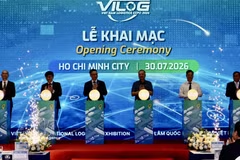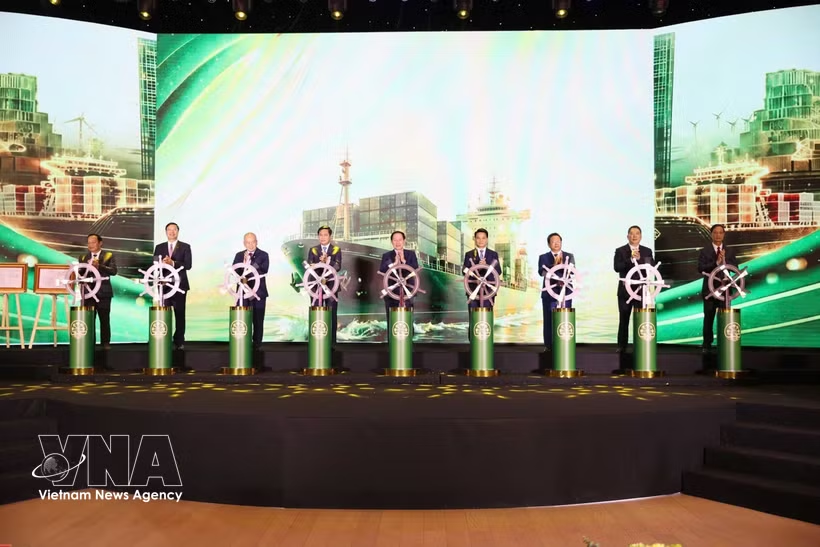
Hai Phong (VNA) – The northern port city of Hai Phong on July 30 announced the Prime Minister’s decisions on the locality’s economic zones, and officially launched the Hai Phong Free Trade Zone, marking the start of a new phase of development.
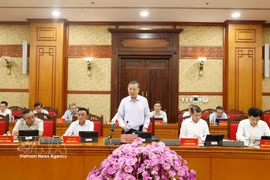
Addressing the event, Deputy Prime Minister Le Tien Chau said this is an invitation for investment in Hai Phong, as well as a commitment to action by the Government and the municipal authorities to domestic and international business communities and investors.
He congratulated the Party Organisation, authorities and people of Hai Phong on the milestone, while commending the city's proactive preparations, close coordination of ministries and agencies, and support of the business community in deploying new economic models.
He said the 14th Party Central Committee's third plenum had adopted a resolution on reforming Vietnam's development model, aimed at shaping the national development model through 2045 and beyond.
According to the Deputy PM, Hai Phong is well positioned to take the lead in renewing the country’s growth model. Following its July 2025 merger with Hai Duong province, the city has become one of the largest economic hubs in the country, with an expanded development space and direct connectivity between industrial and agricultural production regions, and urban areas in the west with the seaport and logistics system in the east.
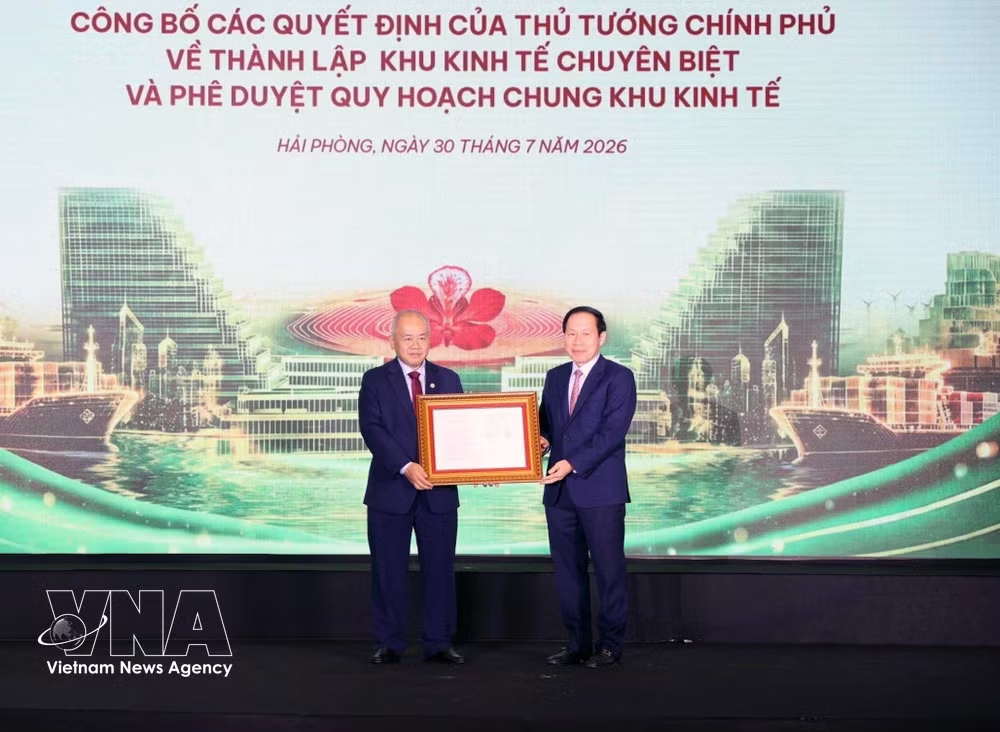
Chau noted that the National Assembly has approved a pilot mechanism comprising six groups of 41 special policies for the city, while additional preferential mechanisms are expected after the Law on Urban Development takes effect. He said these policies will enable Hai Phong to turn its geographical and infrastructure advantages into strengths in governance and implementation.
According to the Deputy PM, the 5,300-ha Hai Phong Specialised Economic Zone, established under the Prime Minister's Decision No. 288/QD-TTg dated February 12, 2026, will develop high value-added industries and services driven by science and technology, with a focus on artificial intelligence, robotics, big data, chemicals, and research and development (R&D).
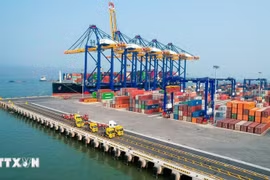
Meanwhile, the PM approved the master plan for the Southern Hai Phong Coastal Economic Zone to 2050 under Decision No. 431/QD-TTg dated March 14, 2026. Covering about 20,000ha, the zone will integrate industrial parks, urban areas, services, seaports and logistics infrastructure, he said.
These development spaces are expected to complement one another and create a unified economic ecosystem capable of linking manufacturing with international trade, attracting investment and technology, strengthening the competitiveness of Vietnamese enterprises, and positioning Hai Phong as a strategic growth pole for the Red River Delta, the northern coastal region and the country at large, Chau stressed.
However, the Deputy PM stressed that expanding the number and size of economic zones alone would not guarantee growth, warning that overlapping functions and poorly coordinated planning could lead to inefficient investment and internal competition.
He called on the city to develop an integrated strategy for its economic zones and free trade zone, clearly define the functions and priority sectors of each zone, establish a unified investment promotion mechanism, and shift from quantity-based to quality-driven investment attraction while ensuring green and sustainable development.
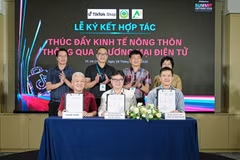
At the ceremony, the municipal authorities granted 13 investment registration certificates, and signed two memoranda of understanding (MoUs) on cooperation with businesses, with total registered and committed capital exceeding 3.1 billion USD.
According to Secretary of the municipal Party Committee Le Ngoc Chau, the city is home to more than 1,868 FDI projects from 42 countries and territories with combined registered capital of over 54 billion USD, accounting for nearly 10% of Vietnam's cumulative FDI.
Hai Phong has maintained double-digit economic growth for 11 consecutive years. In the first half of 2026, its gross regional domestic product (GRDP) expanded by 11.33% – the highest in five years – ranking third nationwide and first among the country's centrally-run cities. Its industrial production rose 14.8%, exports reached nearly 26 billion USD, and cargo throughput at the city's ports totalled nearly 96 million tonnes, up 14.8%, 8.3% and 11.4% year on year, respectively. FDI inflows reached 3.1 billion USD, while domestic investment exceeded 98 trillion VND./.