Four strategic shifts underscore Vietnam’s development potential: Japanese expert

The third plenum’s swift move to translate the 14th National Party Congress vision into actionable policy directives should inspire confidence in Vietnam’s future development trajectory.

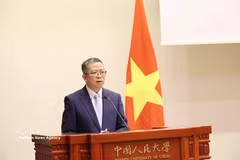
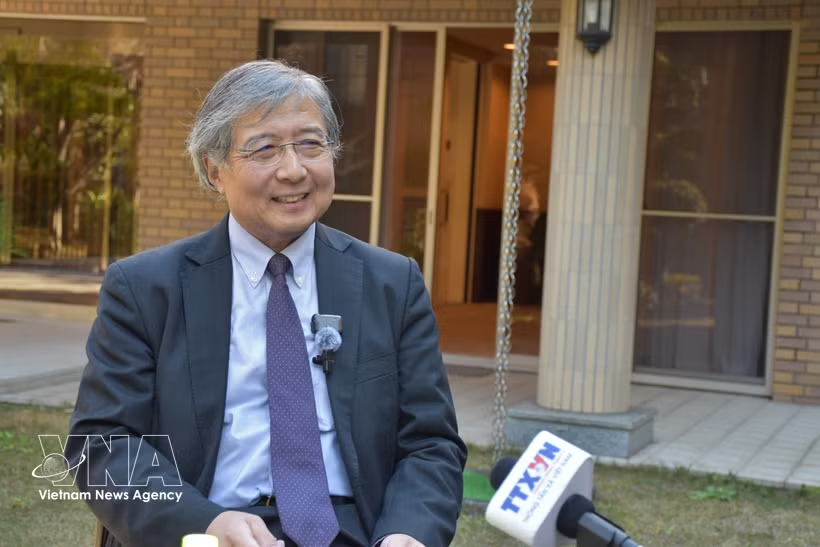
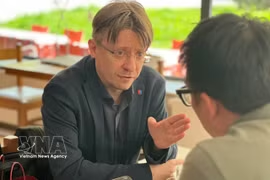
Toshiro Nishizawa, senior fellow at the Strategic Communications Education and Research Unit (SCERU) of the University of Tokyo and fellow at the Asian Development Bank Institute (ADBI), speaks to the Vietnam News Agency. (Photo: VNA)

Tokyo (VNA) – The four strategic shifts outlined by Party General Secretary and State President To Lam at the third plenum of the 14th Party Central Committee not only underscore Vietnam’s development potential but also strengthen the country’s economic and political standing, as well as its autonomy, amid growing geopolitical uncertainty, said Toshiro Nishizawa, senior fellow at the Strategic Communications Education and Research Unit (SCERU) of the University of Tokyo and fellow at the Asian Development Bank Institute (ADBI) in an interview granted to Vietnam News Agency.

Assessing the significance of the four strategic shifts for Vietnam's development in the new era, Nishizawa stated that these orientations highlight the country's development potential. The third plenum’s swift move to translate the 14th National Party Congress vision into actionable policy directives should inspire confidence in Vietnam’s future development trajectory.

He noted that the Party leadership had identified the challenges that needed to be addressed, while placing "renewing the development model" at the centre of the national governance reform process. As Secretary General and President Lam said, these four shifts are meant to reinforce one another as part of a unified national development framework.

The first and second shifts deal mainly with domestic governance challenges. However, they have implications for Vietnam’s regional and global positioning, said the expert.

The third shift of moving from a traditional development model to one driven by productivity, knowledge, technology, and human capital is especially important. It will help Vietnam capitalise on the economic achievements so far and strengthen its negotiation position, not only economically but also politically, at a time when geopolitical uncertainty is increasing.

The fourth shift, moving from a reactive to a proactive approach on traditional and non-traditional security issues, lays the groundwork for a more autonomous and resilient Vietnam.

The researcher held that the country's recent reforms are aimed at strengthening its institutional foundations. However, the effectiveness of these reforms will depend on whether businesses and citizens are genuinely motivated to develop and whether they trust that their efforts will be rewarded fairly.

He cited a Nikkei article referring to the Switzerland-based Institute for Management Development (IMD)'s Professor Arturo Bris who compared the government and the corporate sector to a bicycle and the person riding it.

In Nishizawa’s interpretation, a well-designed bicycle is valuable, but if it is overloaded with unnecessary features, even the strongest rider will not be able to travel fast or far.

The expert said institutions play a crucial role, but they can function effectively only when people are motivated and have sufficient trust in those institutions to move forward.

Regarding the opportunities and challenges arising from Vietnam's shift to a development model driven by productivity, knowledge, science and technology, innovation, and high-quality human resources, Nishizawa stated that many economists have pointed out that growth models relying solely on increases in capital and labour inputs, commonly known as "input-driven growth," tend to overlook the roles of technological change, institutions, distributional dynamics, and structural aspects.

Historically, economic growth during the Industrial Revolution cannot be explained solely by increases in capital or labour, but was driven primarily by major technological and institutional breakthroughs. Therefore, Vietnam's shift towards a development model based on productivity, knowledge, science and technology, and innovation is the right direction.

Regarding the impact of Vietnam's strategic shifts, particularly its proactive risk prevention and stronger national resilience, on Vietnam-Japan cooperation and Vietnam's position in regional and global supply chains, Nishizawa said that, from a Japanese perspective, the four strategic shifts are basically positive. He added that proactive preventing risks and building stronger national resilience is something Japan should also take seriously.

However, the researcher emphasised that geopolitically, Japan-Vietnam cooperation is part of a much bigger and more complicated regional picture. And economically, both countries are plugged into wider supply chains, so the relationship naturally sits within that broader ecosystem.

Nishizawa said that from Vietnam's perspective, Japan is one of several important partners, and the same is true from Japan's perspective with regard to Vietnam. He said cooperation can only achieve its full potential if each country regards the other as a genuine priority rather than simply one partner among many./.
VNA

See more

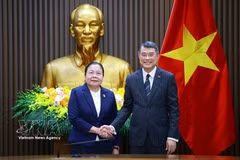
Deputy Minister of Foreign Affairs Ngo Le Van (Photo: VNA)

Local diplomacy proactively creates development space: Deputy FM

Deputy Minister of Foreign Affairs Ngo Le Van said Party, State and people-to-people diplomacy are now tightly coordinated at the local level. With support and coordination local foreign affairs agencies, more than 900 international agreements at the local level have been signed, renewed or kept in force, while over 2,500 international conferences and seminars have been licensed and staged in localities.

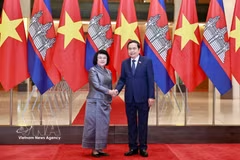
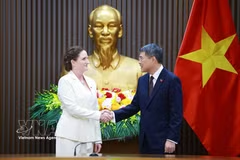
NA Chairman Tran Thanh Man (R) meets with President of Cambodian NA Samdech Maha Rathsapheathika Thipadei Khuon Sudary in Hanoi on July 28. (Photo: VNA)

Cambodian scholar spotlights strategic messages of traditional friendship with Vietnam

Leaders from both sides have demonstrated consistent political will to turn the motto of good neighbourliness, traditional friendship, comprehensive cooperation and long-term sustainability into concrete results, based on the principles of respect for sovereignty and territorial integrity and non-interference in each other’s internal affairs, according to Assoc. Prof. Dr. Neak Chandarith.

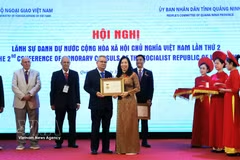
Deputy Minister of Foreign Affairs Le Thi Thu Hang (R) presents the “For the Cause of Vietnam’s Diplomacy” insignia and the Minister of Foreign Affairs’ certificates of merit to outstanding honorary consuls at the conference in Quang Ninh province on July 30. (Photo: VNA)

Vietnam expands honorary consul network to support development in new era

The foreign ministry said it will continue expanding the honorary consul network by identifying qualified candidates while providing them with updated information on Vietnam’s economic potential and investment opportunities, enabling them to make greater contributions to the country’s development in the new era.

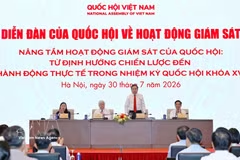
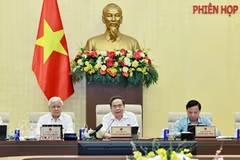
National Assembly Chairman Tran Thanh Man (standing) chairs the legislature's forum on supervision in Hanoi on July 30, 2026. (Photo: VNA)

Ultimate value of oversight lies in delivering tangible change: top legislator

Addressing the NA forum on supervision in Hanoi, the top legislator said it is one of the legislature's three constitutional functions. Supervision serves as a key mechanism for exercising control over State power, ensuring the strict implementation of the Constitution and the law, while also driving institutional reform, strengthening national governance and reinforcing public confidence.

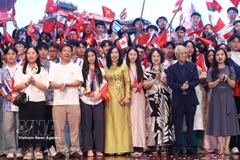
Deputy Minister of Foreign Affairs Le Thi Thu Hang (in yellow) and participants in the Vietnam Summer Camp 2026. (Photo: VNA)

OV resources: From diplomacy's pioneering role to driver of local development

As an inseparable part of the Vietnamese nation, OVs represent a vital source of capital, knowledge, science and technology, management expertise, international networks and influence in their host countries. They are both beneficiaries of the State's support and protection policies and active contributors to Vietnam's foreign affairs, helping connect international resources with the country's and each locality's development needs.

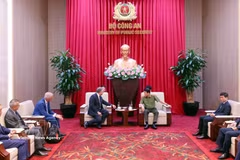
The meeting between Minister of Public Security General Luong Tam Quang and a delegation from Italy's Leonardo S.p.A. led by Daniele Tavano, Director for Global Sales Air Traffic Management Systems in Hanoi on July 29. (Photo: VNA)

High-tech cooperation advanced to strengthen public security

Minister of Public Security General Luong Tam Quang praised Leonardo S.p.A. as one of leading high-tech industrial groups of Italy and Europe, with strengths spanning defence, security, aerospace, helicopters, electronics and digital technologies. He noted the company's extensive experience in cybersecurity, command-and-control systems, radar, sensors, border surveillance and the protection of critical infrastructure.

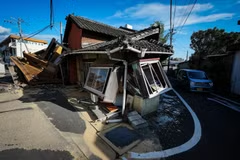
A house was damaged after the earthquake in Kumamoto Prefecture, Japan. (Photo Xinhua/VNA)

Vietnam sends condolences to Japan over earthquake losses

Prime Minister Le Minh Hung on July 29 sent a message of condolences to Japanese Prime Minister Takaichi Sanae over significant losses of life and property caused by a recent earthquake in Kumamoto Prefecture and the Kyushu region.

National Assembly Chairman Tran Thanh Man delivers his closing remarks at the National Assembly Standing Committee's 4th session in Hanoi on July 29, 2026. (Photo: VNA)

National Assembly Standing Committee concludes fourth session

During its fourth session, the National Assembly Standing Committee considered and gave opinions on 28 of the 33 items to be submitted to the NA at its first extraordinary session, as well as two draft laws scheduled for consideration at the legislature's second sitting.

Permanent member of the CPV Central Committee’s Secretariat Tran Cam Tu (R) and CNDD-FDD Secretary General Révérien Ndikuriyo (Photo: VNA)

Vietnam, Burundi cement political trust, substantive ties

During a reception in Hanoi on July 29 for CNDD-FDD Secretary General Révérien Ndikuriyo, who is on an official visit to Vietnam from July 27-31, Politburo member and Permanent member of the CPV Central Committee’s Secretariat Tran Cam Tu believed that that the visit would consolidate political trust, friendship and substantive cooperation between the two parties and countries in the coming time.

Prime Minister Le Minh Hung (R) and Sisay Leudetmounsone, Politburo member, Secretary of the Central Committee of the Lao People's Revolutionary Party (LPRP) and head of its Organisation Commission, in Hanoi on July 29, 2026. (Photo: VNA)

PM receives head of Lao Party's Organisation Commission

Prime Minister Le Minh Hung on July 29 received Sisay Leudetmounsone, Politburo member, Secretary of the Central Committee of the Lao People's Revolutionary Party (LPRP) and head of its Organisation Commission, who is on a working visit to Vietnam.

NA Chairman Tran Thanh Man speaks at the meeting (Photo: VNA)

NA Standing Committee debates revisions to real estate business law

Chairman Man said the amendment of the Law on Real Estate Business must move in lockstep with a clean-up of rules governing land, housing, investment, planning, construction and finance. The amendments, he said, must fully codify principles laid out in the Party Central Committee’s third plenum resolution on land-law reform while making the legal framework coherent, free of overlap and more enforceable.